examstrack logo

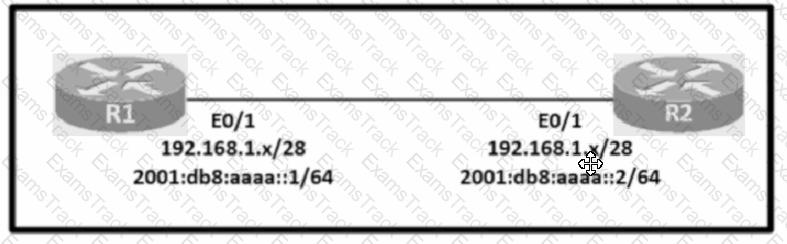
Configure IPv4 and IPv6 connectivity between two routers. For IPv4, use a /28 network from the 192.168.1.0/24 private range. For IPv6, use the first /64 subnet from the 2001:0db8:aaaa::/48 subnet.
1. Using Ethernet0/1 on routers R1 and R2, configure the next usable/28 from the 192.168.1.0/24 range. The network 192.168.1.0/28 is unavailable.
2. For the IPv4 /28 subnet, router R1 must be configured with the first usable host address.
3. For the IPv4 /28 subnet, router R2 must be configured with the last usable host address.
4. For the IPv6 /64 subnet, configure the routers with the IP addressing provided from the topology.
5. A ping must work between the routers on the IPv4 and IPv6 address ranges.
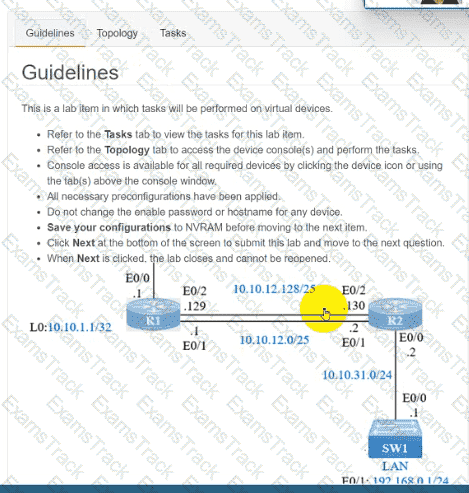
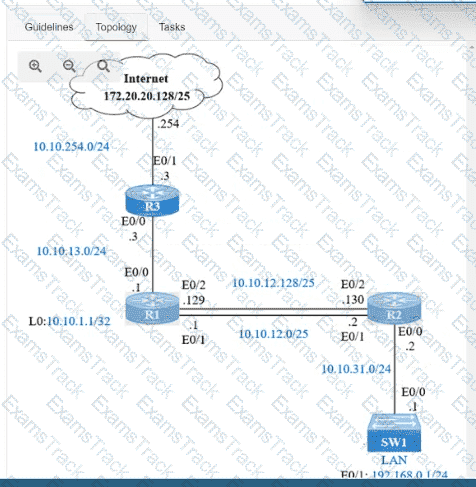
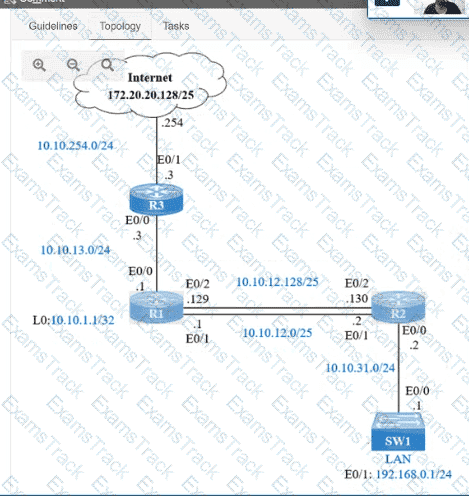
IP connectivity and OSPF are preconfigured on all devices where necessary. Do not make any changes to the IP addressing or OSPF. The company policy uses connected interfaces and next hops when configuring static routes except for load balancing or redundancy without floating static. Connectivity must be established between subnet 172.20.20.128/25 on the Internet and the LAN at 192.168.0.0/24 connected to SW1:
1. Configure reachability to the switch SW1 LAN subnet in router R2.
2. Configure default reachability to the Internet subnet in router R1.
3. Configure a single static route in router R2 to reach to the Internet subnet considering both redundant links between routers R1 and R2. A default route is NOT allowed in router R2.
4. Configure a static route in router R1 toward the switch SW1 LAN subnet where the primary link must be through Ethernet0/1. and the backup link must be through Ethernet0/2 using a floating route. Use the minimal administrative distance value when required.
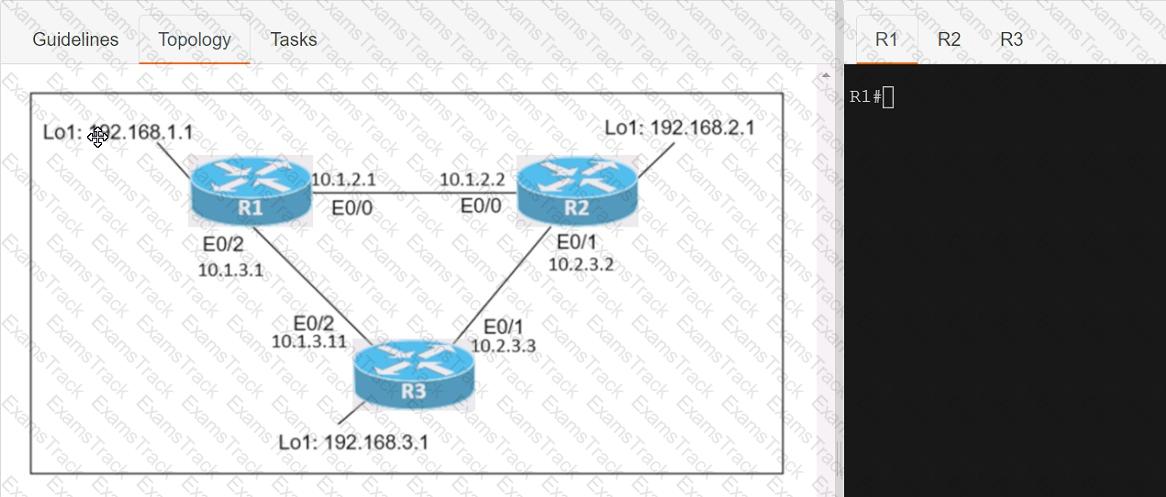
Connectivity between three routers has been established, and IP services must be configured jn the order presented to complete the implementation Tasks assigned include configuration of NAT, NTP, DHCP, and SSH services.
1. All traffic sent from R3 to the R1 Loopback address must be configured for NAT on R2. All source addresses must be translated from R3 to the IP address of Ethernet0/0 on R2, while using only a standard access list named NAT To verify, a ping must be successful to the R1 Loopback address sourced from R3. Do not use NVI NAT configuration.
2. Configure R1 as an NTP server and R2 as a client, not as a peer, using the IP address of the R1 Ethernet0/2 interface. Set the clock on the NTP server for midnight on January 1, 2019.
3. Configure R1 as a DHCP server for the network 10.1.3.0/24 in a pool named TEST. Using a single command, exclude addresses 1-10 from the range. Interface Ethernet0/2 on R3 must be issued the IP address of 10.1.3.11 via DHCP.
4. Configure SSH connectivity from R1 to R3, while excluding access via other remote connection protocols. Access for user root and password Cisco must be set on router R3 using RSA and 1024 bits. Verify connectivity using an SSH session from router R1 using a destination address of 10.1.3.11. Do NOT modify console access or line numbers to accomplish this task.
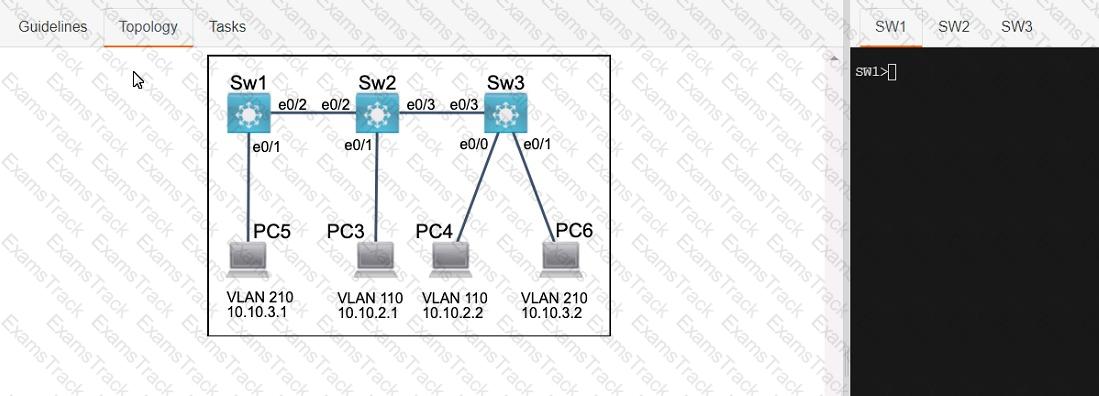
Three switches must be configured for Layer 2 connectivity. The company requires only the designated VLANs to be configured on their respective switches and permitted accross any links between switches for security purposes. Do not modify or delete VTP configurations.
The network needs two user-defined VLANs configured:
VLAN 110: MARKETING
VLAN 210: FINANCE
1. Configure the VLANs on the designated switches and assign them as access ports to the interfaces connected to the PCs.
2. Configure the e0/2 interfaces on Sw1 and Sw2 as 802.1q trunks with only the required VLANs permitted.
3. Configure the e0/3 interfaces on Sw2 and Sw3 as 802.1q trunks with only the required VLANs permitted.
Refer to the exhibit.
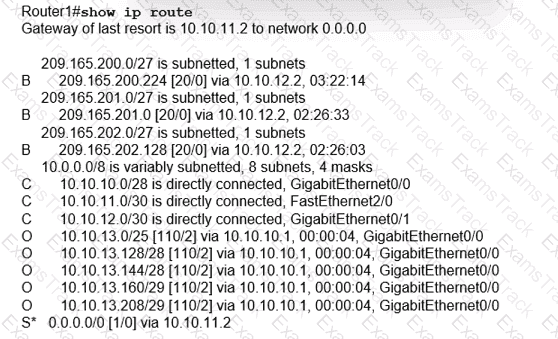
What is the subnet mask of the route to the 10.10.13.160 prefix?
Which advantage does the network assurance capability of Cisco DNA Center provide over traditional campus management?
Which cipher is supported for wireless encryption only with the WPA2 standard?
Refer to the exhibit.
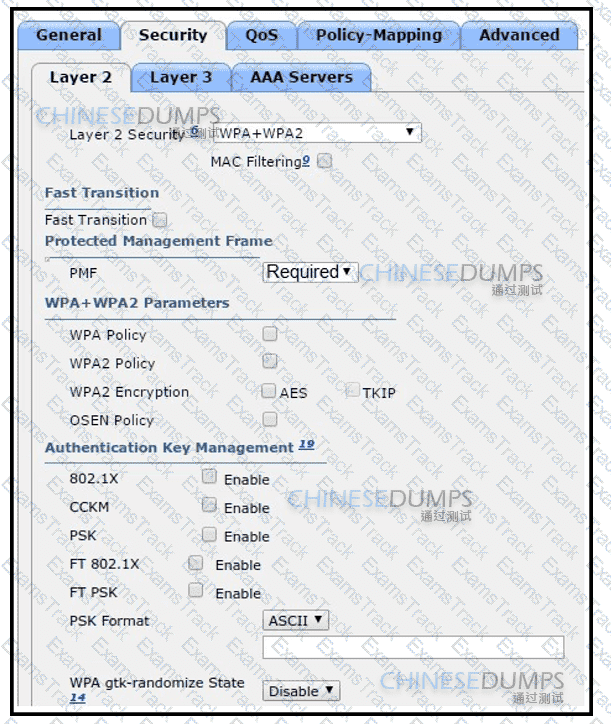
The network engineer is configuring a new WLAN and is told to use a preshared key for authentication instead of the RADIUS servers. Which additional set of tasks must the engineer perform to complete the configuration?
Which benefit does Cisco ONA Center provide over traditional campus management?
Refer to the exhibit.
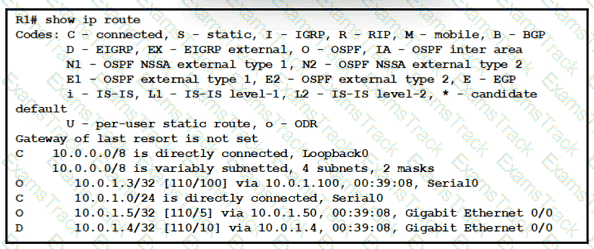
What does route 10.0.1.3/32 represent in the routing table?
Which protocol must be implemented to support separate authorization and authentication solutions for wireless APs?
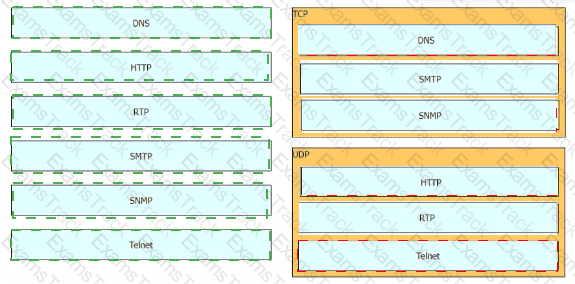
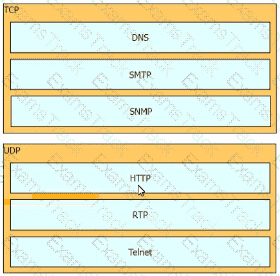
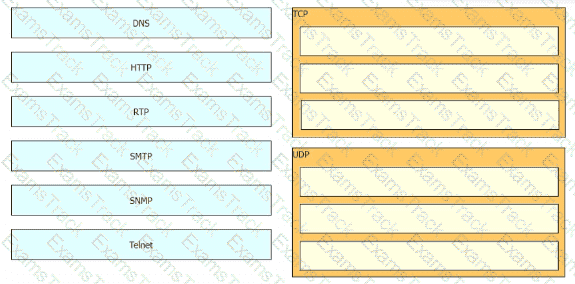
Drag and drop the TCP/IP protocols from the left onto their primary transmission protocols on the right.
A Cisco engineer at a new branch office is configuring a wireless network with access points that connect to a controller that is based at corporate headquarters Wireless client traffic must terminate at the branch office and access-point survivability is required in the event of a WAN outage Which access point mode must be selected?
Which two protocols are used by an administrator for authentication and configuration on access points?
Refer to the exhibit.
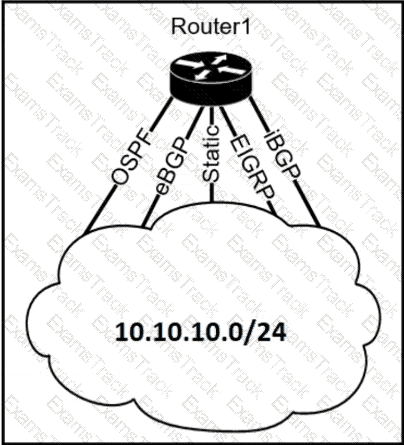
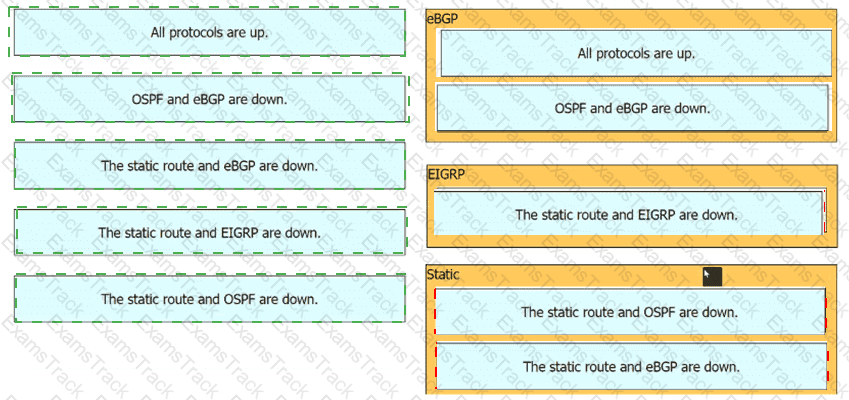
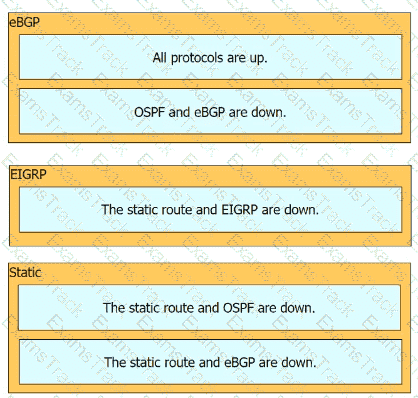
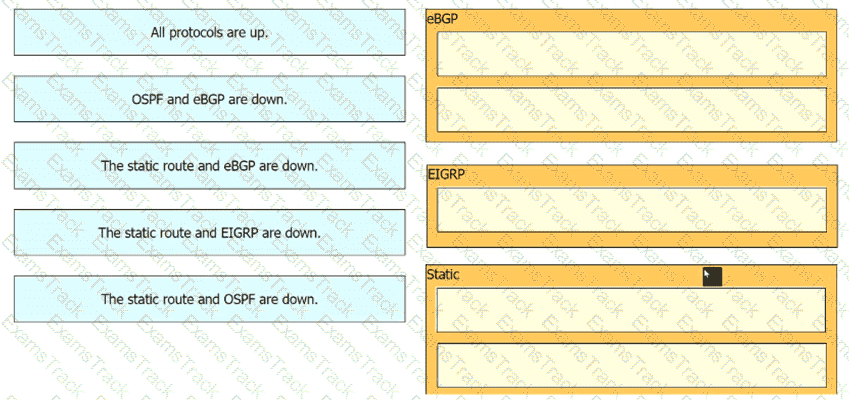
The Router1 routing table has multiple methods to reach 10.10.10.0/24 as shown. The default Administrative Distance is used. Drag and drop the network conditions from the left onto the routing methods that Router1 uses on the right.
What provides connection redundancy increased bandwidth and load sharing between a wireless LAN controller and a Layer 2 switch?
Which IP header field is changed by a Cisco device when QoS marking is enabled?
What is a function of an endpoint?
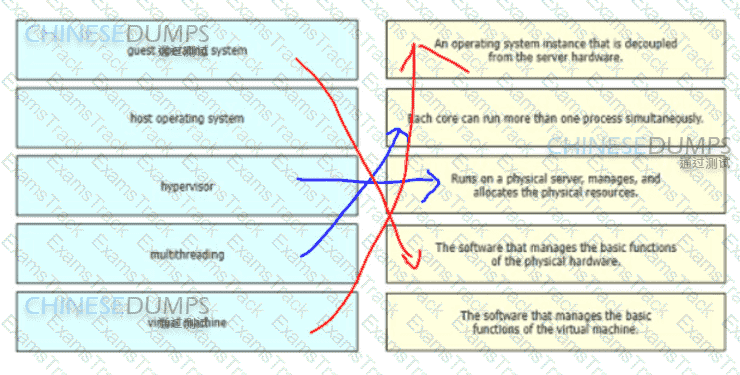
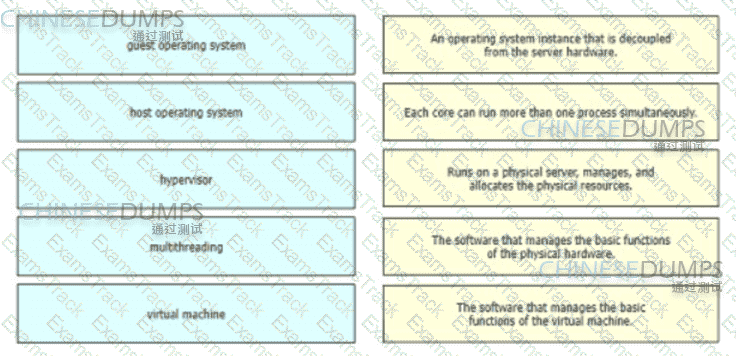
Drag and drop the virtualization concepts from the left onto the matching statements on the right.
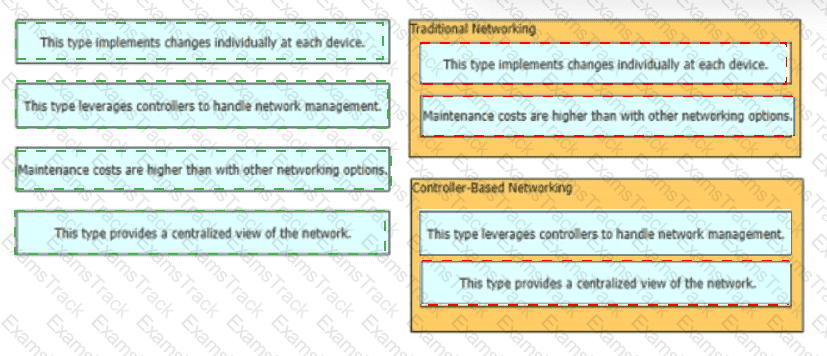
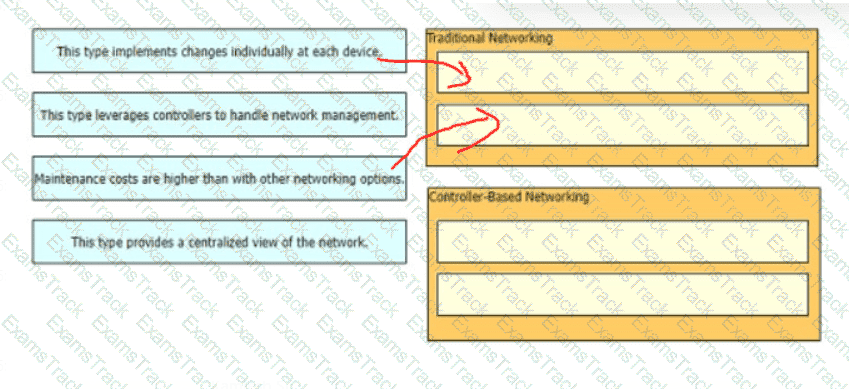
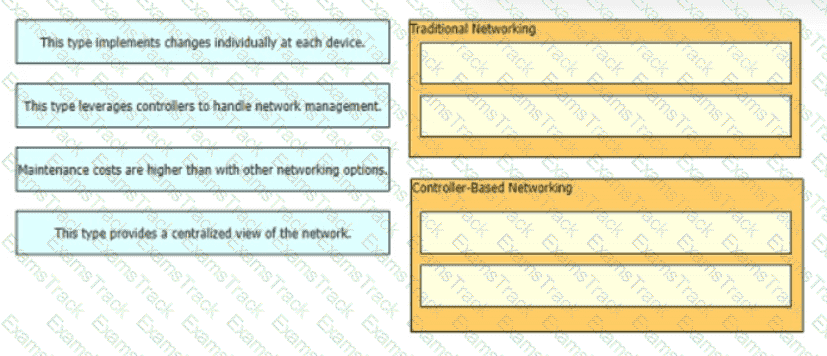
Drag and drop the statements about networking from the left onto the corresponding networking types on the right
|
PDF + Testing Engine
|
|---|
|
$43.75 |
|
Testing Engine
|
|---|
|
$33.75 |
|
PDF (Q&A)
|
|---|
|
$28.75 |
Cisco Free Exams |
|---|

|

Copyright © 2026 Examstrack. All Rights Reserved

TESTED 05 Oct 2026