Spring Sale Limited Time 70% Discount Offer - Ends in 0d 00h 00m 00s - Coupon code: 70track

Free Cisco 200-201 Practice Exam with Questions & Answers | Set: 11

Questions 101

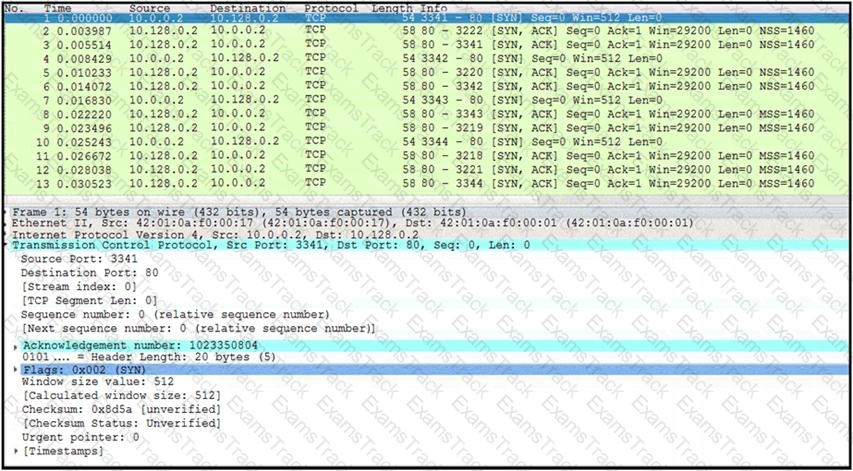
Refer to the exhibit.

200-201 Question 101

What is occurring in this network traffic?

Options:
A.

High rate of SYN packets being sent from a multiple source towards a single destination IP.

B.

High rate of ACK packets being sent from a single source IP towards multiple destination IPs.

C.

Flood of ACK packets coming from a single source IP to multiple destination IPs.

D.

Flood of SYN packets coming from a single source IP to a single destination IP.

Cisco 200-201 Premium Access
Questions 102

What is the purpose of a ransomware attack?

Options:
A.

to make files inaccessible by encrypting the data

B.

to decrypt encrypted data and disks

C.

to send keystrokes to a threat actor

D.

to escalate privileges

Questions 103

What is a difference between tampered and untampered disk images?

Options:
A.

Tampered images have the same stored and computed hash.

B.

Untampered images are deliberately altered to preserve as evidence.

C.

Tampered images are used as evidence.

D.

Untampered images are used for forensic investigations.

Questions 104

Which option describes indicators of attack?
Options:
A.

spam emails on an employee workstation

B.

virus detection by the AV software

C.

blocked phishing attempt on a company

D.

malware reinfection within a few minutes of removal

Questions 105

200-201 Question 105

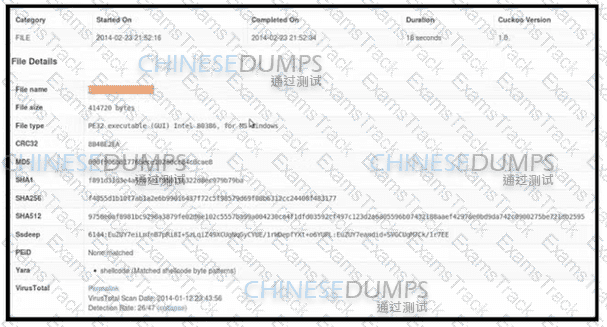
Refer to the exhibit. An employee received an email from an unknown sender with an attachment and reported it as a phishing attempt. An engineer uploaded the file to Cuckoo for further analysis. What should an engineer interpret from the provided Cuckoo report?

Options:
A.

Win32.polip.a.exe is an executable file and should be flagged as malicious.

B.

The file is clean and does not represent a risk.

C.

Cuckoo cleaned the malicious file and prepared it for usage.

D.

MD5 of the file was not identified as malicious.

Questions 106

An engineer is analyzing a recent breach where confidential documents were altered and stolen by the receptionist. Further analysis shows that the threat actor connected an externa USB device to bypass security restrictions and steal data. The engineer could not find an external USB device Which piece of information must an engineer use for attribution in an investigation?

Options:
A.

list of security restrictions and privileges boundaries bypassed

B.

external USB device

C.

receptionist and the actions performed

D.

stolen data and its criticality assessment

Questions 107

Refer to the exhibit.

200-201 Question 107

This request was sent to a web application server driven by a database. Which type of web server attack is represented?

Options:
A.

parameter manipulation

B.

heap memory corruption

C.

command injection

D.

blind SQL injection

Questions 108

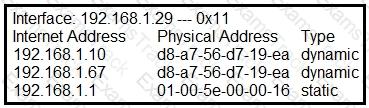
Refer to the exhibit.

200-201 Question 108

What is occurring in this network?

Options:
A.

ARP cache poisoning

B.

DNS cache poisoning

C.

MAC address table overflow

D.

MAC flooding attack

Questions 109

What is the impact of encapsulation on the network?

Options:
A.

Something significant is concealed from virtually separate networks.

B.

Logically separate functions in the network are abstracted from their underlying structures.

C.

Numerous local private addresses are mapped to a public one before the data is moved.

D.

Web requests are taken on behalf of users and the response is collected from the web.

Questions 110

What is the difference between inline traffic interrogation (TAPS) and traffic mirroring (SPAN)?

Options:
A.

TAPS interrogation is more complex because traffic mirroring applies additional tags to data and SPAN does not alter integrity and provides full duplex network.

B.

SPAN results in more efficient traffic analysis, and TAPS is considerably slower due to latency caused by mirroring.

C.

TAPS replicates the traffic to preserve integrity, and SPAN modifies packets before sending them to other analysis tools

D.

SPAN ports filter out physical layer errors, making some types of analyses more difficult, and TAPS receives all packets, including physical errors.