New Year Sale 70% Discount Offer - Ends in 0d 00h 00m 00s - Coupon code: 70track

Free Cisco 350-501 Practice Exam with Questions & Answers | Set: 8

Questions 106

How does Cisco MPLS TE use OSPF extensions to allow for optimized transit between a headend router and a destination router?
Options:
A.

Router LSAs share router link advertisements to each router within the MPLS environment so that tunnels can be built bidirectionally.

B.

ASBR Summary LSAs share OSPF domain information so that the two routers know how to reach each other during tunnel setup.

C.

Network LSAs share RSVP information to build the tunnel between the two routers.

D.

Opaque LSAs calculate and establish unidirectional tunnels that are set according to the network constraint.

Cisco 350-501 Premium Access
Questions 107

350-501 Question 107

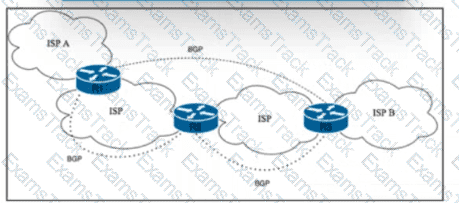
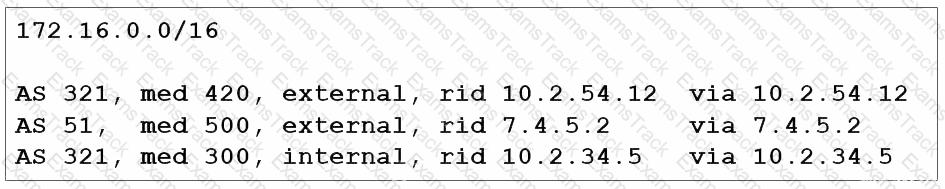
Refer to the exhibit. Tier 2 ISP A on AS 653 is connected to two Tier 1 ISPs on AS 321 and AS 51 respectively. The network architect at ISP A is planning traffic flow inside the network to provide predictable network services. Cisco Express Forwarding is disabled on the edge router. How should the architect implement BGP to direct all traffic via the Tier 1 ISP with next-hop 7.4.5.2?

Options:
A.

Implement the BGP routing protocol and run the bgp deterministic-med command.

B.

Implement MP-BGP with a 4-byte AS number with the bgp best path compare-routerid command.

C.

Implement the BGP routing protocol and the maximum-paths 2 configuration.

D.

Implement BGP route-reflector functionality with the bgp always-compare-med configuration.

Questions 108

Which statement about TLS is accurate when using RESTCONF to write configurations on network devices'?

Options:
A.

It requires certificates for authentication.

B.

It is provided using NGINX acting as a proxy web server

C.

It is used for HTTP and HTTPS requests.

D.

It is not supported on Cisco devices

Questions 109

Which two features will be used when defining SR-TE explicit path hops if the devices are using IP unnumbered interfaces? (Choose two.)
Options:
A.

router ID

B.

labels

C.

node address

D.

next hop address

E.

output interface

Questions 110

350-501 Question 110

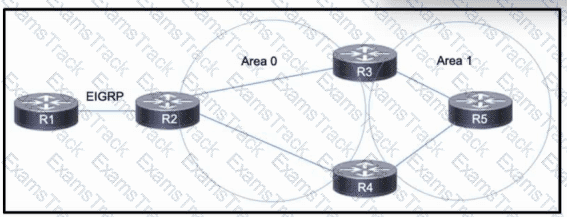
Refer to the exhibit. Company A is running OSPF within its network, comprised of routers R2, R3, R4, and R5 and consisting of two areas. Company A just acquired Company B, which uses EIGRP on its own R1. R1 has several routes in its routing table. The network engineering team at Company A needs access to the Company B network to manage network devices there, but each company will otherwise operate independently. R2 will serve as the ASBR between the two networks. Which action must the team take to reduce the number of EIGRP routes received on R2 and include only the necessary routes in the routing table?

Options:
A.

Apply an outbound distribute list on R3 and R4 to filter unnecessary intra-area routes from reaching the rest of the OSPF domain.

B.

Apply an inbound distribute list on R2 with a route map that permits only the necessary networks.

C.

Implement an offset list on R1 for the necessary networks.

D.

Attach an access list to the R2 interface connected to R1 that denies all traffic except for the necessary engineering team traffic.

Questions 111

350-501 Question 111

Refer to the exhibit. A network operator working for a private telecommunication company with an employee id: 7138: 13:414 just added new users to the network, which resides in VLANs connected to routers R1 and R4. The engineer now must configure the network so that routers R1 and R4 share routes to the VLANs, but routers R2 and R3 are prevented from including the routes in their routing tables. Which configuration must the engineer apply to R4 to begin implementing the request?

Options:
A.

pseudowire -class ciscotest

encapsulation mpls

interface gigabitethernet 1/0/1

connect neighbor 192.168.1.1 101 pw-class cisco

B.

pseudowire -class ciscotest

encapsulation mpls

interface gigabitethernet 1/0/1

xconnect 192.168.1.1 101 pw-class ciscotest

C.

pseudowire-class ciscotest

encapsulation mpls

service-policy output ciscotest

D.

interface serial 2/0/0

frame-relay encapsulation

ip address 192.168.1.4 255.255.255.0

service-policy output ciscotest

Questions 112

Refer to the exhibit.

350-501 Question 112

Router 1 and router 2 are running OSPF Area 0. The router logs on both routers show that the LDP link has flapped. Which configuration must the engineer apply to the two routers to implement session protection on the link?
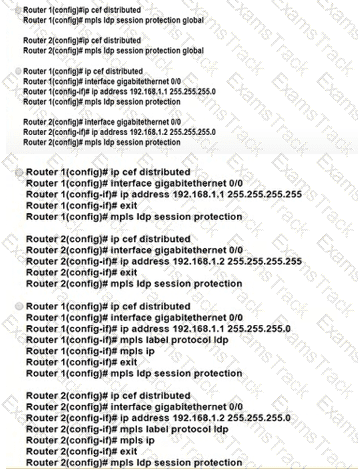
350-501 Question 112

Options:
A.

Option A

B.

Option B

C.

Option C

D.

Option D

Questions 113

A network architect décides to expand the scope of the multicast deployment within the company network the network is already using PlM-SM with a static RP that supports a high-bandwidth. video-based training application that s heavily used by the employees, but excessive bandwidth usage is a concern How must the engineer update the network to provide a more efficient multicast implementation'?

Options:
A.

Configure IGMP to manage the multicast hosts on each LAN

B.

implement BSR to support dynamic RP notification.

C.

Deploy ICMP to Improve multicast reachability across the network using static RP.

D.

Implement STP to improve switching performance for multicast data.

Questions 114

Network devices in the core layer use different IGPs, and the network is split into several areas. The engineer must use a NETCONF operation to load a full interface configuration on multiple Cisco devices to ensure that they meet company standards. The devices must work over SSH from the Linux jump server. Which action meets the configuration requirements?

Options:
A.

Use the NETCONF operation to load the configuration and verify that TCP port 830 is open from the Linux server to the routers.

B.

Use the NETCONF operation to load the configuration and verify that TCP port 630 is open from the Linux server to the routers.

C.

Use the NETCONF operation to load the configuration and verify that TCP port 22 is open from the Linux server to the routers.

D.

Use the NETCONF operation to load the configuration and verify that TCP port 22 is open from the Linux server to the routers.

Questions 115

What is the purpose of microsegments in the SRv6 architecture?

Options:
A.

They ensure that routers in the path sufficiently examine the indexed mapping tables.

B.

They support a scalable control plane.

C.

They reduce fragmentation as packets traverse the network.

D.

They allow for configuration changes in the SRv6 data plane without requiring the device to reboot.

Questions 116

Which configuration enables BGP FlowSpec client function and installation of policies on all local interfaces?

A)

350-501 Question 116

B)

350-501 Question 116

C)

350-501 Question 116

D)

350-501 Question 116

Options:
A.

Option A

B.

Option B

C.

Option C

D.

Option D

Questions 117

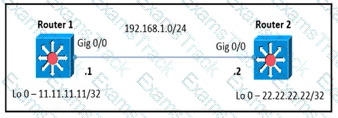
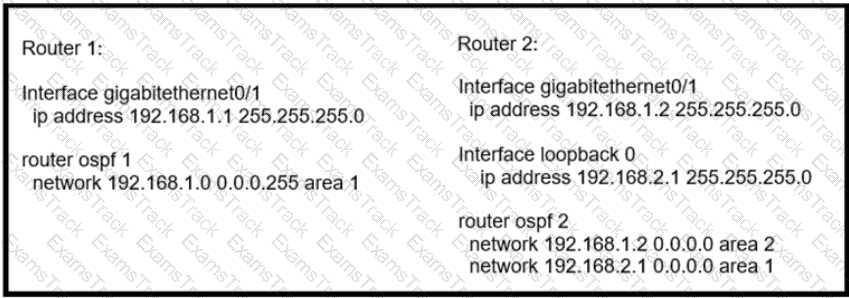
Refer to the exhibit.

350-501 Question 117

Router 1 is missing the route for the router 2 loopback 0. What should the engineer change to fix the problem?

Options:
A.

the area numbers on Router 1 and Router 2 to be similar

B.

the wildcard mask network statement in OSPF of Router 2

C.

Router 1 to be an ABR

D.

the hello timers on Router 1 and Router 2 to be different

Questions 118

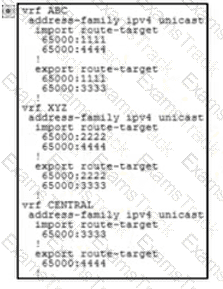
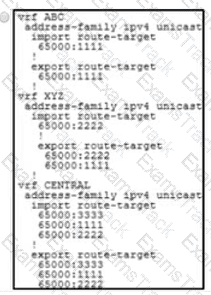
An engineer is setting up overlapping VPNs to allow VRF ABC and XYZ to communicate with VRF CENTRAL but wants to make sure that VRF ABC and XYZ cannot communicate. Which configuration accomplishes these objectives?
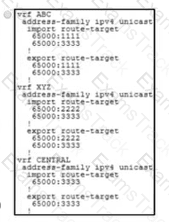
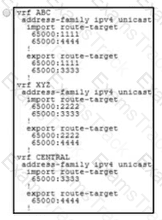
350-501 Question 118

350-501 Question 118

350-501 Question 118

350-501 Question 118

Options:
A.

Option A

B.

Option B

C.

Option C

D.

Option D

Questions 119

350-501 Question 119

Refer to the exhibit. Tier 1 ISP A is connected to small Tier 3 ISP B. The EBGP routing protocol is used for route exchange. The networking team at ISP A noticed the flapping of BGP sessions with ISP B. The team decides to Improve stability on the network by suppressing the subnet for 30 minutes when a session begins to flap. Which action must the team perform to meet this goal?

Options:
A.

Implement a BGP route-penalty timer on ISP A router R1 with the bgp penalty-timer 30 250 750 15 command.

B.

Implement BGP route dampening on ISP A router R1 with the bgp dampening 15 700 1500 30 command.

C.

Implement BGP route suppression on ISP A router R2 with the bgp suppression 30 600 1200 30 command.

D.

Implement a BGP route withdraw-delay timer on ISP B router R3 with the bgp withdraw-delay 30 15 90 30 command.

Questions 120

Refer to the exhibit.

350-501 Question 120

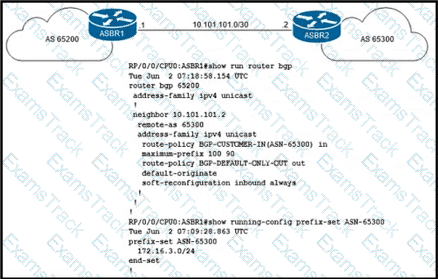
A network engineer is implementing a standard customer route-policy on ASBR1 with these requirements:

• It must accept only customer-assigned prefixes

• It must preserve customer advertised BGP communities

• It must set the local-preference to 110 for all prefixes

• It must attach the ORIGINATION-PE and LOCAL-CITY communities to all accepted prefixes.

Which route policy must the engineer implement on ASBR1 to satisfy the requirements?
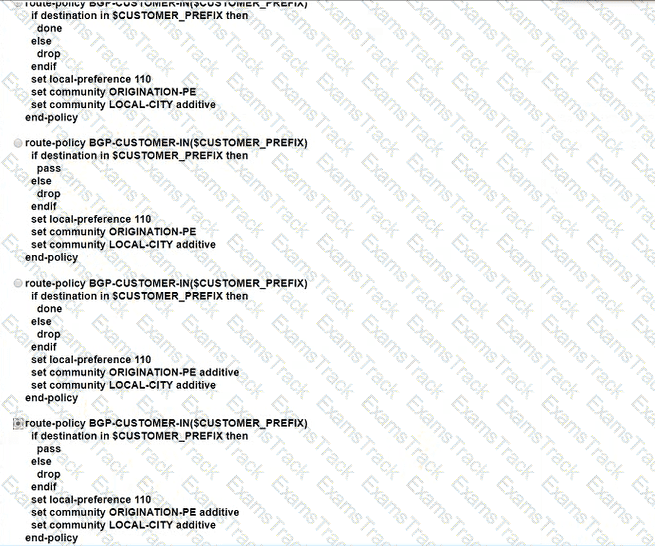
350-501 Question 120

Options:
A.

Option A

B.

Option B

C.

Option C

D.

Option D

Exam Code: 350-501
Certification Provider: Cisco
Exam Name: Implementing and Operating Cisco Service Provider Network Core Technologies (350-501 SPCOR)
Last Update: Dec 15, 2025
Questions: 547