New Year Sale 70% Discount Offer - Ends in 0d 00h 00m 00s - Coupon code: 70track

Free Cisco 350-501 Practice Exam with Questions & Answers | Set: 7

Questions 91

What is the primary purpose of Terraform in the network?

Options:
A.

to manage the Cisco network infrastructure as code to ensure consistent configuration and scalability

B.

to facilitate the integration of Cisco networking solutions with cloud platforms to improve scalability

C.

to schedule and manage maintenance tasks on Cisco network devices to minimize errors and downtime

D.

to enable the seamless migration of Cisco network configurations between diverse network environments

Cisco 350-501 Premium Access
Questions 92

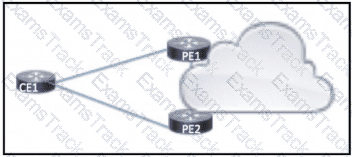
Refer To the exhibit.

350-501 Question 92

Which BGP attribute should be manipulated to have CE1 use PE1 as the primary path to the Internet?

Options:
A.

The weight attribute should be manipulated on PE1 on outbound routes advertised to CE1.

B.

The MED should be manipulated on CE1 on inbound routes from PE1.

C.

The local preference attribute should be manipulated on PE2 on inbound routes advertised to CE1.

D.

The origin of all routes should be modified on each router on inbound and outbound routes advertised to CE1.

Questions 93

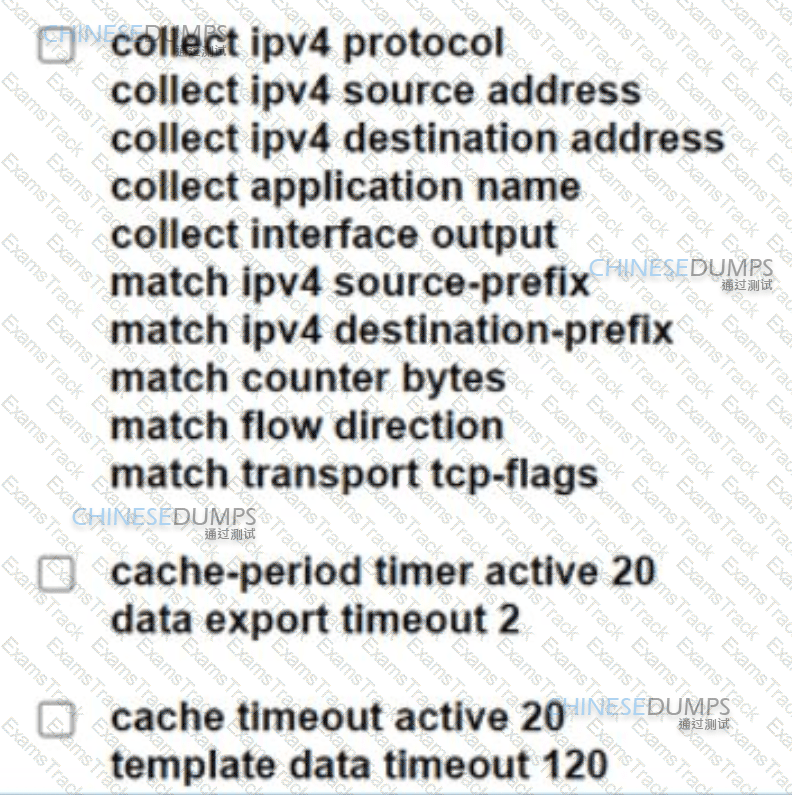
A network engineer must collect traffic statistics for an internal LAN toward the internet The sample must include the source and destination IP addresses, the destination ports, the total number of bytes from each flow using a 64-bit counter, and all transport flag information. Because of CPU limits, the flow collector processes samples that are a maximum of 20 seconds long. Which two configurations must the network engineer apply to the router? (Choose two.)
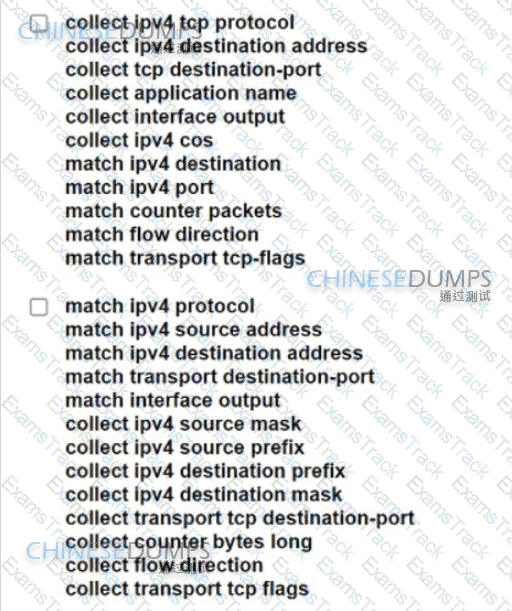
350-501 Question 93

350-501 Question 93

Options:
A.

Option A

B.

Option B

C.

Option C

D.

Option D

E.

Option E

Questions 94

Which feature describes the weight parameter for BGP path selection?

Options:
A.

Its value is local to the router

B.

Its value is set either locally or globally.

C.

Its default value is 0.

D.

Its value is global to the router.

Questions 95

Which feature describes the adjacency SID?

Options:
A.

It applies only to point-to-point links.

B.

It applies only to multipoint links

C.

It is locally unique

D.

It is globally unique.

Questions 96

A network administrator is planning a new network with a segment-routing architecture using a distributed control plane. How is routing information distributed on such a network?

Options:
A.

Each segment is signalled by an SR controller, but each segment makes Its own steering decisions based on SR policy.

B.

Each segment is signalled by MPLS, and each segment makes steering decisions based on the routing policy pushed by BGP.

C.

Each segment is signalled by an SR controller that makes the steering decisions for each node.

D.

Each segment is signalled by a compatible routing protocol and each segment makes its own steering decisions based on SR policy.

Questions 97

Refer to the exhibit: 350-501 Question 97

BGPsec is implemented on R1. R2. R3. and R4 BGP peering is established between neighboring autonomous systems Which statement about implementation is true?
Options:
A.

BGP updates from the eBGP peers are appended with an additional AS path value that is statically set by the domain administrator

B.

BGP updates from the iBGP peers are appended with a community of local-as

C.

BGP updates from the all BGP peers are appended with a community of no export

D.

BGP updates from the eBGP peers are appended with a BGPsec attribute sequence that includes a public key hash and digital signature

Questions 98

350-501 Question 98

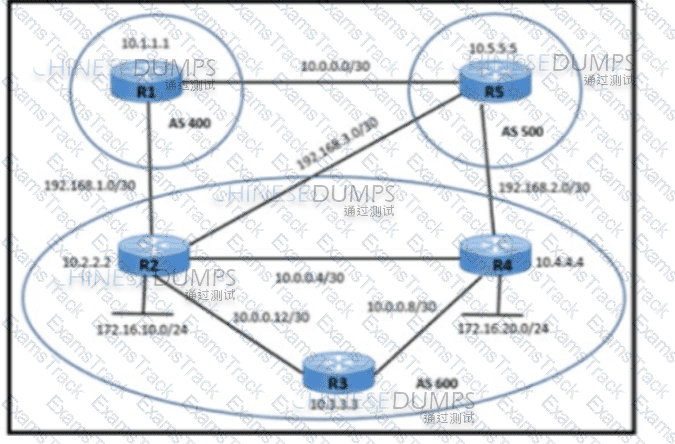
Refer to the exhibit. A network engineer is implementing iBGP and eBGP between AS 600 and AS 500 with these requirements:

    R2 must establish eBGP peering on 192.168.3.0/30 with R5 for sending unicast and multicast traffic

    R2 must wait for 30 seconds before sending BGP updates to R5 for multicast traffic.

Which action must be taken on R2 to meet the requirements?
Options:
A.

Configure advertisement-interval 30 In address-family ipv4 unicast

B.

Configure advertisement-Interval 30 in address-family Ipv4 multicast

C.

Apply timers bgp 30 in address-family ipv4 unicast

D.

Apply timers bgp 30 in address-family ipv4 multicast.

Questions 99

350-501 Question 99

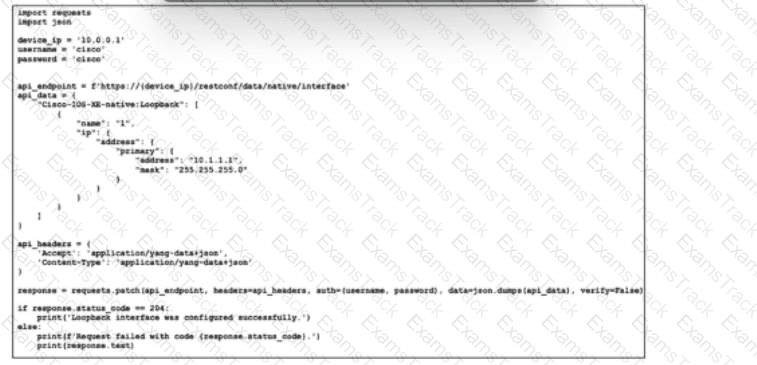
Refer to the exhibit. An operations team recently located an archive of scripts for deploying routine network changes with an error-free approach. A junior network engineer, who is working to modify the scripts to support RESTCONF, has been asked to document the purpose of each updated script. Which two actions does the given script take? (Choose two.)
Options:
A.

Send a patch request to the API endpoint.

B.

Print a fail message when the response code is 204.

C.

Pass an XML data-format request in the API header.

D.

Print a success message when the device receives a full-content response code.

E.

Ignore SSL certificate verification.

Questions 100

350-501 Question 100

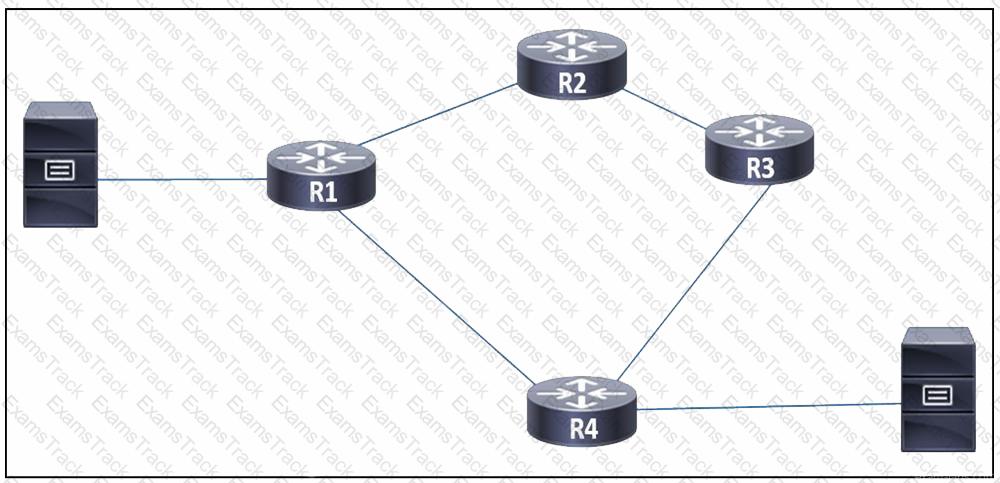
Refer to the exhibit. A network engineer observed congestion between routers R1 and R4, which are connected on a point-to-point link. Two servers that reside on networks on R1 and R4 generate heavy traffic between them with most traffic going from R4 to R1. To improve overall performance, the engineer wants to drop inbound packets that exceed a configured threshold, without disrupting traffic that passes from R4 to R3. Which action must the engineer take to resolve the issue?

Options:
A.

Implement traffic policing to drop packets that exceed the given threshold.

B.

Implement FIFO to queue excess traffic for transmission when bandwidth is available.

C.

Implement traffic shaping to drop excess packets.

D.

Implement a service policy in the outbound direction on each interface on the link to tag traffic exiting each router.

Questions 101

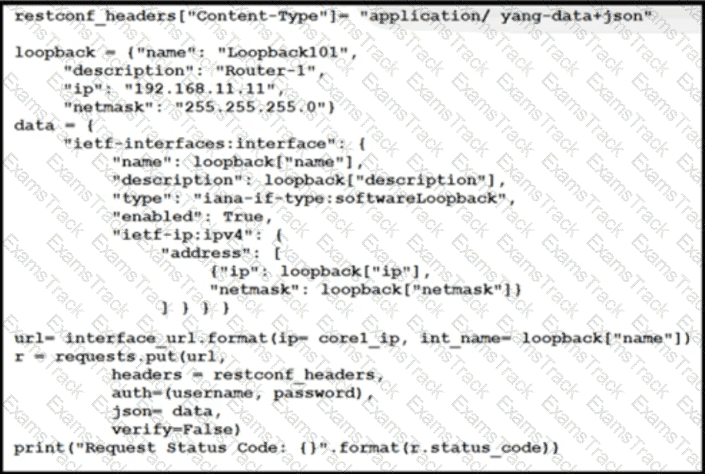
Refer to the exhibit.

350-501 Question 101

An engineer at a new ISP must configure many Cisco devices in the data center. To make the process more efficient, the engineer decides to automate the task with a REST API. Which action does this JSON script automate?

Options:
A.

Configure the IP address for the existing loopback interface.

B.

Configure a physical interface on the router with an IP address and then create a loopback interface.

C.

Configure a physical interface on the router with an IP address.

D.

Delete the existing loopback Interface and replace it with a new loopback interface.

Questions 102

How does Cisco DNA Center enhance network automation?
Options:
A.

It allows network administrators to quickly deploy Cisco Layer 2 devices without requiring STP and broadcast transport.

B.

It allows network administrators to reduce inconsistencies when they deploy and validate network configurations.

C.

It allows network administrators to reduce the number of VRFs in a multi customer environment by automatically implementing a single VLAN per customer.

D.

It allows network administrators to combine voice and data networks into a single topology without manual configuration.

Questions 103

350-501 Question 103

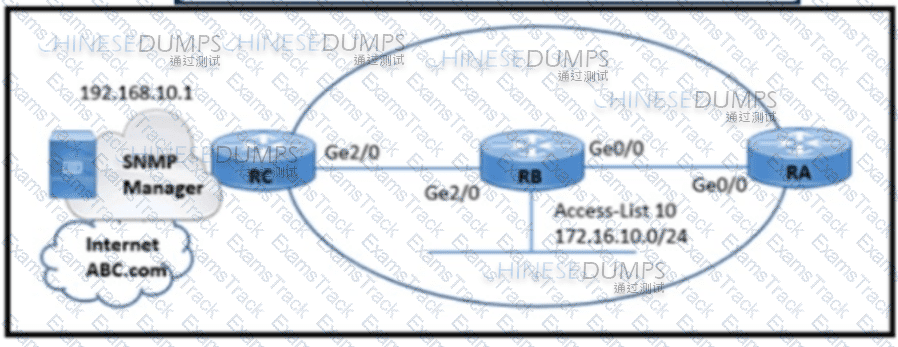
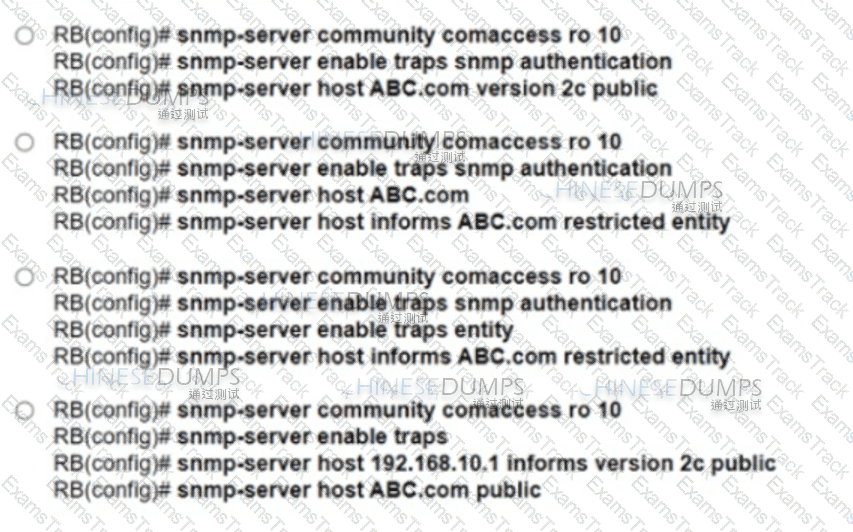
Refer to the exhibit. A network engineer is configuring an SNMP community on router RB with these requirements:

    Allow read-only access for all objects to members of Access-List 10 that use the comaccess community string.

    Other SNMP managers must not have access to objects.

    SNMP authentication failure traps must be sent to SNMPv2c and then to the host using SNMPv2c with the public community string.

Which configuration meets these requirements?
350-501 Question 103

Options:
A.

Option A

B.

Option B

C.

Option C

D.

Option D

Questions 104

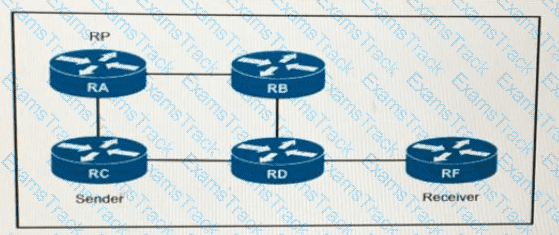
Refer to the exhibit:

350-501 Question 104

If router A is the RP, which PIM mode can you configure so that devices will send multicast traffic toward the RP?

Options:
A.

PIM-SM

B.

PI MM-DM

C.

BIDIR-PIM

D.

PIM-SSM

Questions 105

After implement MPLS protocol for multiple VRFs on a single Cisco device, the engineer notices all VRFs on the router still do to not LDP session protection feature enabled. Which configuration must the engineer apply to enable the LDP session protection feature FOR LDP neighbors within each VRF?

Options:
A.

Configure LDP session protection globally on the device only.

B.

Configure LDP session protection globally on the device and on each neighbor that requires session protection.

C.

Configure LDP session authentication on the device to enable LDP session protection on each VRF automatically.

D.

Configure LDP session protection within the individual VRFs.

Exam Code: 350-501
Certification Provider: Cisco
Exam Name: Implementing and Operating Cisco Service Provider Network Core Technologies (350-501 SPCOR)
Last Update: Dec 15, 2025
Questions: 547