examstrack logo

You are configuring gateway IDS/IPS settings in HPE Aruba Networking Central.
Why would you set the Fail Strategy to Bypass?
Refer to the exhibit.
An administrator has configured a remote mirror between an AOS-CX switch and a station running a protocol analyzer. The exhibit displays a sample of the packet capture.
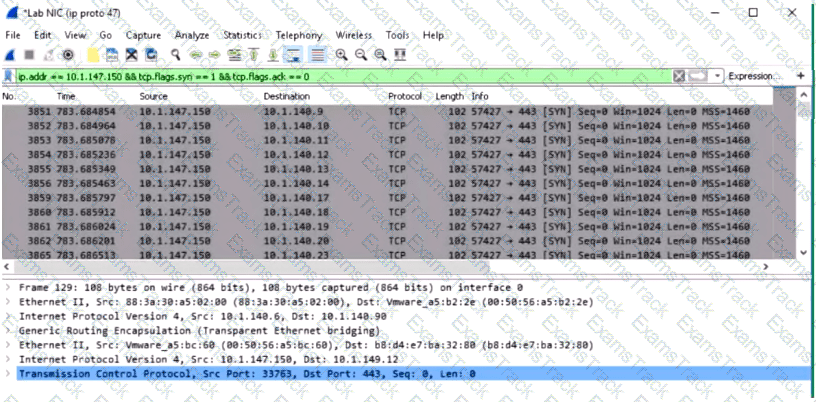
Packet trace details:
Source: 10.1.147.150 - > Destination: 10.1.140.9 TCP 57427 - > 443 [SYN] Seq=0 Len=0
Source: 10.1.147.150 - > Destination: 10.1.140.10 TCP 57427 - > 443 [SYN] Seq=0 Len=0
Source: 10.1.147.150 - > Destination: 10.1.140.11 TCP 57427 - > 443 [SYN] Seq=0 Len=0
Source: 10.1.147.150 - > Destination: 10.1.140.12 TCP 57427 - > 443 [SYN] Seq=0 Len=0
Source: 10.1.147.150 - > Destination: 10.1.140.13 TCP 57427 - > 443 [SYN] Seq=0 Len=0
Packet encapsulation tree shows Generic Routing Encapsulation (Transparent Ethernet bridging).
Which characteristic is suspicious?
You are helping a company add HPE Aruba Networking ClearPass to its network, which uses HPE Aruba Networking infrastructure devices.
The company already has a Windows domain and Windows CA. The Windows CA issues certificates to domain computers, domain users, and servers such as domain controllers.
ClearPass cluster IP addressing and hostnames
Publisher = 10.47.47.5
Subscriber 1 = 10.47.47.6
Subscriber 2 = 10.47.47.7
Virtual IP with Subscriber 1 and Subscriber 2 = 10.47.47.8
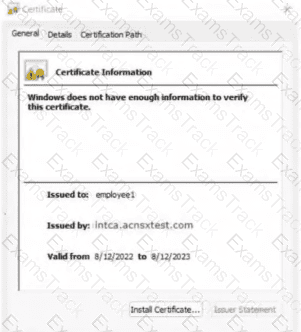
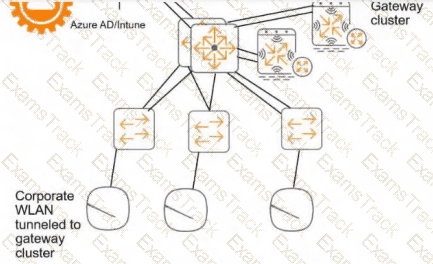
Refer to the scenario.
You have begun creating a CA to meet the customer's requirements for issuing certificates to mobile clients, as shown in the exhibit below.
Certificate Authority Settings:
Name: Exam Onboard CA
Mode: Root CA
Authority Info Access: Do not include OCSP Responder URL
Validity Period: 365 days
Clock Skew Allowance: 15
Subject Alternative Name: [X] Include device information in TLS client certificates
Digest Algorithm: SHA-512
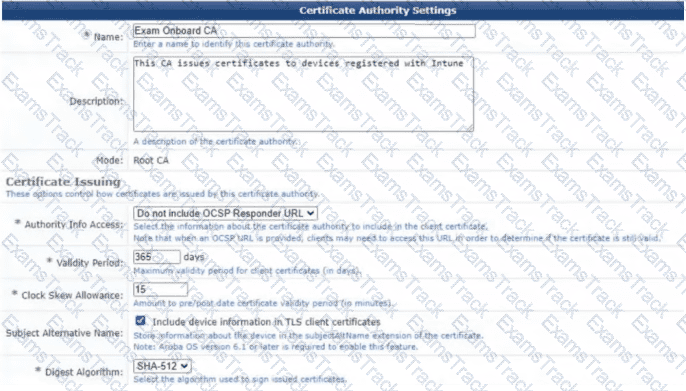
What change will help meet those requirements and the requirements for authenticating clients?
A customer has an AOS-10 architecture consisting of HPE Aruba Networking APs and AOS-CX switches, managed through HPE Aruba Networking Central. The customer wants information about clients, including their general category and OS.
What should you explain?
Your company uses HPE Aruba Networking AOS-10 APs and gateways, along with AOS-CX switches, all managed through HPE Aruba Networking Central. In HPE Aruba Networking Central, you need to collect a packet capture for a client connected to an AP.
What is a prerequisite?
Refer to the scenario.
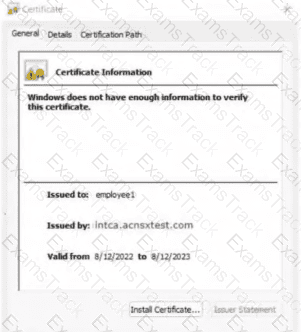
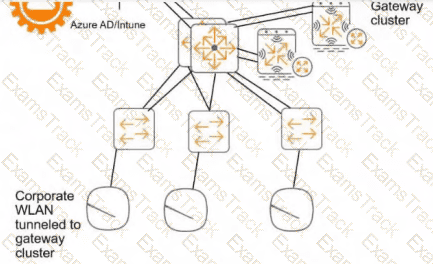
You must configure HPE Aruba Networking ClearPass Onboard to issue client certificates for Azure AD-joined devices. Which step is required to accomplish this objective?
A customer operates an HPE Aruba Networking ClearPass cluster. The customer has AOS-CX switches that use 802.1X authentication with HPE Aruba Networking ClearPass Policy Manager (CPPM).
The switches use local port-access policies. The customer wants to begin tunneling wired clients that pass only user authentication to an HPE Aruba Networking gateway cluster. The gateway cluster must assign these clients the eth-internet role. The gateway must also assign the clients to VLAN 20.
The intended enforcement policy and profiles are shown below:
* Policy: `written-exam-3`
* Profile: `written-exam-b`
The gateway cluster contains two gateways with the following IP addresses:
Gateway 1: VLAN 4085 (system IP) = 10.20.4.21 | VLAN 20 (users) = 10.20.20.1 | VLAN 4094 (WAN) = 198.51.100.14
Gateway 2: VLAN 4085 (system IP) = 10.20.4.22 | VLAN 20 (users) = 10.20.20.2 | VLAN 4094 (WAN) = 198.51.100.12 | VRRP on VLAN 20 = 10.20.20.254
The customer needs high availability for tunnels between the switches and the gateway cluster. If one gateway fails, the other gateway must take over its tunnels. The switch must also be able to discover the gateway cluster even if one gateway in the cluster is unavailable.
Refer to the scenario. Assume that `myzone` is the name used for the UBT zone.
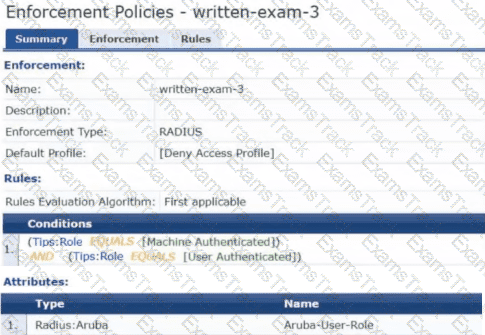
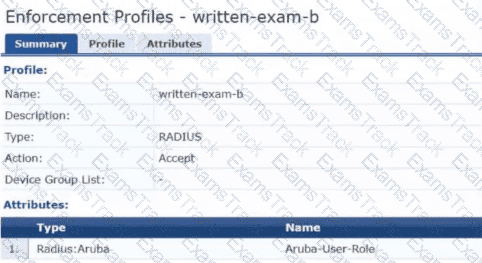
Which option is a valid minimal configuration for the AOS-CX port-access roles?
Introduction to the customer
You are assisting a company with adding HPE Aruba Networking ClearPass to its network, which uses HPE Aruba Networking network-infrastructure devices.
The company already has a Windows domain and Windows CA. The Windows CA issues certificates to domain computers, domain users, and servers such as domain controllers.
ClearPass cluster IP addressing and hostnames
Publisher = 10.47.47.5
Subscriber 1 = 10.47.47.6
Subscriber 2 = 10.47.47.7
Virtual IP with Subscriber 1 and Subscriber 2 = 10.47.47.8
Refer to the scenario.
Assume that you configured CPPM to assign HPE Aruba Networking ClearPass roles and AOS user roles as indicated in the scenario. However, a penetration tester was able to access the network with medical-staff privileges on a client with a valid computer certificate but a revoked medical user certificate. In this situation, the customer wants the client to receive computer-only access.
What can you do to resolve this issue while continuing to meet the other customer requirements?
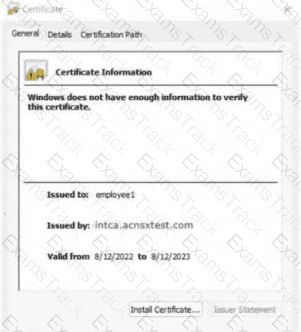
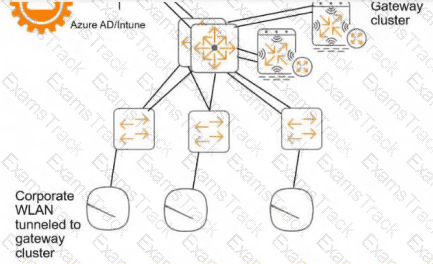
A customer uses an AOS-10 architecture that includes HPE Aruba Networking APs. The customer recently enabled WIDS at the High level on the APs. Administrators observe many "detect disconnect station" events.
What should you explain?
A company has HPE Aruba Networking gateways and plans to begin implementing gateway IDS/IPS. The customer has chosen Block as the Fail Strategy.
What could you recommend to help reduce unexpected outages caused by this particular fail strategy?
|
PDF + Testing Engine
|
|---|
|
$42.5 |
|
Testing Engine
|
|---|
|
$32.5 |
|
PDF (Q&A)
|
|---|
|
$26.25 |
HP Free Exams |
|---|

|

Copyright © 2026 Examstrack. All Rights Reserved

TESTED 17 Nov 2026
