
Weekend Special Sale 75% Discount Offer - Ends in 0d 00h 00m 00s - Coupon code: sale75best

Free Huawei H12-821_V1.0 Practice Exam with Questions & Answers | Set: 11

Questions 101

See the following figure. All routers on the network run IS-IS and are in area 49.0001. By referring to the LSDB of R1, the Level-2 DIS is. (Enter the device name, for example, R1.)

Options:
Huawei H12-821_V1.0 Premium Access
Questions 102

Route summarization is a mechanism that combines multiple routes. BGP supports automatic summarization and manual summarization on IPv6 networks.

Options:
A.

TRUE

B.

FALSE

Questions 103

Which of the following statements regarding the MED value in BGP are true?

Options:
A.

According to BGP route selection rules, the MED value has a lower priority than AS_Path, Preferred-Value, Local-Preference, and Origin.

B.

The default MED value of BGP routes is 0.

C.

By default, BGP can compare the MED values of routes from different ASs.

D.

By default, if there is no MED value in routes, the value 0 is used. If the bestroute med-none-as-maximum command is configured, the maximum MED value 4294967295 is used.

Questions 104

STP ensures a loop-free network but has a slow network topology convergence speed, affecting communication quality. RSTP has made some improvements based on STP. Which of the following improvements is not included?

Options:
A.

If a port does not receive configuration BPDUs from the upstream device within four Hello intervals, the switch considers that the negotiation with the neighbor fails.

B.

The non-root switch running RSTP sends configuration BPDUs at the interval specified by the Hello timer, which is performed independently by each device.

C.

RSTP reduces five port states to three port states based on user traffic forwarding and MAC address learning.

D.

RSTP deletes three port states and adds two port roles.

Questions 105

On an OSPF network, if a router receives an update of an LSA that exists in the local LSDB, the router updates the LSDB and floods the LSA.

Options:
A.

TRUE

B.

FALSE

Questions 106

A firewall receives a packet that PC1 sends to PC2. Which of the following statements are true?
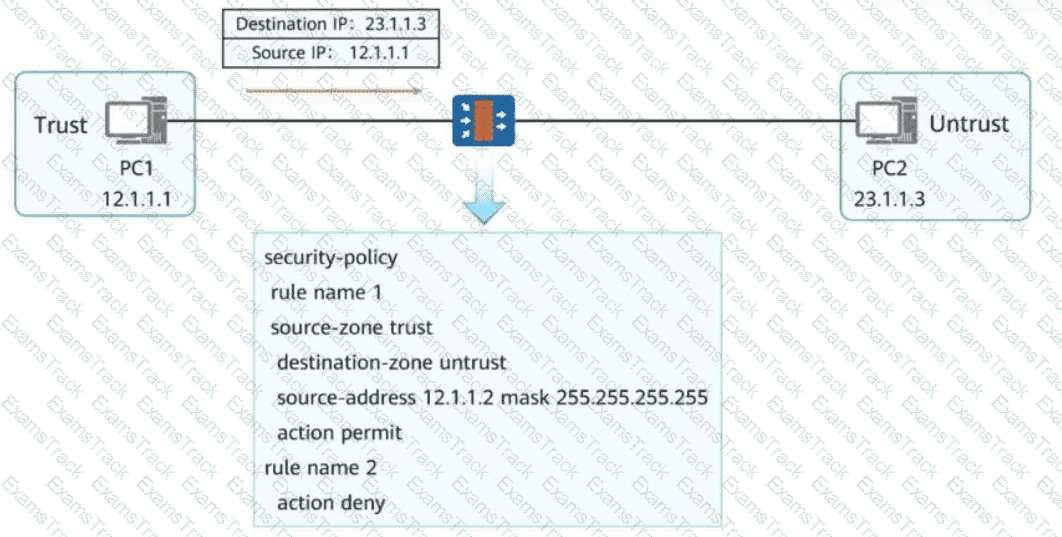
H12-821_V1.0 Question 106

Options:
A.

The packet does not match any security policy.

B.

The packet matches security policy rule 1, and the firewall forwards the packet.

C.

No source or destination security zone is specified in security policy rule 2, indicating that any security zone is a match.

D.

The packet matches security policy rule 1, and the firewall discards the packet.

Questions 107

An OSPF area ID identifies an OSPF area. Which of the following OSPF area IDs is equivalent to 0.0.1.0?

Options:
A.

1

B.

255

C.

256

D.

10

Questions 108

On a large-scale network, the BGP routing table of each device is extremely large, which overloads devices. To address this problem, route summarization can be configured. Which of the following statements is false about BGP route summarization?

Options:
A.

IPv6 networks support only manual summarization.

B.

In manual summarization, the attributes of summary routes cannot be controlled.

C.

The AS_Set attribute helps BGP prevent routing loops that may arise during route summarization.

D.

With automatic summarization, BGP summarizes routes based on natural network segments.

Questions 109

An enterprise uses OSPF to implement network communication. To ensure data validity and security, all authentication modes supported by OSPF are enabled on routers. In this case, interface authentication is preferentially used by the routers.

Options:
A.

TRUE

B.

FALSE

Questions 110

After IPsec is deployed on an enterprise network, services are interrupted. The administrator finds that no data flow triggers IKE negotiation.

Which of the following are possible causes? (Select all that apply)

Options:
A.

Configuration error of an interzone security policy

B.

An unreachable route

C.

The IPsec policy is not correctly applied to the related interface.

D.

A mismatch between the ACL and protected data flow