Spring Sale Limited Time 70% Discount Offer - Ends in 0d 00h 00m 00s - Coupon code: 70track

Free Fortinet FCSS_NST_SE-7.6 Practice Exam with Questions & Answers | Set: 4

Questions 31

Which two statements about conserve mode are true? (Choose two.)

Options:
A.

FortiGate enters conserve mode when the system memory reaches the configured extreme threshold.

B.

FortiGate starts taking the configured action for new sessions requiring content inspection when the system memory reaches the configured red threshold.

C.

FortiGate exits conserve mode when the system memory goes below the configured green threshold.

D.

FortiGate starts dropping all new sessions when the system memory reaches the configured red threshold.

Fortinet FCSS_NST_SE-7.6 Premium Access
Questions 32

Refer to the exhibit.

FCSS_NST_SE-7.6 Question 32

The port1 interface configuration on FortiGate and partial session information for ICMP traffic are shown.

Which two things happen to the session information if a routing change occurs that affects this session? (Choose two answers)

Options:
A.

This session will be unaffected by routing changes. The routing changes will apply only to new sessions.

B.

The session will be flagged as dirty but no route lookups will be performed.

C.

The session information will not change unless the current route has been removed from the routing table.

D.

The session information will not change even when the active route has been removed from the routing table.

Questions 33

Refer to the exhibit.

FCSS_NST_SE-7.6 Question 33

The exhibit shows a session entry. Which statement about this TCP session is true?

Options:
A.

The session will expire in one second.

B.

It is a TCP session from 10.9.31.117 to 10.1.0.3.

C.

The session is offloaded using NPU.

D.

Return traffic to the initiator is sent to 10.9.31.117.

Questions 34

Refer to the exhibit, which shows partial outputs from two routing debug commands.

FCSS_NST_SE-7.6 Question 34

Why is the port2 default route not in the second command output?

Options:
A.

The port2 interface is disabled in the FortiGate configuration.

B.

The port1 default route has a higher priority value than the default route using port2.

C.

The port1 default route has a lower priority value than the default route using port2.

D.

The port1 default route has a lower distance than the default route using port2.

Questions 35

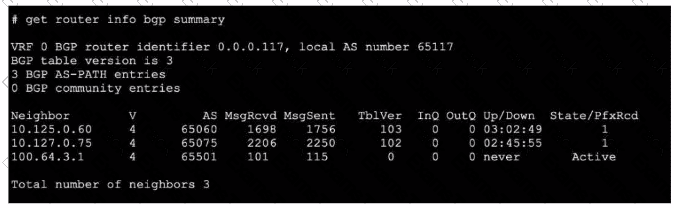
Refer to the exhibit.

FCSS_NST_SE-7.6 Question 35

The output of a BGP debug command is shown.

Why has the local router at 172.16.23.58 been unable to establish adjacency with its only neighbor?

Options:
A.

The neighbor router has become unreachable, which is evident by the low ratio of messages received to messages sent.

B.

The local router has not received an OPEN message from the neighbor.

C.

The local router has not received a SYN/ACK packet from the neighbor.

D.

There is no active route to the BGP neighbor.

Questions 36

Refer to the exhibit, which shows a session entry.

FCSS_NST_SE-7.6 Question 36

Which statement about this session is true?

Options:
A.

Return traffic to the initiator is sent to 10.1.0.1.

B.

Return traffic to the initiator is sent lo 10.200.1.254.

C.

It is an ICMP session from 10.1.10.10 to 10.200.1.1.

D.

It is an ICMP session from 10.1.10.1 to 10.200.5.1.

Questions 37

Refer to the exhibit, which shows the port1 interface configuration on FortiGate and partial session information for ICMP traffic.

FCSS_NST_SE-7.6 Question 37

What happens to the session information if a routing change occurs that affects this session?

Options:
A.

Only the interface and gateway information for dev=7 will be removed.

B.

The session information will not change unless the current route has been removed from the routing table.

C.

The session will be flagged as dirty but no route lookups will be performed.

D.

Sessions involving port7 or port19 will not have their routing information flushed.

Questions 38

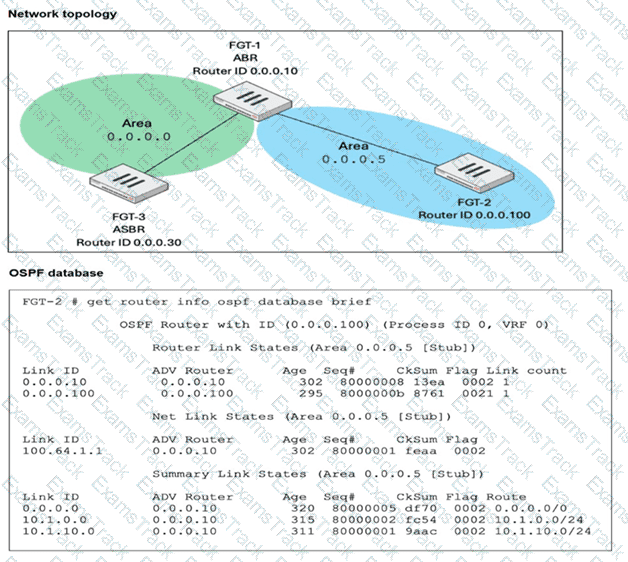
Refer to the exhibits.

FCSS_NST_SE-7.6 Question 38

FGT-1 is an area border router (ABR) that has interfaces in OSPF areas 0.0.0.0 and 0.0.0.5. FGT-3 acts as an autonomous system border router (ASBR), importing static routes into OSPF. FGT-2 is an internal router with all its interfaces belonging to area 0.0.0.5. FGT-1 is receiving all advertised routes from FGT-2, however, FGT-3 is not receiving any of the advertised routes from FGT-1. What is the most likely reason for this? (Choose one answer)

Options:
A.

Area 0.0.0.5 is configured not to propagate type 5 LSAs.

B.

FGT-2 is configured with a distribution list to block all advertised routes from FGT-3.

C.

FGT-3 and FGT-2 have not formed an OSPF adjacency yet.

D.

IP protocol 89 is blocked between FGT-1 and FGT-3.

Questions 39

Exhibit.

FCSS_NST_SE-7.6 Question 39

Refer to the exhibit, which shows two entries that were generated in the FSSO collector agent logs.

What three conclusions can you draw from these log entries? {Choose three.)

Options:
A.

Remote registry is not running on the workstation.

B.

The user ' s status shows as " not verified " in the collector agent.

C.

DNS resolution is unable to resolve the workstation name.

D.

The FortiGate firmware version is not compatible with that of the collector agent.

E.

A firewall is blocking traffic to port 139 and 445.

Exam Code: FCSS_NST_SE-7.6
Certification Provider: Fortinet
Exam Name: Fortinet NSE 6 - Network Security 7.6 Support Engineer
Last Update: Apr 7, 2026
Questions: 131

Fortinet Free Exams

Fortinet Free Exams
Access free Fortinet exam study guides and practice tests at Examstrack. Ensure your success with top-notch preparation resources at Examstrack.