Spring Sale Limited Time 70% Discount Offer - Ends in 0d 00h 00m 00s - Coupon code: 70track

Free CIPS L4M5 Practice Exam with Questions & Answers | Set: 5

Questions 41

Which characteristics are likely to feature within an integrative negotiation?

Maximising the other party’s outcome to enhance relationships

Maximising joint outcomes

Short-term focus

Pursuit of goals held jointly with the other party

Options:
A.

1 and 3 only

B.

1 and 2 only

C.

3 and 4 only

D.

2 and 4 only

CIPS L4M5 Premium Access
Questions 42

A procurement professional is negotiating with a supplier on cleaning service. She realises that there are huge cost-saving opportunities if the supplier agrees to reduce its mark-up and unnecessary employee benefits. Supplier's mark-up and employee benefits are examples of which of the following?

Options:
A.

Spend waterfall

B.

Spend cube

C.

Spend tree

D.

Addressable spend

Questions 43

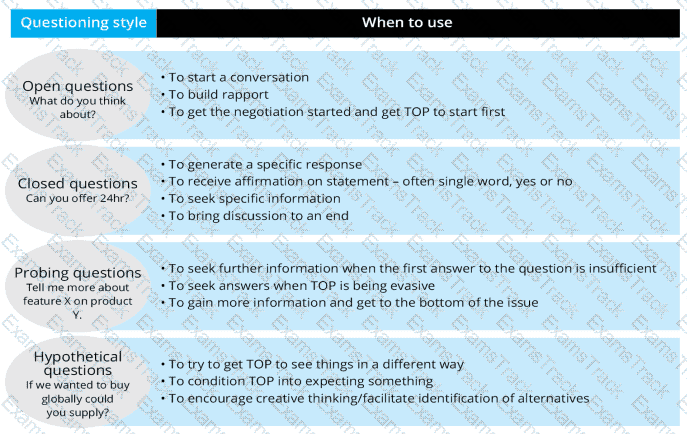
Which type of question should be used to receive affirmation on statement?

Options:
A.

Open

B.

Closed

C.

Leading

D.

Narrow

Questions 44

The sourcing manager has decided to adopt an adversarial style of negotiation to take advantage of the buyer's greater bargaining power over the suppliers. In what other circumstances should an adversarial relationship be used?

Options:
A.

When the supplier is likely to respond with further concessions to maintain a long-term relationship

B.

In all forms of negotiation as each party is always trying to gain advantage over the other

C.

In a monopoly market as the supplier will respond by conceding quantity discounts

D.

When the issues concerned are non-negotiable, for example, health and safety commitments

Questions 45

Champion Toys (CT) is negotiating a large order of luxury toys with its supplier. CT has identified that lead times, order quantities, and delivery locations are tradeables that could be used in this negotiation. At which negotiation stage should CT introduce these tradeables?

Options:
A.

Bargaining

B.

Opening

C.

Closure

D.

Proposing

Questions 46

Procurement gets involved in negotiating purchase requisitions only when there is a value analysis to ensure that only value-adding aspects are included. Is this statement true?

Options:
A.

No, purchasing can negotiate other details of the purchase requisition even where value analysis is absent

B.

No, value analysis is a very technical process that requires the expertise of engineering and financial analysts

C.

Yes, the role of purchasing is to add value to the purchase, and therefore every purchase requisition must go through a team value analysis

D.

Yes, value analysis is the single most important responsibility of procurement in the processing of repeat requisitions

Questions 47

A negotiation is coming to the end. Both parties haven't had any official commitments. Right before leaving the room, the buyer strongly disagrees with supplier's set up prices and requests a discount. The supplier doesn't reply but nods and smiles. Can the buyer consider these actions as an acceptance?

Options:
A.

Yes, because smiling shows supplier's readiness in signing the deal off

B.

No, because nodding and smiling are etiquette of polite rejection

C.

No, because nodding and smiling are not clear signs of neither acceptance nor rejection

D.

Yes, because negotiator should rely on non-verbal communications only

Questions 48

Which TWO strategies are recognised for achieving a win–lose outcome?

Making the other party lower its resistance point

Making the other party believe this settlement is the best it can achieve

Employing empathy to gain mutual understanding

Using compromise and creativity tactics

Options:
A.

1 and 2 only

B.

3 and 4 only

C.

1 and 3 only

D.

2 and 4 only

Questions 49

Which of the following is NOT a barrier to entry in a monopolized market?

Options:
A.

The costs of production make a single producer more efficient than a large number of producers

B.

A single firm is very large

C.

The government gives a single firm the exclusive right to produce some good

D.

A key resource is owned by a single firm

Questions 50

Which of the following is the true statement?

Options:
A.

External stakeholders such as suppliers can largely influence an organisation's procurement negotiations

B.

Internal stakeholder support will be important for both negotiation and contract performance

C.

All connected stakeholders have a low level of impact on procurement negotiations

D.

Commercial negotiation objectives should be driven by just the instincts of procurement

CIPS Free Exams

CIPS Free Exams
Access free CIPS exam study guides and practice tests at Examstrack. Ensure your success with top-notch preparation resources at Examstrack.