examstrack logo

Say, there is a legacy CRM system called CRM-Z which is offering below functions:
1. Customer creation
2. Amend details of an existing customer
3. Retrieve details of a customer
4. Suspend a customer
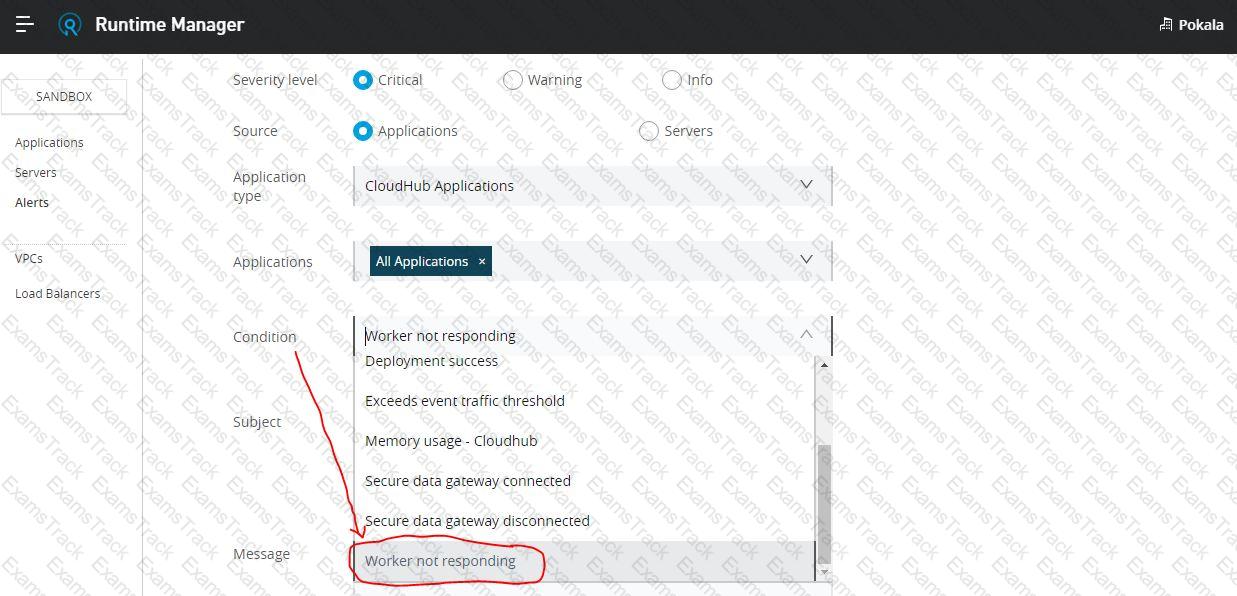
An API implementation is deployed on a single worker on CloudHub and invoked by external API clients (outside of CloudHub). How can an alert be set up that is guaranteed to trigger AS SOON AS that API implementation stops responding to API invocations?
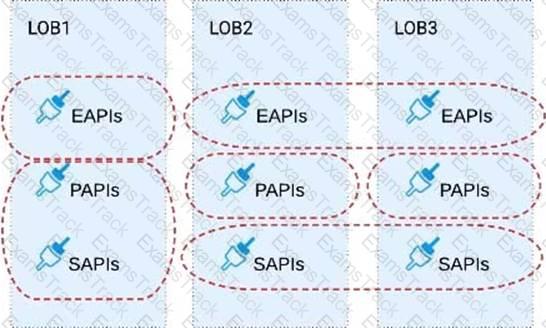
Refer to the exhibit.
Three business processes need to be implemented, and the implementations need to communicate with several different SaaS applications.
These processes are owned by separate (siloed) LOBs and are mainly independent of each other, but do share a few business entities. Each LOB has one development team and their own budget
In this organizational context, what is the most effective approach to choose the API data models for the APIs that will implement these business processes with minimal redundancy of the data models?
A) Build several Bounded Context Data Models that align with coherent parts of the business processes and the definitions of associated business entities
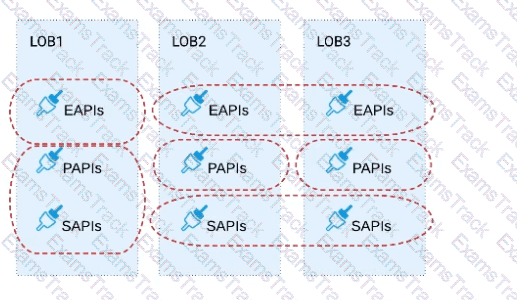
B) Build distinct data models for each API to follow established micro-services and Agile API-centric practices
C) Build all API data models using XML schema to drive consistency and reuse across the organization
D) Build one centralized Canonical Data Model (Enterprise Data Model) that unifies all the data types from all three business processes, ensuring the data model is consistent and non-redundant
Mule applications that implement a number of REST APIs are deployed to their own subnet that is inaccessible from outside the organization.
External business-partners need to access these APIs, which are only allowed to be invoked from a separate subnet dedicated to partners - called Partner-subnet. This subnet is accessible from the public internet, which allows these external partners to reach it.
Anypoint Platform and Mule runtimes are already deployed in Partner-subnet. These Mule runtimes can already access the APIs.
What is the most resource-efficient solution to comply with these requirements, while having the least impact on other applications that are currently using the APIs?
A customer has an ELA contract with MuleSoft. An API deployed to CloudHub is consistently experiencing performance issues. Based on the root cause analysis, it is
determined that autoscaling needs to be applied.
How can this be achieved?
An organization has built an application network following the API-led connectivity approach recommended by MuleSoft. To protect the application network against
attacks from malicious external API clients, the organization plans to apply JSON Threat Protection policies.
To which API-led connectivity layer should the JSON Threat Protection policies most commonly be applied?
A business process is being implemented within an organization's application network. The architecture group proposes using a more coarse-grained application
network design with relatively fewer APIs deployed to the application network compared to a more fine-grained design.
Overall, which factor typically increases with a more coarse-grained design for this business process implementation and deployment compared with using a more fine-grained
design?
In an organization, the InfoSec team is investigating Anypoint Platform related data traffic.
From where does most of the data available to Anypoint Platform for monitoring and alerting originate?
When should idempotency be taken into account?
An organization is deploying their new implementation of the OrderStatus System API to multiple workers in CloudHub. This API fronts the organization's on-premises Order Management System, which is accessed by the API implementation over an IPsec tunnel.
What type of error typically does NOT result in a service outage of the OrderStatus System API?
|
PDF + Testing Engine
|
|---|
|
$41.25 |
|
Testing Engine
|
|---|
|
$31.25 |
|
PDF (Q&A)
|
|---|
|
$26.25 |
Salesforce Free Exams |
|---|

|

Copyright © 2026 Examstrack. All Rights Reserved

TESTED 18 Oct 2026