examstrack logo

You are carrying out a third-party surveillance audit of a client's ISMS. You are currently in the secure storage area of the data centre where the organisation's customers are able to temporarily locate equipment coming into or going out of the site. The equipment is contained within locked cabinets and each cabinet is allocated to a single, specific client.
Out of the corner of your eye you spot movement near the external door of the storage area. This is followed by a loud noise. You ask the guide what is going on. They tell you that recent high rainfall has raised local river levels and caused an infestation of rats. The noise was a specialist pest control stunning device being triggered. You check the device in the corner and find there is a large immobile rat contained within it.
What three actions would be appropriate to take next?
You are performing an ISMS audit at a residential nursing home that provides healthcare services. The next step in your audit plan is to verify the information security incident management process. The IT Security Manager presents the information security incident management procedure and explains that the process is based on ISO/IEC 27035-1:2016.
You review the document and notice a statement "any information security weakness, event, and incident should be reported to the Point of Contact (PoC) within 1 hour after identification". When interviewing staff, you found that there were differences in the understanding of the meaning of "weakness, event, and incident".
You sample incident report records from the event tracking system for the last 6 months with summarized results in the following table.
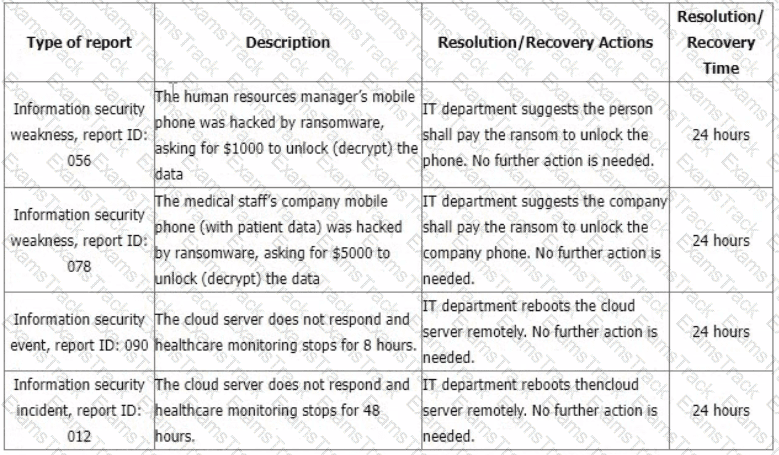
You would like to further investigate other areas to collect more audit evidence. Select two options that will not be in your audit trail.
Which four of the following statements about audit reports are true?
Scenario 5: Data Grid Inc. is a well-known company that delivers security services across the entire information technology infrastructure. It provides cybersecurity software, including endpoint security, firewalls, and antivirus software. For two decades, Data Grid Inc. has helped various companies secure their networks through advanced products and services. Having achieved reputation in the information and network security field, Data Grid Inc. decided to obtain the ISO/IEC 27001 certification to better secure its internal and customer assets and gain competitive advantage.
Data Grid Inc. appointed the audit team, who agreed on the terms of the audit mandate. In addition, Data Grid Inc. defined the audit scope, specified the audit criteria, and proposed to close the audit within five days. The audit team rejected Data Grid Inc.'s proposal to conduct the audit within five days, since the company has a large number of employees and complex processes. Data Grid Inc. insisted that they have planned to complete the audit within five days, so both parties agreed upon conducting the audit within the defined duration. The audit team followed a risk-based auditing approach.
To gain an overview of the main business processes and controls, the audit team accessed process descriptions and organizational charts. They were unable to perform a deeper analysis of the IT risks and controls because their access to the IT infrastructure and applications was restricted. However, the audit team stated that the risk that a significant defect could occur to Data Grid Inc.'s ISMS was low since most of the company's processes were automated. They therefore evaluated that the ISMS, as a whole, conforms to the standard requirements by asking the representatives of Data Grid Inc. the following questions:
•How are responsibilities for IT and IT controls defined and assigned?
•How does Data Grid Inc. assess whether the controls have achieved the desired results?
•What controls does Data Grid Inc. have in place to protect the operating environment and data from malicious software?
•Are firewall-related controls implemented?
Data Grid Inc.'s representatives provided sufficient and appropriate evidence to address all these questions.
The audit team leader drafted the audit conclusions and reported them to Data Grid Inc.'s top management. Though Data Grid Inc. was recommended for certification by the auditors, misunderstandings were raised between Data Grid Inc. and the certification body in regards to audit objectives. Data Grid Inc. stated that even though the audit objectives included the identification of areas for potential improvement, the audit team did not provide such information.
Based on this scenario, answer the following question:
Based on scenario 5, the audit team assessed the ISMS as a whole, rather than assessing the effectiveness and conformity of each process. Is this acceptable?
The purpose of a management system audit is to? Select 1
|
PDF + Testing Engine
|
|---|
|
$49.5 |
|
Testing Engine
|
|---|
|
$37.5 |
|
PDF (Q&A)
|
|---|
|
$31.5 |
PECB Free Exams |
|---|

|

Copyright © 2026 Examstrack. All Rights Reserved

TESTED 12 Oct 2026
