examstrack logo

Select two of the following options that are the responsibility of a legal technical expert on the audit team during a certification audit.
Evaluating the auditee's legal knowledge
Which one of the following options best describes the main purpose of a Stage 2 third-party audit?
Scenario 8: Tessa. Malik, and Michael are an audit team of independent and qualified experts in the field of security, compliance, and business planning and strategies. They are assigned to conduct a certification audit in Clastus, a large web design company. They have previously shown excellent work ethics, including impartiality and objectiveness, while conducting audits. This time, Clastus is positive that they will be one step ahead if they get certified against ISO/IEC 27001.
Tessa, the audit team leader, has expertise in auditing and a very successful background in IT-related issues, compliance, and governance. Malik has an organizational planning and risk management background. His expertise relies on the level of synthesis and analysis of an organization's security controls and its risk tolerance in accurately characterizing the risk level within an organization On the other hand, Michael is an expert in the practical security of controls assessment by following rigorous standardized programs.
After performing the required auditing activities, Tessa initiated an audit team meeting They analyzed one of Michael s findings to decide on the issue objectively and accurately. The issue Michael had encountered was a minor nonconformity in the organization's daily operations, which he believed was caused by one of the organization's IT technicians As such, Tessa met with the top management and told them who was responsible for the nonconformity after they inquired about the names of the persons responsible
To facilitate clarity and understanding, Tessa conducted the closing meeting on the last day of the audit. During this meeting, she presented the identified nonconformities to the Clastus management. However, Tessa received advice to avoid providing unnecessary evidence in the audit report for the Clastus certification audit, ensuring that the report remains concise and focused on the critical findings.
Based on the evidence examined, the audit team drafted the audit conclusions and decided that two areas of the organization must be audited before the certification can be granted. These decisions were later presented to the auditee, who did not accept the findings and proposed to provide additional information. Despite the auditee's comments, the auditors, having already decided on the certification recommendation, did not accept the additional information. The auditee's top management insisted that the audit conclusions did not represent reality, but the audit team remained firm in their decision.
Based on the scenario above, answer the following question:
Question:
Was the closing meeting conducted accordingly?
You are performing an ISMS audit at a residential nursing home called ABC that provides healthcare services.
The next step in your audit plan is to verify the information security on ABC's healthcare mobile app
development, support, and lifecycle process. During the audit, you learned the organization outsourced the
mobile app development to a professional software development company with CMMI Level 5, ITSM (ISO/IEC
20000-1), BCMS (ISO 22301) and ISMS (ISO/IEC 27001) certified. The IT Manager presented the software
security management procedure and summarised the process as follows:
The mobile app development shall adopt "security-by-design" and "security-by-default" principles, as a
minimum. The following security functions for personal data protection shall be available:
Access control.
Personal data encryption, i.e., Advanced Encryption Standard (AES) algorithm, key lengths: 256 bits; and
Personal data pseudonymization.
Vulnerability checked and no security backdoor
You sample the latest Mobile App Test report - details as follows:
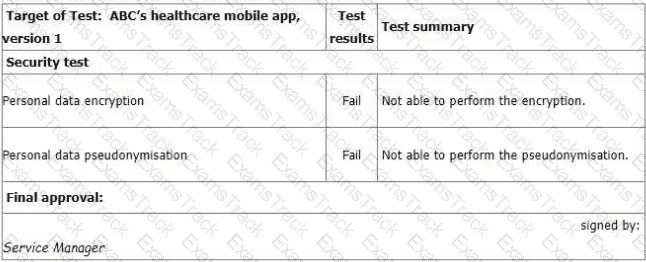
You ask the IT Manager why the organisation still uses the mobile app while personal data
encryption and pseudonymization tests failed. Also, whether the Service Manager is authorized to
approve the test.
The IT Manager explains the test results should be approved by him according to the software
security management procedure. The reason why the encryption and pseudonymization functions
failed is that these functions heavily slowed down the system and service performance. An extra
150% of resources are needed to cover this. The Service Manager agreed that access control is
good enough and acceptable. That's why the Service Manager signed the approval.
You sample one of the medical staff's mobile and found that ABC's healthcare mobile app, version
1.01 is installed. You found that version 1.01 has no test record.
The IT Manager explains that because of frequent ransomware attacks, the outsourced mobile app
development company gave a free minor update on the tested software, performed an emergency
release of the updated software, and gave a verbal guarantee that there will be no impact on any
security functions. Based on his 20 years of information security experience, there is no need to re-
test.
You are preparing the audit findings Select two options that are correct.
The following are the guidelines to protect your password, except:
Scenario 8: Tessa. Malik, and Michael are an audit team of independent and qualified experts in the field of security, compliance, and business planning and strategies. They are assigned to conduct a certification audit in Clastus, a large web design company. They have previously shown excellent work ethics, including impartiality and objectiveness, while conducting audits. This time, Clastus is positive that they will be one step ahead if they get certified against ISO/IEC 27001.
Tessa, the audit team leader, has expertise in auditing and a very successful background in IT-related issues, compliance, and governance. Malik has an organizational planning and risk management background. His expertise relies on the level of synthesis and analysis of an organization's security controls and its risk tolerance in accurately characterizing the risk level within an organization On the other hand, Michael is an expert in the practical security of controls assessment by following rigorous standardized programs.
After performing the required auditing activities, Tessa initiated an audit team meeting They analyzed one of Michael s findings to decide on the issue objectively and accurately. The issue Michael had encountered was a minor nonconformity in the organization's daily operations, which he believed was caused by one of the organization's IT technicians As such, Tessa met with the top management and told them who was responsible for the nonconformity after they inquired about the names of the persons responsible
To facilitate clarity and understanding, Tessa conducted the closing meeting on the last day of the audit. During this meeting, she presented the identified nonconformities to the Clastus management. However, Tessa received advice to avoid providing unnecessary evidence in the audit report for the Clastus certification audit, ensuring that the report remains concise and focused on the critical findings.
Based on the evidence examined, the audit team drafted the audit conclusions and decided that two areas of the organization must be audited before the certification can be granted. These decisions were later presented to the auditee, who did not accept the findings and proposed to provide additional information. Despite the auditee's comments, the auditors, having already decided on the certification recommendation, did not accept the additional information. The auditee's top management insisted that the audit conclusions did not represent reality, but the audit team remained firm in their decision.
Based on the scenario above, answer the following question:
Question:
Based on the decision of the audit team, what is the next step that Clastus should take?
Scenario 5
CyberShielding Systems Inc. provides security services spanning the entire information technology infrastructure. It provides cybersecurity software, including endpoint security, firewalls, and antivirus software. CyberShielding Systems Inc. has helped various companies secure their networks for two decades through advanced products and services. Having achieved a reputation in the information and network security sector, CyberShielding Systems Inc. decided to implement a security information management system (ISMS) based on ISO/IEC 27001 and obtain a certification to better secure its internal and customer assets and gain a competitive advantage.
The certification body initiated the process by selecting the audit team for CyberShielding Systems Inc.'s ISO/IEC 27001 certification. They provided the company with the name and background information of each audit member. However, upon review, CyberShielding Systems Inc. discovered that one of the auditors did not hold the security clearance required by them. Consequently, the company objected to the appointment of this auditor. Upon review, the certification body replaced the auditor in response to CyberShielding Systems Inc.'s objection.
As part of the audit process, CyberShielding Systems Inc.'s approach to risk and opportunity determination was assessed as a standalone activity. This involved examining the organization’s methods for identifying and managing risks and opportunities. The audit team’s core objectives encompassed providing assurance on the effectiveness of CyberShielding Systems Inc.'s risk and opportunity identification mechanisms and reviewing the organization's strategies for addressing these determined risks and opportunities. During this, the audit team also identified a risk due to a lack of oversight in the firewall configuration review process, where changes were implemented without proper approval, potentially exposing the company to vulnerabilities. This finding highlighted the need for stronger internal controls to prevent such issues.
The audit team accessed process descriptions and organizational charts to understand the main business processes and controls. They performed a limited analysis of the IT risks and controls because their access to the IT infrastructure and applications was limited by third-party service provider restrictions. However, the audit team stated that the risk of a significant defect occurring in CyberShielding’s ISMS was low since most of the company's processes were automated. They therefore evaluated that the ISMS, as a whole, conforms to the standard requirements by questioning CyberShielding representatives on IT responsibilities, control effectiveness, and anti-malware measures. CyberShielding’s representatives provided sufficient and appropriate evidence to address all these questions.
Despite the agreement signed before the audit, which outlined the audit scope, criteria, and objectives, the audit was primarily focused on assessing conformity with established criteria and ensuring compliance with statutory and regulatory requirements.
Question
Based on Scenario 5, what else should CyberShielding Systems Inc. have included when defining the audit objectives?
You are an experienced ISMS audit team leader guiding an auditor in training. She asks you about the grading of nonconformities in audit reports. You decide to test her knowledge by asking her which four of the following statements are true.
You are an ISMS auditor conducting a third-party surveillance audit of a telecom's provider. You are in the equipment staging room where network switches are pre-programmed before being despatched to clients. You note that recently there has been a significant increase in the number of switches failing their initial configuration test and being returned for reprogramming.
You ask the Chief Tester why and she says, 'It's a result of the recent ISMS upgrade'. Before the upgrade each technician had their own hard copy work instructions. Now, the eight members of my team have to share two laptops to access the clients' configuration instructions online. These delays put pressure on the technicians, resulting in more mistakes being made'.
Based solely on the information above, which clause of ISO/IEC 27001:2022 would be the most appropriate to raise a nonconformity against? Select one.
Information or data that are classified as ______ do not require labeling.
|
PDF + Testing Engine
|
|---|
|
$49.5 |
|
Testing Engine
|
|---|
|
$37.5 |
|
PDF (Q&A)
|
|---|
|
$31.5 |
PECB Free Exams |
|---|

|

Copyright © 2026 Examstrack. All Rights Reserved

TESTED 12 Oct 2026
