examstrack logo

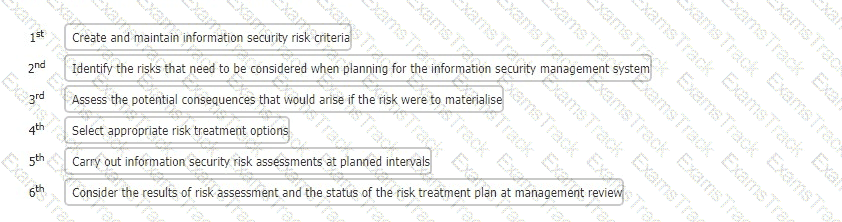
You are an experienced ISMS audit team leader providing instruction to a class of auditors in training. The subject of today's lesson is the management of information security risk in accordance with the requirements of ISO/IEC 27001:2022.
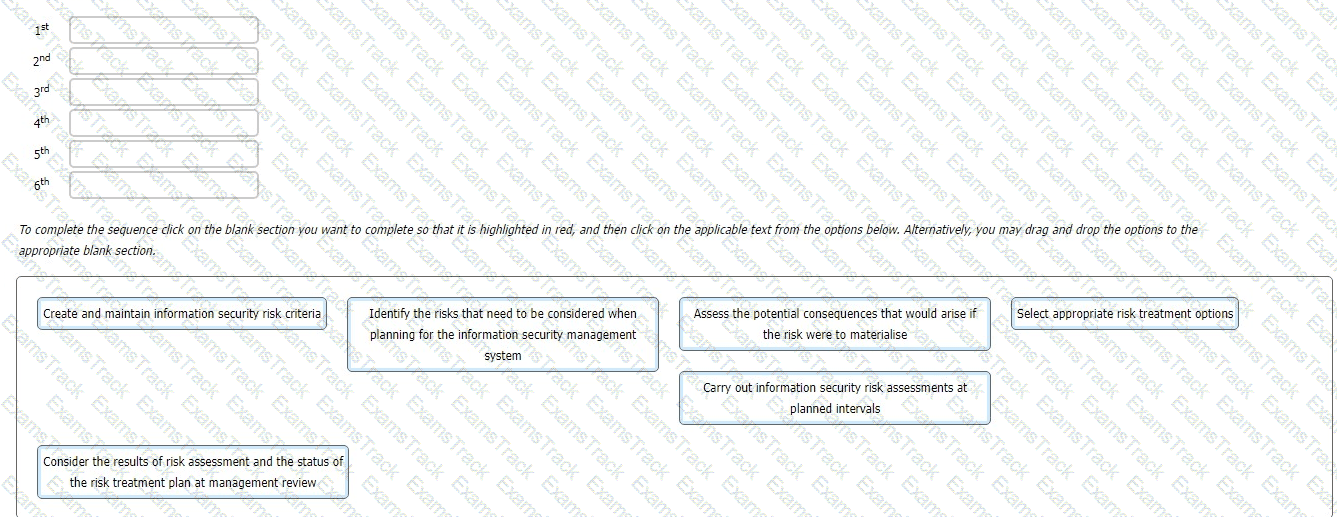
You provide the class with a series of activities. You then ask the class to sort these activities into the order in which they appear in the standard.
What is the correct sequence they should report back to you?
Question
Another auditor appointed by the certification body reviews the audit team leader’s working documents before the audit conclusions are finalized. According to good auditing practice, which statement is correct?
Scenario 1: Fintive is a distinguished security provider for online payments and protection solutions. Founded in 1999 by Thomas Fin in San Jose, California, Fintive
offers services to companies that operate online and want to improve their information security, prevent fraud, and protect user information such as PII. Fintive centers
its decision-making and operating process based on previous cases. They gather customer data, classify them depending on the case, and analyze them. The company
needed a large number of employees to be able to conduct such complex analyses. After some years, however, the technology that assists in conducting such analyses
advanced as well. Now, Fintive is planning on using a modern tool, a chatbot, to achieve pattern analyses toward preventing fraud in real-time. This tool would also be
used to assist in improving customer service.
This initial idea was communicated to the software development team, who supported it and were assigned to work on this project. They began integrating the chatbot
on their existing system. In addition, the team set an objective regarding the chatbot which was to answer 85% of all chat queries.
After the successful integration of the chatbot, the company immediately released it to their customers for use. The chatbot, however, appeared to have some issues.
Due to insufficient testing and lack of samples provided to the chatbot during the training phase, in which it was supposed "to learn" the queries pattern, the chatbot
failed to address user queries and provide the right answers. Furthermore, the chatbot sent random files to users when it received invalid inputs such as odd patterns
of dots and special characters. Therefore, the chatbot was unable to properly answer customer queries and the traditional customer support was overwhelmed with
chat queries and thus was unable to help customers with their requests.
Consequently, Fintive established a software development policy. This policy specified that whether the software is developed in-house or outsourced, it will undergo a
black box testing prior to its implementation on operational systems.
What type of security control does the use of black box testing represent? Refer to scenario 1.
Question:
What is the purpose of using a combination of audit test plans?
Which two of the following statements are true?
A decent visitor is roaming around without visitor's ID. As an employee you should do the following, except:
You are an ISMS auditor conducting a third-party surveillance audit of a telecom's provider. You are in the equipment staging room where network switches are pre-programmed before being despatched to clients. You note that recently there has been a significant increase in the number of switches failing their initial configuration test and being returned for reprogramming.
You ask the Chief Tester why and she says, 'It's a result of the recent ISMS upgrade'. Before the upgrade each technician had their own hard copy work instructions. Now, the eight members of my team have to share two laptops to access the clients' configuration instructions online. These delays put pressure on the technicians, resulting in more mistakes being made'.
Based solely on the information above, which clause of ISO to raise a nonconformity against' Select one.
You are an ISMS audit team leader who has been assigned by your certification body to carry out a follow-up audit of a client. You are preparing your audit plan for this audit.
Which two of the following statements are true?
Which three of the following work documents are not required for audit planning by an auditor conducting a certification audit?
Which of the options below is a control related to the management of personnel that aims to avoid the occurrence of incidents?
|
PDF + Testing Engine
|
|---|
|
$49.5 |
|
Testing Engine
|
|---|
|
$37.5 |
|
PDF (Q&A)
|
|---|
|
$31.5 |
PECB Free Exams |
|---|

|

Copyright © 2026 Examstrack. All Rights Reserved

TESTED 12 Oct 2026