
Spring Sale Limited Time 70% Discount Offer - Ends in 0d 00h 00m 00s - Coupon code: 70track

Free NAHQ CPHQ Practice Exam with Questions & Answers | Set: 15

Questions 211

Which organization accredits opioid treatment programs?

Options:
A.

Commission on Accreditation of Rehabilitation Facilities (CARF)

B.

Community Health Accreditation Partner (CHAP)

C.

American Medical Association (AMA)

D.

National Committee for Quality Assurance (NCQA)

NAHQ CPHQ Premium Access
Questions 212

A continuous quality improvement team has proposed a major change in the billing process for home health service. Staff acceptance of the change is best facilitated by:

Options:
A.

Immediate implementation

B.

Medical staff education

C.

Long-range planning

D.

A pilot project

Questions 213

During development of a clinical pathway, a quality professional should

Options:
A.

evaluate peer review committee findings.

B.

implement best practice alerts.

C.

consult peer-reviewed evidence.

D.

gather patient outcome data.

Questions 214

Which of the following stages may cause continuous quality improvement teams to dissolve prematurely?

Options:
A.

Performing

B.

Storming

C.

Norming

D.

Forming

Questions 215

A positive correlation Is seen in a scatter diagram when

Options:
A.

increases on the x-axisrelate to decreases on the y-axis.

B.

there is a scattering of points in a triangular pattern.

C.

there is a scattering of points in a circular pattern.

D.

increases on the x-axis relate to increases on the y-axis.

Questions 216

Which of the following is the key responsibility of a healthcare quality professional in all types of facilities and organizations?

Options:
A.

Resolve the management problems of the organization.

B.

Coordinate Internal support for quality improvement activities.

C.

Identify safety issues of the facility.

D.

Correct clinical qualityproblems.

Questions 217

A goal of measurement is to collect valid and reliable data that reflects

Options:
A.

actual performance.

B.

desired performance.

C.

potential performance

D.

targeted performance.

Questions 218

A team has been working together for six months to improve a patient outcome, and the desired result has not been achieved. An assessment of team effectiveness was conducted and revealed the following:

The healthcare quality professional should recommend

Options:
A.

evaluating barriers impacting team productivity.

B.

developing interventions to maintain team member satisfaction.

C.

continuing to monitor as the team is performing within acceptable limits.

D.

creating a reward system based on team member growth.

Questions 219

A process that is stable can best be identified through using a:

Options:
A.

Scatter diagram

B.

Histogram

C.

Run chart

D.

Shewhart chart

Questions 220

Data from an Incident reporting system compares Incident rates for one facility to similar facilities:
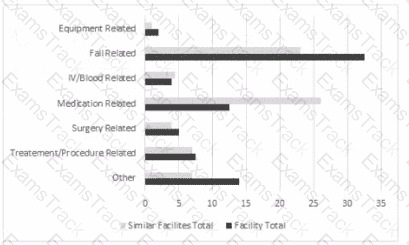
CPHQ Question 220

After reviewing the graph, which of the following should be done first?

Options:
A.

Review medication processes.

B.

Research best practices.

C.

Share data with the governing body.

D.

perform additional analysis on falls data.

Questions 221

Hospitals must be in compliance with the Centers for Medicare and Medicaid Services (CMS) Conditions of Participation in order to

Options:
A.

Submit core measure data

B.

Receive reimbursement

C.

Be part of the state hospital association

D.

Be licensed

Questions 222

Prior to a regulatory or accreditation visit, a healthcare quality professional should:

Options:
A.

Hire a consultant.

B.

Evaluate employee performance.

C.

Perform time-outs.

D.

Complete a gapanalysis.

Questions 223

To determine the success of a transfusion quality improvement project, a healthcare quality professional should:

Options:
A.

Present the results to the staff.

B.

Monitor patient outcomes.

C.

Provide the report to the state department of health.

D.

Share results with the governing board.

Questions 224

A public health agency is developing a proposal to provide free flu Vaccinations to anyone who requests one. Which of the following would be considered an intangible benefit?

Options:
A.

Prevention of hospital admissions

B.

Peace of mind among vaccinated persons

C.

Savings resulting from lower morbidity among unvaccinated persons

D.

Savings associated with prevented illness among vaccinated persons

Questions 225

Which of the following tools Is most effective in assisting an organization seeking to evaluate the current culture of safety?

Options:
A.

anonymous surveys

B.

brainstorming by a governing body

C.

face-to-face interviews

D.

focus groups facilitated by leaders