Big 11.11 Sale 65% Discount Offer - Ends in 0d 00h 00m 00s - Coupon code: sale65best

Free NAHQ CPHQ Practice Exam with Questions & Answers | Set: 7

Questions 91

A healthcare quality Improvement team is working on an action plan to address medication system defects. Based on the data from the chart below, what would be the next step?

Options:
A.

Begin working to address the "Administration" defects.

B.

Conduct further analysis on "Administration" defects.

C.

Conduct further analysis on "Other" defects.

D.

Begin working to address the "Other" defects.

NAHQ CPHQ Premium Access
Questions 92

Before patient outcome data can be used for benchmarking, the data should be

Options:
A.

organized by patient age.

B.

adjusted for length of stay.

C.

adjusted for severity of illness.

D.

organized by patient gender.

Questions 93

When reporting infection control indicators to a governing body, a healthcare quality professional should demonstrate improvement with which of the following tools?

Options:
A.

run chart

B.

frequency plot

C.

pie chart

D.

scatter plot

Questions 94

A hospital quality team notices there is an increased number of falls in the inpatient stroke unit. Which of the following is the best method to analyze the issue?

Options:
A.

fishbone diagram

B.

failure mode and effects analysis (FMEA)

C.

brainstorming

D.

process map

Questions 95

A quality professional is reviewing identified deficiencies from a regulatory survey. Which of the following deficiencies should the quality professional prioritize for review?

Options:
A.

A nurse was unable to recall a process related to a high-risk medication

B.

A per diem provider was found to have an expired certification

C.

A patient on suicide precautions was left alone in an emergency department room

D.

Improper hand hygiene practices were noted among several dietary staff members

Questions 96

The most important determinant of quality improvement success is

Options:
A.

The CQI model selected

B.

Organizational culture

C.

Monetary resource allocation

D.

The type of organization

Questions 97

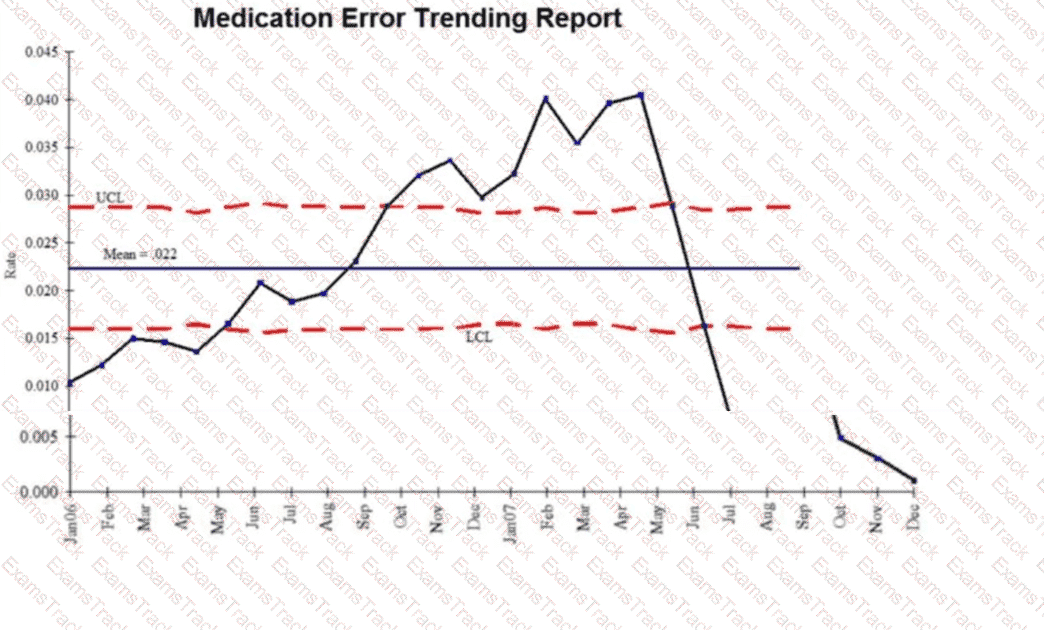
The upper and lower limits of a control chart are

Options:
A.

calculated from actual process measurements.

B.

calculated by projecting future requirements.

C.

derived from special cause variation.

D.

derived from external regulatory standards.

Questions 98

A pay-for-performance structure includes a payout based on achieving the NCQA Quality Compass® 50th Percentile, plus an additional bonus for achieving the NCQA Quality Compass® 75th Percentile. Individual performance on measures is as follows:

NCQA Measure

Physician A

Physician B

Nurse Practitioner C

Physician Assistant D

50th Percentile

75th Percentile

Diabetic Retinal Eye Exam

75%

80%

60%

63%

65%

70%

Nephropathy

53%

43%

50%

48%

50%

52%

HbA1c Testing

76%

80%

52%

70%

72%

76%

Which provider will not earn pay-for-performance based on reaching either the NCQA Quality Compass® 50th or 75th percentile?

Options:
A.

Physician A

B.

Physician B

C.

Nurse Practitioner C

D.

Physician Assistant D

Questions 99

A provider requests to see the peer review file on another provider in their department. What is the healthcare quality professional’s most appropriate response?

Options:
A.

Inform them the file cannot be shared and notify the appropriate personnel.

B.

Inquire what they would like to see in the file and disclose only that information.

C.

Provide them the copy of the file to review since they are a provider in their department.

D.

Ask them to obtain written permission from the provider to review the file.

Questions 100

The following information is available on a health system's performance dashboard:

Employee turnover decreased from 9% to 6%

Reporting of patient safety events and near misses increased 5%

Overall patient satisfaction increased from 58% to 61%Which of the following should the quality professional conclude as a result of this information?

Options:
A.

Safety culture remains unchanged; while patient satisfaction increased, the safety events also increased.

B.

Safety culture has improved; metrics are moving in the right direction.

C.

Safety culture remains unchanged; while turnover decreased, the safety events increased.

D.

Safety culture has declined; metrics are moving in the wrong direction.

Questions 101

An organization has established an ambulatory diabetic management program. Which of the following will best define a successful outcome of the program?

Options:
A.

decreased frequency of missed appointments

B.

increased patient satisfaction

C.

increased compliance with follow-up visits

D.

decreased hospital admission rates

Questions 102

In reviewing information offered by the Agency for Healthcare Research and Quality (AHRQ), the quality improvement (QI) specialist recognizes that the three broad aims pursued by the National Quality Strategy are

Options:
A.

reduce medical waste, use Lean, and achieve equity and better access to care.

B.

reduce complications, reduce readmissions, and improve health outcomes.

C.

better care, healthy people/health communities, and affordable care.

D.

triple aim, reduce utilization, and affordable care.

Questions 103

An annual evaluation of a radiology department's quality improvement program did not identify any opportunities for improvement. The healthcare quality professional should recommend a review of:

Options:
A.

Team-based communication.

B.

The clinical indicators in use.

C.

The statistical methods used in analysis.

D.

The effectiveness of actions taken.

Questions 104

Which of the following performance improvement models is at the core of the Institute for Healthcare Improvement (IHI) collaborative approach?

Options:
A.

DMAIC

B.

PDSA

C.

Lean

D.

Six Sigma

Questions 105

An organization conducts daily briefing sessions. Which of the following questions demonstrates a culture of safety?

Options:
A.

“Do we have available beds in the ICU?”

B.

“What was the patient’s intake and output?”

C.

“Who is the last person that committed a medication error?”

D.

“Did anything happen last night that could lead to a central line infection?”