examstrack logo

You have an Azure Databricks workspace named Workspace! that uses a Git repository. The repository contains a Databricks notebook named Notebook1.
From the main branch, you create a feature branch named Branch! and commit changes to Notebooks Another user commits changes to Notebook1 in main.
When you attempt to merge Branch! into main, the merge fails due to conflicts.
You need to merge Branch! into the main branch. The solution must ensure that Notebook1 includes all the changes from both the branches.
What should you do?
You have an Azure Databricks workspace that is enabled for Unity Catalog.
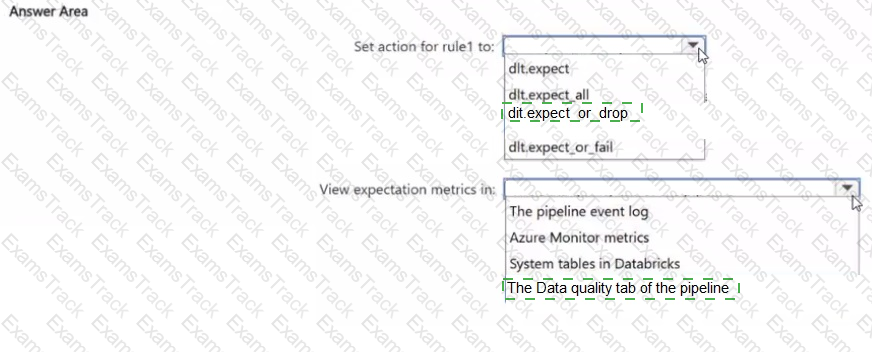
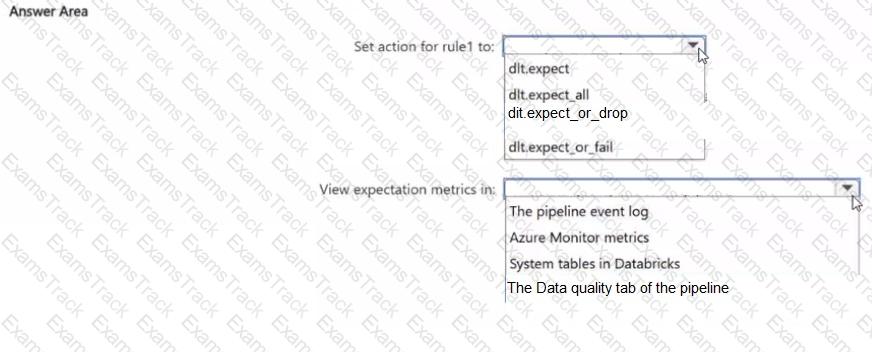
You have a Lakeflow Spark Declarative Pipelines (SDP) pipeline that writes records to a Delta table named Table1 by using a data quality rule named rule1
You need to meet the following requirements:
• Records that violate rule! must NOT be written to Table1. but the pipeline must continue processing valid records.
• Data engineers must be able to review expectation metrics by using minimal development effort.
What should you do? To answer, select the appropriate options in the answer area.
NOTE: Each correct selection is worth one point.
You have an Azure Databricks workspace named Workspace1 that contains a Git folder linked to a remote Git repository. The Git folder contains a Databricks notebook named Notebook1.
From the main branch, you create a feature branch named Branch1 and commit changes to Notebook1.
Another user commits changes to Notebook1 in main.
When you attempt to merge Branch1 into main, a merge conflict occurs.
You need to ensure that Notebook1 in main includes the changes from both branches.
What should you do?
You have an Azure Databricks workspace.
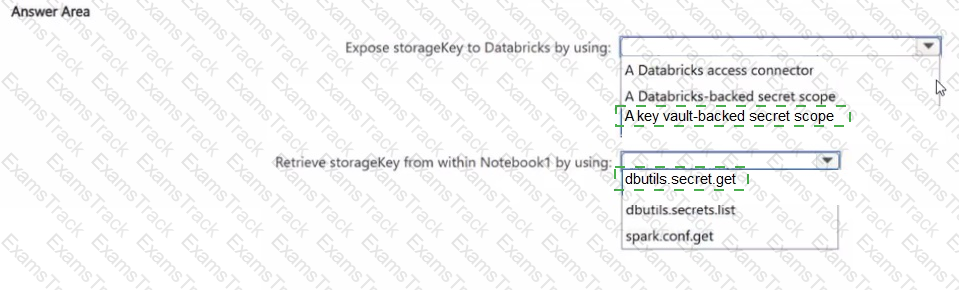
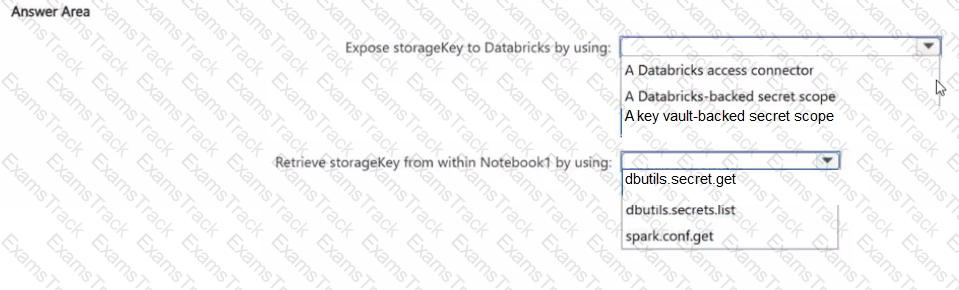
You have an Azure key vault named kv-secure that stores a secret named storageKey. The value of storageKey is managed and updated by the cloud security team at your company.
You need to enable a Databricks notebook named Notebook 1 to retrieve the value of storageKey securely at runtime. The solution must follow the principle of least privilege and always retrieve the latest value.
What should you do? To answer, select the appropriate options in the answer area.
NOTE: Each correct selection is worth one point.
|
PDF + Testing Engine
|
|---|
|
$43.75 |
|
Testing Engine
|
|---|
|
$33.75 |
|
PDF (Q&A)
|
|---|
|
$28.75 |
Microsoft Free Exams |
|---|

|

Copyright © 2026 Examstrack. All Rights Reserved

TESTED 20 Sep 2026