examstrack logo

You have a Microsoft Foundry agent named Agent1.
You open Agent1 in the playground and update the instructions.
You need to run a full evaluation against the updated instructions. The solution must meet the following requirements:
• Test the changes by using a synthetic dataset.
• Ensure that the changes are available only for the development team that has access to Agent1.
What should you do first?
You need to recommend a Microsoft Foundry multi-agent solution that has the following domain-specific requirements:
• Agent responses must never include the names of two specific sanctioned companies.
• Agent responses must NOT expose customer account numbers
Which guardrail strategy should you include in the recommendation?
You are designing Microsoft Foundry multi-agent solution. The agents will use Agent-to-Agent (A2A) delegation and access separate Azure Storage containers within a resource group named RG1.
You need to recommend identity components for the design. The solution must meet the following requirements:
• Eliminate stored application secrets.
• Limit the impact of a compromised agent or deployment.
Solution: Use delegated user permissions for agent actions. Assign Azure roles by using a shared security group. Does this meet the goal?
You have a Microsoft Foundry resource that hosts Azure OpenAI model deployments for three projects. Each project is for a different business unit. The projects share the same Foundry resource.
You need to implement a Microsoft Cost Management view that separates the shared model spend by the project The solution must meet the following requirements:
• Use cost data that can be reconciled by using Azure Cost Management.
• Minimize manual tagging.
What should you use?
You have a Microsoft Agent Framework multi-agent workflow. The workflow includes a context provider that injects a condensed memory summary into each agent invocation. Requirements and acceptance criteria are stored in GitHub issues.
During a long-running workflow, the acceptance criteria changes. Later agents sometimes apply the earlier criteria. Token telemetry shows condensed summaries grow across handoffs. causing older content to be truncated.
You need to ensure that the later agents use the current requirements. The solution must limit context window growth.
What should you do?
You have a Microsoft Foundry multi-agent solution that routes requests from an intake agent to a retrieval agent, and then to a resolution agent. The retrieval agent uses a knowledge search tool.
Security testing reveals the following recurring issues:
• Some users submit jailbreak-style prompts at the start of a conversation.
• Some retrieved documents contain hidden instructions intended to manipulate the downstream agent
The legal department at your company requires that final responses be flagged for review if they contain protected text. You need to configure guardrails to resolve the security issues and meet the legal requirements. What should you configure?
You have a LangGraph multi-agent workflow that uses Azure Cosmos DB as a checkpointer.
You plan to change the pruning rules for the running message list before the next release
You need to implement evaluations tor memory. The solution must meet the following requirements:
• Verify that claim-related state values remain correct at transition points.
• Verify that conversation context is preserved after an interruption.
• Identify the source of any loss of continuity during a run
Which three actions should you perform Each correct answer presents part of the solution NOTE: Each correct selection is worth one point.
You need to implement the business rule for claim Approval. Which workflow node should you use?
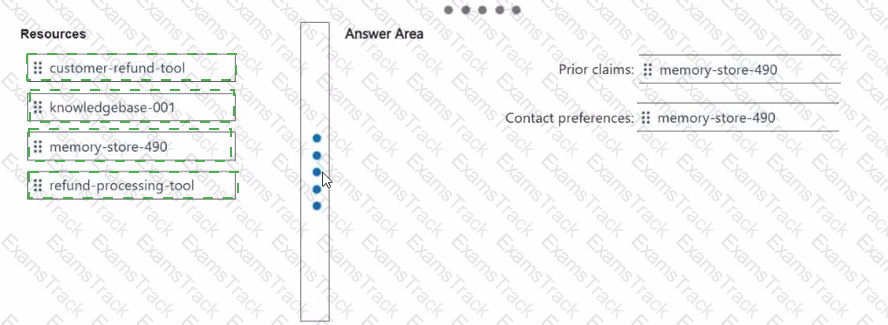
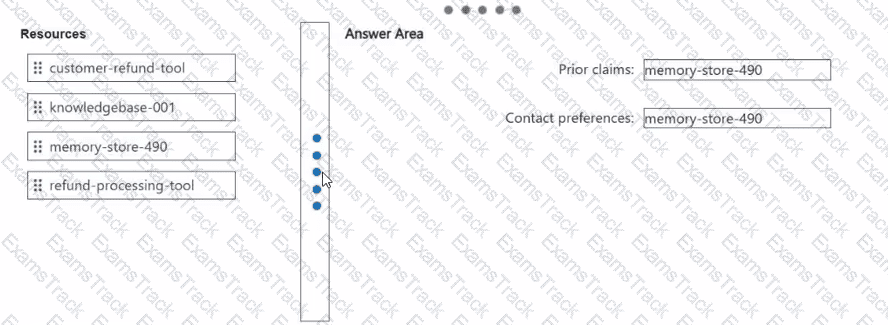
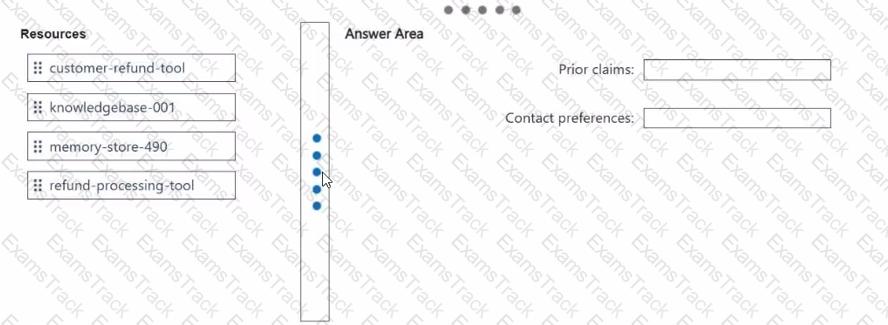
You need to recommend a memory retrieval strategy to support the planned changes for claim Approval.
What should you recommend? To answer, drag the appropriate resources to the correct requirements. Each resource may be used once, more than once, or not at all. You may need to drag the split bar between panes or scroll to view content.
NOTE: Each correct selection is worth one point.
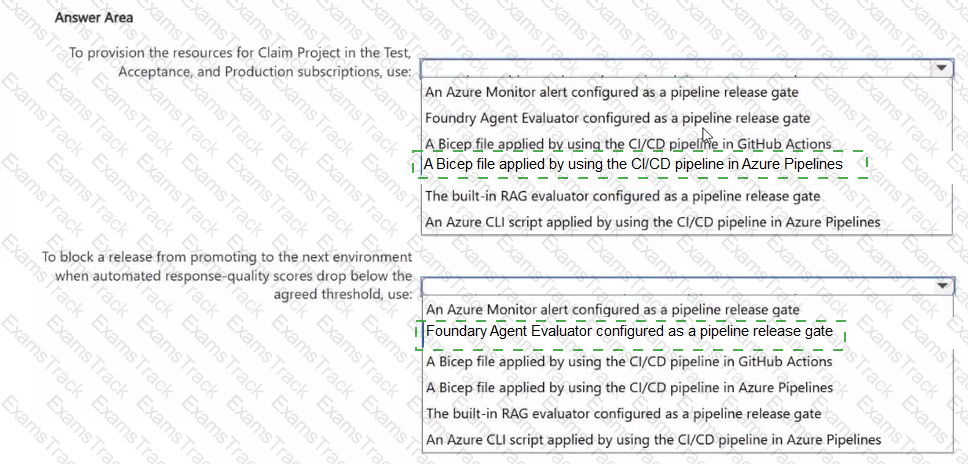
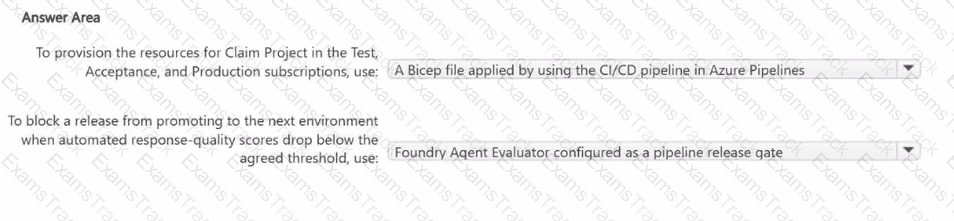
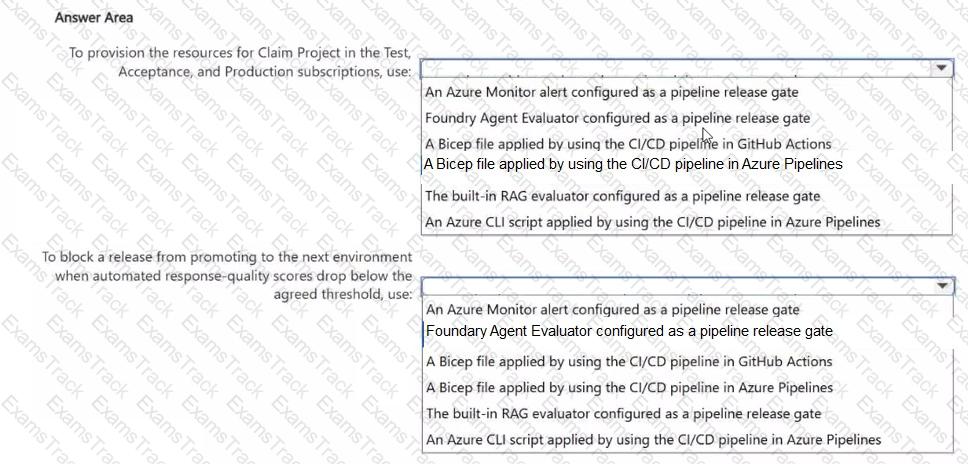
You need to recommend an end-to-end release lifecycle for claim Approval. The solution must meet the technical requirements.
What should you recommend for each requirement? To answer, drag the appropriate recommendations to the correct requirements. Each recommendation may be used once, more than once, or not at all. You may need to drag the split bar between panes or scroll to view content.
NOTE: Each correct selection is worth one point.
|
PDF + Testing Engine
|
|---|
|
$43.75 |
|
Testing Engine
|
|---|
|
$33.75 |
|
PDF (Q&A)
|
|---|
|
$28.75 |
Microsoft Free Exams |
|---|

|

Copyright © 2026 Examstrack. All Rights Reserved

TESTED 27 Sep 2026