Pre-Summer Sale Limited Time 70% Discount Offer - Ends in 0d 00h 00m 00s - Coupon code: 70track

Free Juniper JN0-650 Practice Exam with Questions & Answers | Set: 2

Questions 11

You are asked to configure 802.1X on an EX Series switch port that connects to a downstream switch with several devices attached. You must ensure that the first device is authenticated while all subsequent devices are permitted.

What will accomplish this request?

Options:
A.

single supplicant

B.

MAC RADIUS

C.

single-secure supplicant

D.

multiple supplicant

Juniper JN0-650 Premium Access
Questions 12

You are deploying IP phones in your enterprise networks. When plugged in. the IP phones must automatically be provided with their geographic location details by the EX Series switches.

In this scenario, which protocol should be used to enable this behavior?

Options:
A.

CDP

B.

LLDP-MED

C.

LLDP

D.

MP-BGP

Questions 13

Which statement about LLDP and LLDP-MED operations on EX Series devices is correct?

Options:
A.

LLDP only operates on interfaces configured for Layer 2

B.

EX Series devices flood LLDP frames across a Layer 2 domain to calculate a network topology

C.

EX Series devices support LLDP-MED power negotiation, enabling dynamic allocation of PoE power based on endpoint device needs.

D.

LLDP-MED focuses on discovering network connectivity devices like routers and switches.

Questions 14

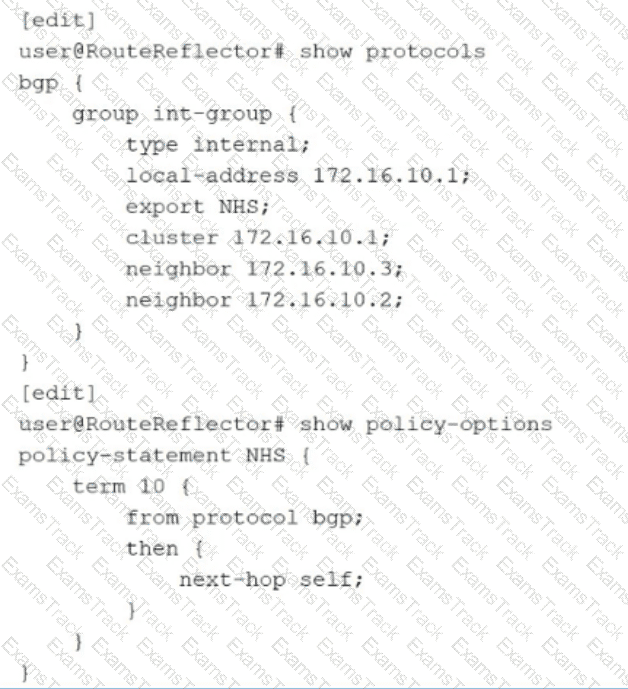
Exhibit.

JN0-650 Question 14

You have determined that traffic in your network is being routed through your route reflector instead of using the optimal path. Referring to the exhibit, what are two configuration changes on the route reflector that would solve the problem? (Choose two.)

Options:
A.

set policy-options policy-statement NHS term 10 from route-type external

B.

set protocols bgp group int-group import NHS

C.

delete protocols bgp group int-group export IfJHS

D.

set policy-options policy-statement NHS term 10 from route-type internal

Questions 15

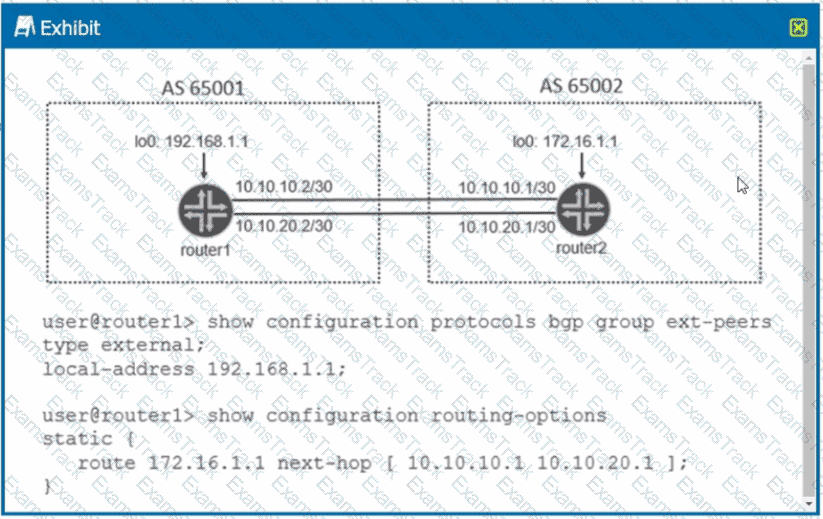
Exhibit.

JN0-650 Question 15

Referring to the exhibit, what is required for the BGP peering to establish?

Options:
A.

Configure neighbor 172.16.1.1 multipath under the ext-peers hierarchy.

B.

Configure neighbor 10.10.20. l multihop under the ext-peers hierarchy

C.

Configure neighbor lo.io.io.i multihop under the ext-peers hierarchy

D.

Configure neighbor 172.16.1.1 multihop under the ext-peers hierarchy

Questions 16

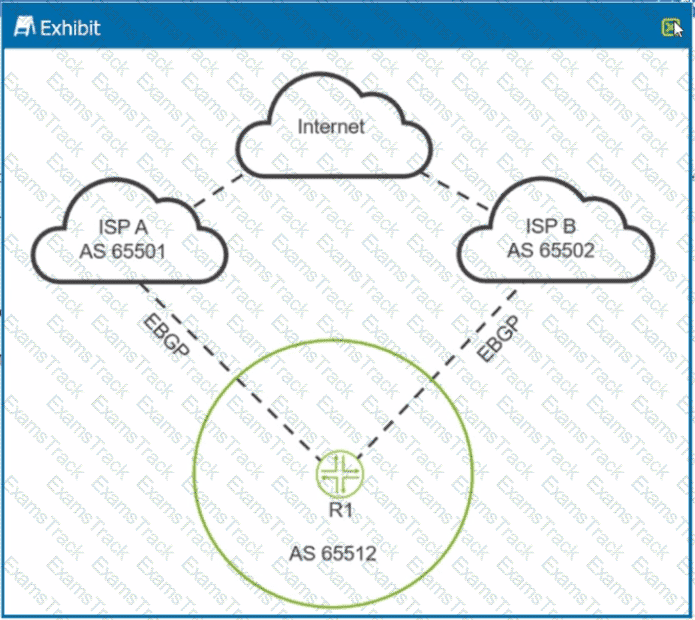
Exhibit

JN0-650 Question 16

You are receiving the same BGP Internet routes on R1 from both upstream ISPs. You are asked to load-balance traffic destined to the Internet across both ISPs.

Referring to the exhibit, which BGP solution should you use?

Options:
A.

Use the multihop feature on R1.

B.

Use the multipath multiple-as feature on R1.

C.

Use the prefix limit feature on R1

D.

Use the damping feature on R1.

Questions 17

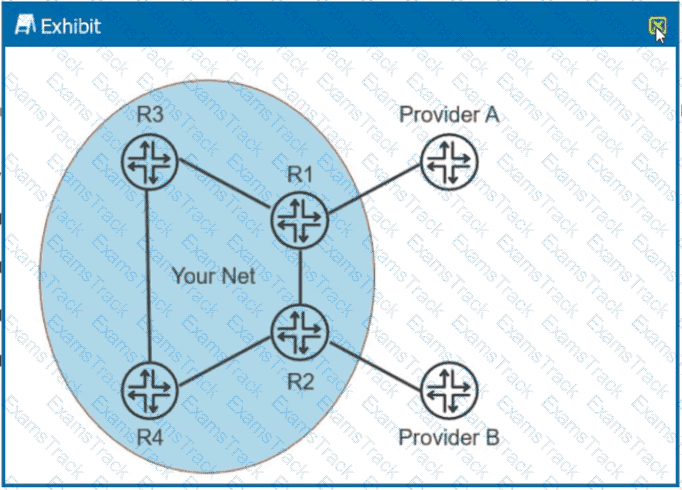
Exhibit

JN0-650 Question 17

Your network receives the full Internet BGP routing table from two different ISPs. You want your local routers to use Provider A to forward all Internet traffic as long as Provider A is available.

Referring to the exhibit, which two actions would satisfy this requirement? (Choose two.)

Options:
A.

Use a routing policy to set the local preference attribute value higher for the routes that are learned by R1

B.

Use a routing policy to set the local preference attribute value higher for the routes that are learned by R2.

C.

Use a routing policy to set the local preference attribute value lower for the routes that are learned by R2.

D.

Use a routing policy to set the local preference attribute value lower for the routes that are learned by R1.

Questions 18

Which two statements are correct about multicast routing tables? (Choose two.)

Options:
A.

inet. 2 is used when the multicast forwarding topology differs from unicast forwarding

B.

MBGP and IS-IS place routes in met. l directly.

C.

inet. 0 is used for RPF checks.

D.

IS-IS and OSPFv3 place routes in met. 2 directly.

Questions 19

When configuring OSPF. what is the purpose of adding the secondary command to an OSPF interface?

Options:
A.

The secondary command is used in conjunction with VRRP for failover.

B.

The secondary command allows an interface to be in multiple areas.

C.

The secondary command creates an mtra-area backup path.

D.

The secondary command sets a backup path for virtual links

Questions 20

Which two statements are correct about EVPN/VXLAN deployments? (Choose two.)

Options:
A.

VNIs are used for encapsulating and de-encapsulating traffic entering and leaving the tunnels

B.

VTEPs are used for encapsulating and de-encapsulating traffic entering and leaving the tunnels.

C.

VTEPs are used to identify broadcast domains within an EVPN/VXLAN environment.

D.

VNIs are used to identify broadcast domains within an EVPN/VXLAN environment.