Spring Sale Limited Time 70% Discount Offer - Ends in 0d 00h 00m 00s - Coupon code: 70track

Free Juniper JN0-650 Practice Exam with Questions & Answers

Questions 1

You have several switches in your network that use Cisco's PVST+ protocol. You want your Juniper switches to interoperate with those devices.

In this scenario, which protocol would you use?

Options:
A.

RPVST+

B.

MSTP

C.

VSTP

D.

RSTP

Juniper JN0-650 Premium Access
Questions 2

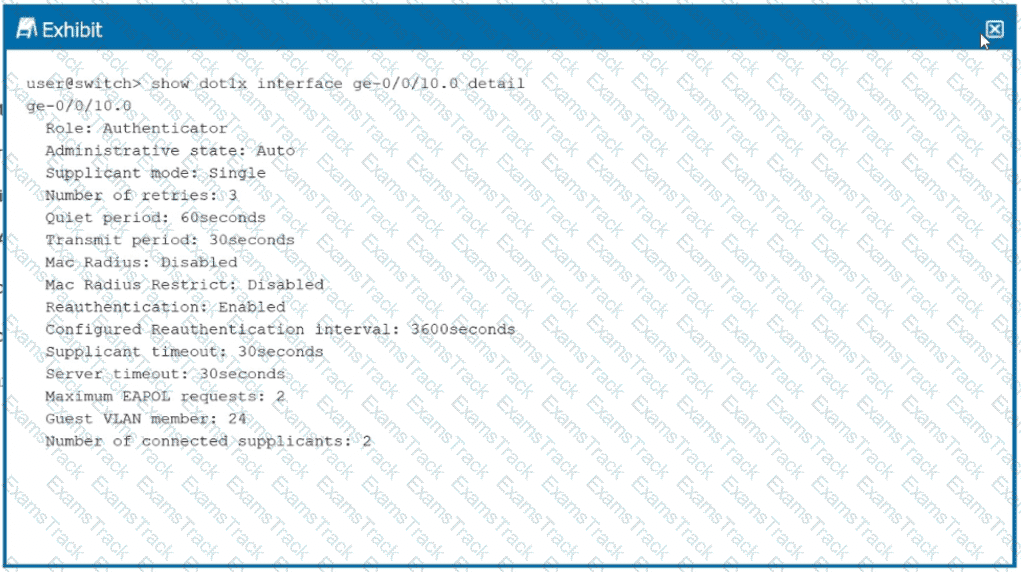
Your Layer 2 network uses 802.1X to authenticate user devices connecting to the network. You are asked to include a new Layer 2 interface connection from the conference room in your network. You must ensure that only a single device is allowed to authenticate on this port at one time to avoid users from being able to plug in a rogue switch to this port.

In this scenario, which 802.1X method would you use for the new interface?

Options:
A.

single-secure supplicant mode

B.

multiple supplicant mode

C.

single supplicant mode

D.

MAC-RADIUS

Questions 3

You run a multivendor switching environment where you have configured VSTP. You have 450 VLANs and notice that some of your VLANs do not function properly. How should you change the configuration to get all 450 VLANs working?

Options:
A.

Include the force-version stp; statement in your configuration

B.

Enable RSTP to handle additional VLANs.

C.

Set the VLAN max-age to 3600 or more.

D.

Increase the bridge priority on all VLANs to at least 16k.

Questions 4

You are enabling CoS throughout your enterprise network using the DSCP bits. You plan to use an MF classifier on all edge devices while using BA classifiers on all transit core devices

In this scenario, what should you use to provide consistent handling of traffic?

Options:
A.

You should implement rewrite rules on the edge devices' egress interfaces to rewrite the DSCP bits as it leaves the device toward the core.

B.

You should implement rewrite rules on the edge devices' ingress interfaces to rewrite the DSCP bits as it enters the device.

C.

You should implement rewrite rules on the core devices' ingress interfaces to rewrite the DSCP bits as it enters the device.

D.

You should implement rewrite rules on the core devices' egress interfaces to rewrite the DSCP bits as it leaves the device toward other core devices.

Questions 5

Which two statements are correct about multicast routing tables? (Choose two.)

Options:
A.

inet. 2 is used when the multicast forwarding topology differs from unicast forwarding

B.

MBGP and IS-IS place routes in met. l directly.

C.

inet. 0 is used for RPF checks.

D.

IS-IS and OSPFv3 place routes in met. 2 directly.

Questions 6

Exhibit

JN0-650 Question 6

You are receiving the 203 0.113.0/24 route from both upstream ISPs You are asked to ensure that ISP A is the preferred ISP for traffic being sent to the 203.0.113.0/24 network from devices in AS 65512.

Referring to the exhibit, which two statements will accomplish this behavior? (Choose two.)

Options:
A.

You should assign a local preference that is lower than 100 for the route learned from ISP A.

B.

You should assign a local preference that is higher than 100 for the route learned from ISP A.

C.

You should assign a local preference that is lower than 100 for the route learned from ISP B.

D.

You should assign a local preference that is higher than 100 for the route learned from ISP B.

Questions 7

You configured MVRP in your Layer 2 network and you are adding two new interfaces to your distribution switch. You are asked to ensure that if a rogue device that uses MVRP is connected to these interfaces, that the MVRP PDUs are ignored

In this scenario, what should you configure to accomplish this task?

Options:
A.

Configure the join-timer to 500 ms.

B.

Configure the no-dynamic-vlan feature under MVRP.

C.

Configure the two new interfaces as point-to-point.

D.

Configure the two new interfaces under MVRP using the forbidden registration mode.

Questions 8

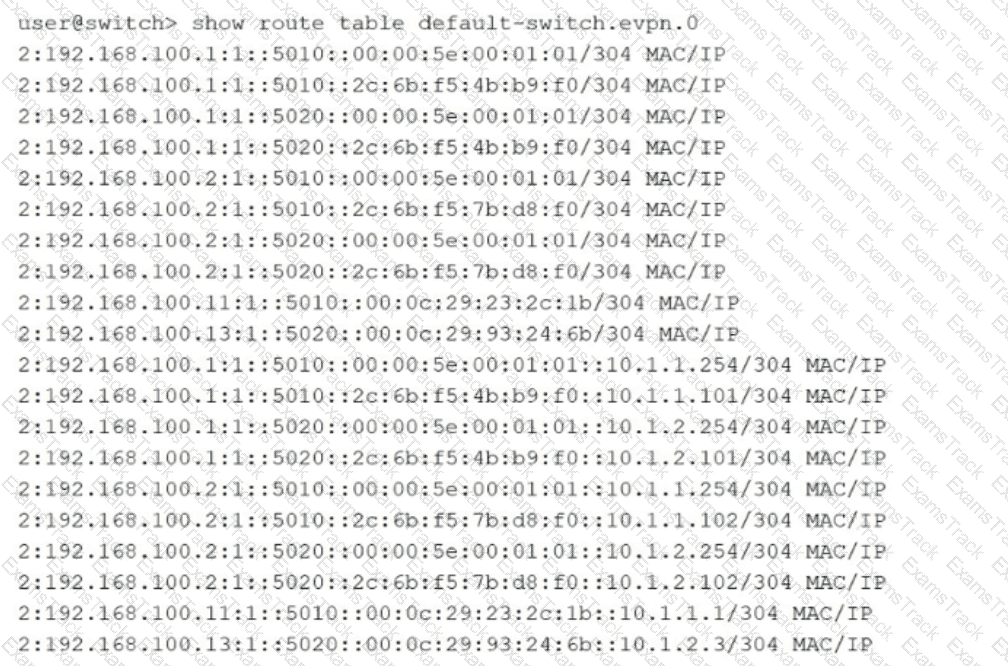
You must implement EVPN signaling on an EX Series device that is configured with both underlay and overlay networks. Which network protocol accomplishes this task?

Options:
A.

OSPF underlay network

B.

IS-IS underlay network

C.

MPLS overlay network

D.

EBGP overlay network

Questions 9

Exhibit

JN0-650 Question 9

Referring to the exhibit, what will enable active routes from both peers?

Options:
A.

Configure neighbor 172.16.1.1 multipath under the ext-peers hierarchy.

B.

Configure multipath under the ext-peers hierarchy

C.

Configure neighbor 172.16.1.1 under the ext-peers hierarchy.

D.

Configure neighbor 10.10.20.2 multipath under the ext-peers hierarchy.

Questions 10

Exhibit

JN0-650 Question 10

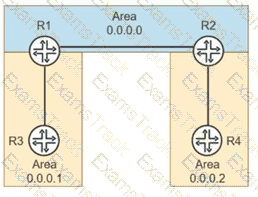
What is the OSPF router type shown in the exhibit for router 192.168.2.1?

Options:
A.

neither an ABR nor an ASBR

B.

an ASBR

C.

both an ABR and an ASBR

D.

an ABR