examstrack logo

Your regression test suite contains five test cases, TC1–TC5. They cover use-case scenarios UC1–UC10 as follows:
TC1 covers UC1, UC2, UC3, UC4, UC5, UC6, UC7, UC8
TC2 covers UC7, UC8
TC3 covers UC2, UC4, UC6, UC7
TC4 covers UC10
TC5 covers UC5, UC8, UC9
The system has three components: C1, C2, and C3.
C1 implements UC1, UC2, UC3, and UC4.
C2 implements UC5, UC6, and UC7.
C3 implements UC8, UC9, and UC10.
The latest project iteration refactored component C3. Your organization follows a scenario-coverage-based regression test-selection strategy.
Because of time constraints, only two regression tests can be run. Which TWO test cases should be executed?
Choose two
Which of the following demonstrates the test analyst’s contribution to interoperability testing?
You are testing a loan-assignment system. You have been given the following decision table to analyze; each condition can take only the value Y (yes, the condition holds) or N (no, the condition does not hold).
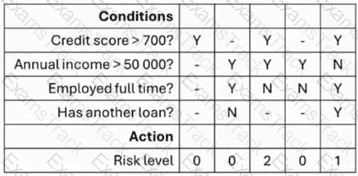
What inference can be made from this decision table?
Which of the following is not an example of a test analyst’s contribution to defect prevention?
You are defining test environment requirements for an online retail application that will have to handle high transaction volumes and uses a third-party payment authorization gateway.
Which requirement is MOST important for the functional testing?
Consider the following state diagram for a simple ATM.
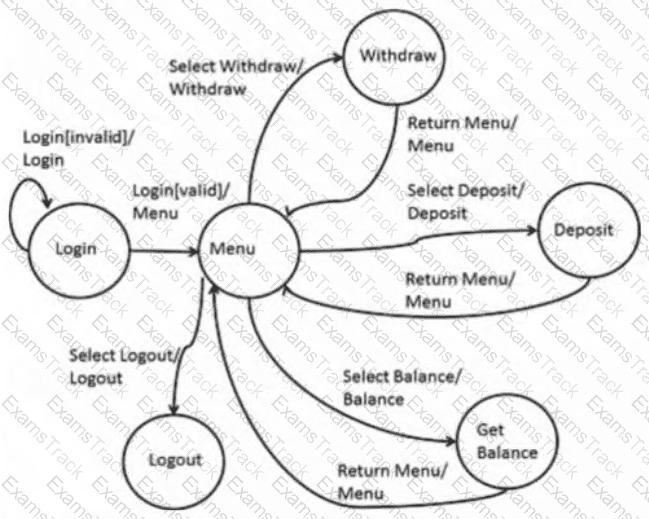
The decision has been made to add the following capabilities:
Allow the customer to move from Get Balance to Deposit, Withdrawal, or Menu.
Allow the customer to move from Deposit to Withdrawal, Get Balance, or Menu.
From Withdrawal, the customer will still be able to go only to Menu.
How many test cases are required to achieve 100% 0-switch coverage of both the new and existing capabilities?
You are assigned to an Agile team as a Test Analyst. In most ways, the team seems to be working well. Iteration planning goes smoothly because the user stories are good quality. Most defects that are found by testing are fixed in the same iteration and those that do go live are not causing significant dissatisfaction amongst stakeholders. However, the team is unhappy because the Defect Removal Efficiency rate, measured for each iteration, is less than 80%.
What would be the MOST effective contribution by you as a TA, to improve the situation?
Which test technique would be most suitable for testing a database application that supports adding and deleting data, and that also controls which users can view the data and which users can update it?
You are testing the functional correctness of an application which allows the driver of a car to control if the air that enters the passenger compartment is fresh or recycled. The car may be ordered in various configurations:
• Engine Size (can be: 1500cc, 1900cc, 2200cc, 2500cc)
• Gearbox type (can be: automatic, manual 5-speed, manual 6-speed)
• Cruise control (can be: yes or no)
• Electric sunroof (can be: yes or no)
It is expected that the most popular configuration will have a 1900cc engine and a manual 5-speed gearbox with cruise control and no electric sunroof. In order to achieve full BASE CHOICE coverage, how many configurations must be tested?
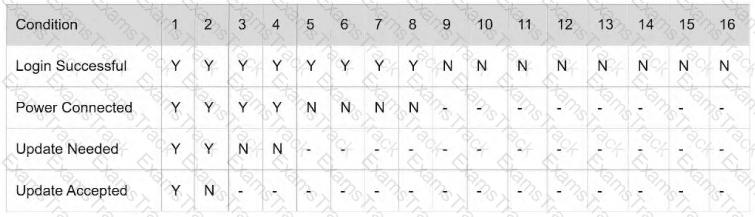
You have been given the following partially minimized decision table. What further minimization is required?
|
PDF + Testing Engine
|
|---|
|
$34 |
|
Testing Engine
|
|---|
|
$26 |
|
PDF (Q&A)
|
|---|
|
$21 |
iSQI Free Exams |
|---|

|

Copyright © 2026 Examstrack. All Rights Reserved

TESTED 29 Nov 2026
