New Year Sale 70% Discount Offer - Ends in 0d 00h 00m 00s - Coupon code: 70track

Free HP HPE7-A02 Practice Exam with Questions & Answers | Set: 4

Questions 31

You are setting up HPE Aruba Networking SSE. Which use case requires you to apply a non-default device posture in a rule?

Options:
A.

Applying threat inspection to users when they access certain websites

B.

Checking whether a client has antivirus software as a condition for receiving access to resources

C.

Redirecting compromised clients to a remediation server

D.

Integrating with HPE Aruba Networking ClearPass OnGuard

HP HPE7-A02 Premium Access
Questions 32

Refer to Exhibit.

HPE7-A02 Question 32

A company is using HPE Aruba Networking ClearPass Device Insight (CPDI) (the standalone application). In the CPDI interface, you go to the Generic Devices

page and see the view shown in the exhibit.

What correctly describes what you see?

Options:
A.

Each cluster is a group of unclassified devices that CPDI's machine learning has discovered to have similar attributes.

B.

Each cluster is a group of devices that match one of the tags configured by admins.

C.

Each cluster is all the devices that have been assigned to the same category by one of CPDI's built-in system rules.

D.

Each cluster is a group of devices that have been classified with user rules, but for which CPDI offers different recommendations.

Questions 33

A company assigns a different block of VLAN IDs to each of its access layer AOS-CX switches. The switches run version 10.07. The IDs are used for standard

purposes, such as for employees, VolP phones, and cameras. The company wants to apply 802.1X authentication to HPE Aruba Networking ClearPass Policy

Manager (CPPM) and then steer clients to the correct VLANs for local forwarding.

What can you do to simplify setting up this solution?

Options:
A.

Assign consistent names to VLANs of the same type across the AOS-CX switches and have user-roles reference names.

B.

Use the trunk allowed VLAN setting to assign multiple VLAN IDs to the same role.

C.

Change the VLAN IDs across the AOS-CX switches so that they are consistent.

D.

Avoid configuring the VLAN in the role; use trunk VLANs to assign multiple VLANs to the port instead.

Questions 34

A company has HPE Aruba Networking infrastructure devices. The devices authenticate clients to HPE Aruba Networking ClearPass Policy Manager (CPPM). You want CPPM to track information about clients, such as their IP addresses and their network bandwidth utilization. What should you set up on the network infrastructure devices to help that happen?

Options:
A.

Logging with CPPM configured as a Syslog server.

B.

Dynamic authorization enabled in the RADIUS settings for CPPM.

C.

RADIUS accounting to CPPM, including interim updates.

D.

An IF-MAP interface with CPPM as the destination.

Questions 35

A company needs you to integrate HPE Aruba Networking ClearPass Policy Manager (CPPM) with HPE Aruba Networking ClearPass Device Insight (CPDI). What is one task you should do to prepare?

Options:
A.

Install the root CA for CPPM’s HTTPS certificate as trusted in the CPDI application.

B.

Enable Insight in the CPPM server configuration settings.

C.

Configure WMI, SSH, and SNMP external accounts for device scanning on CPPM.

D.

Collect a Data Collector token from HPE Aruba Networking Central.

Questions 36

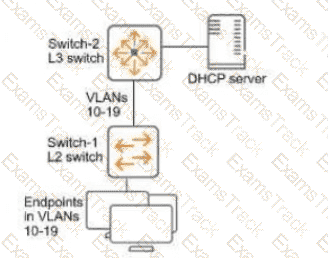
HPE7-A02 Question 36

All of the switches in the exhibit are AOS-CX switches.

What is the preferred configuration on Switch-2 for preventing rogue OSPF routers in this network?

Options:
A.

Disable OSPF entirely on VLANs 10-19.

B.

Configure OSPF authentication on VLANs 10-19 in password mode.

C.

Configure OSPF authentication on Lag 1 in MD5 mode.

D.

Configure passive-interface as the OSPF default and disable OSPF passive on Lag 1.

Questions 37

A company has several use cases for using its AOS-CX switches' HPE Aruba Networking Network Analytics Engine (NAE).

What is one guideline to keep in mind as you plan?

Options:
A.

Each switch model has a maximum number of supported monitors, and one agent might have multiple monitors.

B.

You can install multiple scripts on a switch, but you can deploy only one agent per script.

C.

The switch will permit you to deploy as many NAE agents as you want, but they might degrade the switch functionality.

D.

When you use custom scripts, you can create as many agents from each script as you want.

Questions 38

A company wants HPE Aruba Networking ClearPass Policy Manager (CPPM) to periodically poll Microsoft Endpoint Manager (formerly Intune) for attributes about its managed clients.

What should you do on ClearPass to permit this integration?

Options:
A.

Install the Intune extension from ClearPass Guest

B.

Import the Intune dictionary into the ClearPass dictionaries

C.

Create an Intune authentication source on CPPM

D.

Configure Endpoint Manager (Intune) as an event source on CPPM

Questions 39

A company is using HPE Aruba Networking ClearPass Device Insight (CPDI) (the standalone application). You have identified a device, which is currently

classified as one type, but you want to classify it as a custom type. You also want to classify all devices with similar attributes as this type, both already-discovered

devices and new devices discovered later.

What should you do?

Options:
A.

Create a user tag from the Generic Devices page, select the desired attributes for the tag, and save the tag.

B.

In the device details, select reclassify, create a user rule based on its attributes, and choose "Save & Reclassify."

C.

In the device details, select filter, create a user tag based on the device attributes, and save the tag.

D.

Create a user rule from the Generic Devices page, select the desired attributes for the rule, and choose "Save."

Questions 40

You need to set up HPE Aruba Networking ClearPass Policy Manager (CPPM) to provide certificate-based authentication of 802.1X supplicants. How should you upload the root CA certificate for the supplicants’ certificates?

Options:
A.

As a ClearPass Server certificate with the RADIUS/EAP usage.

B.

As a ClearPass Server certificate with the Database usage.

C.

As a Trusted CA with the AD/LDAP usage.

D.

As a Trusted CA with the EAP usage.