Pre-Summer Sale Limited Time 70% Discount Offer - Ends in 0d 00h 00m 00s - Coupon code: 70track

Free HP HPE7-A02 Practice Exam with Questions & Answers

Questions 1

You are deploying a virtual Data Collector for use with HPE Aruba Networking ClearPass Device Insight (CPDI). You have identified VLAN 101 in the data center

as the VLAN to which the Data Collector should connect to receive its IP address and connect to HPE Aruba Networking Central.

Which Data Collector virtual ports should you tell the virtual admins to connect to VLAN 101?

Options:
A.

The one with the lowest MAC address

B.

The one with the highest port ID

C.

The one with the highest MAC address

D.

The one with the lowest port ID

HP HPE7-A02 Premium Access
Questions 2

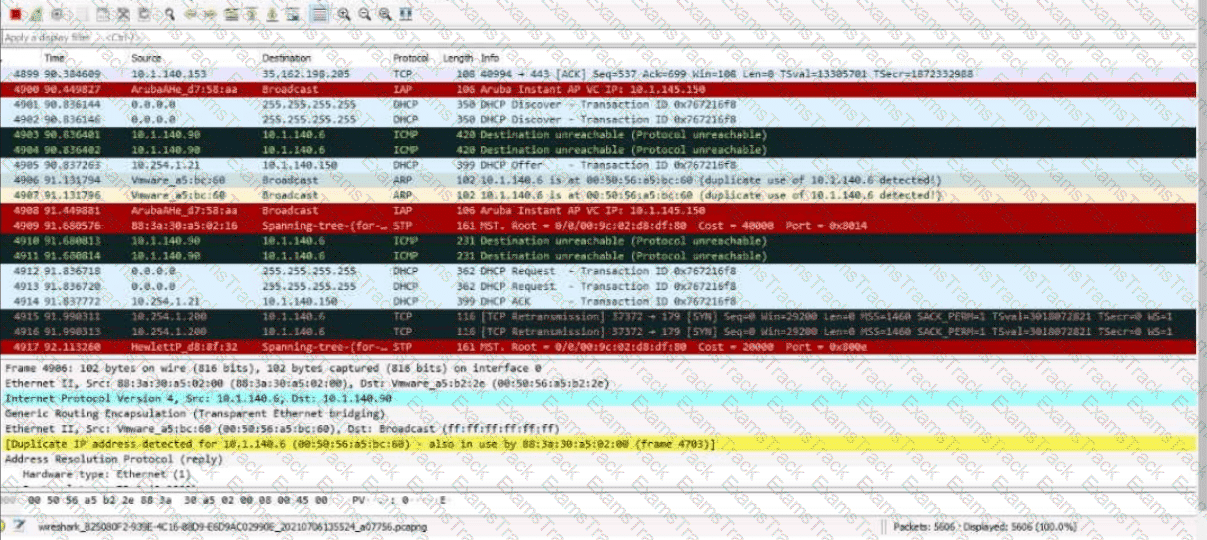
Refer to the Exhibit:

HPE7-A02 Question 2

These packets have been captured from VLAN 10. which supports clients that receive their IP addresses with DHCP.

What can you interpret from the packets that you see here?

These packets have been captured from VLAN 10, which supports clients that receive their IP addresses with DHCP. What can you interpret from the packets that you see here?

Options:
A.

Someone is possibly implementing a MAC spoofing attack to gain unauthorized access.

B.

The mirroring session that captured the packets was likely misconfigured and captured duplicate traffic.

C.

An admin has likely misconfigured two clients to use the same DHCP settings.

D.

Someone is possibly implementing an ARP poisoning and MITM attack.

Questions 3

You manage AOS-10 APs with HPE Aruba Networking Central. A role is configured on these APs with the following rules:

Allow UDP on port 67 to any destination

Allow any to network 10.1.6.0/23

Deny any to network 10.1.0.0/16 + log

Deny any to network 10.0.0.0/8

Allow any to any destination

You add this new rule immediately before rule 2:

Deny SSH to network 10.1.4.0/23 + denylist

What happens when a client assigned to this role sends SSH traffic to 10.1.11.42?

Options:
A.

The traffic is permitted.

B.

The traffic is dropped and logged.

C.

The traffic is dropped (without any logging or further action against the client).

D.

The traffic is dropped, and the client is denylisted.

Questions 4

You are setting up policy rules in HPE Aruba Networking SSE. You want to create a single rule that permits users in a particular user group to access multiple applications. What is an easy way to meet this need?

Options:
A.

Associate the applications directly with the IdP used to authenticate the users; choose any for the destination in the policy rule.

B.

Apply the same tag to the applications; select the tag as a destination in the policy rule.

C.

Place all the applications in the same connector zone; select that zone as a destination in the policy rule.

D.

Select the applications within a non-default web profile; select that profile in the policy rule.

Questions 5

You have installed an HPE Aruba Networking Network Analytic Engine (NAE) script on an AOS-CX switch to monitor a particular function.

Which additional step must you complete to start the monitoring?

Options:
A.

Reboot the switch.

B.

Enable NAE, which is disabled by default.

C.

Edit the script to define monitor parameters.

D.

Create an agent from the script.

Questions 6

You have enabled " rogue AP containment " in the Wireless IPS settings for a company’s HPE Aruba Networking APs. What form of containment does HPE Aruba Networking recommend?

Options:
A.

Wireless deauthentication only

B.

Wireless tarpit and wired containment

C.

Wireless tarpit only

D.

Wired containment

Questions 7

A company uses both HPE Aruba Networking ClearPass Policy Manager (CPPM) and HPE Aruba Networking ClearPass Device Insight (CPDI).

What is one way integrating the two solutions can help the company implement Zero Trust Security?

Options:
A.

CPPM can provide CPDI with custom device fingerprint definitions in order to enhance the company ' s total visibility.

B.

CPDI can provide CPPM with extra information about users ' identity; CPPM can then use that information to apply the correct identity-based enforcement.

C.

CPPM can inform CPDI that it has assigned a particular Aruba-User-Role to a client; CPDI can then use that information to reclassify the client.

D.

CPDI can use tags to inform CPPM that clients are using prohibited applications; CPPM can then tell the network infrastructure to quarantine those clients.

Questions 8

A company uses HPE Aruba Networking ClearPass Device Insight (CPDI) as the standalone application.

How does CPDI handle devices that it cannot classify with user rules, system rules, or MAC range classifiers?

Options:
A.

It uses a machine learning method to cluster similar devices together.

B.

It marks the devices as unknown and submits them to HPE Aruba Networking experts for classification.

C.

It marks the devices as generic and leaves them for admins to classify individually.

D.

It uses API calls to query integrated applications for more information about the devices.

Questions 9

You have created a Web-based Health Check Service that references a posture policy. You want the service to trigger a RADIUS change of authorization (CoA) when a client receives a Healthy or Quarantine posture. Where do you configure those rules?

Options:
A.

In a RADIUS enforcement policy

B.

In the Agents and Software Updates > OnGuard Settings

C.

In the posture policy

D.

In a WEBAUTH enforcement policy

Questions 10

Assume that an AOS-CX switch is already implementing DHCP snooping and ARP inspection successfully on several VLANs.

What should you do to help minimize disruption time if the switch reboots?

Options:
A.

Configure the switch to act as an ARP proxy.

B.

Create static IP-to-MAC bindings for the DHCP and DNS servers.

C.

Save the IP-to-MAC bindings to external storage.

D.

Configure the IP helper address on this switch, rather than a core routing switch.