Spring Sale Limited Time 70% Discount Offer - Ends in 0d 00h 00m 00s - Coupon code: 70track

Free Cisco 300-215 Practice Exam with Questions & Answers | Set: 3

Questions 21

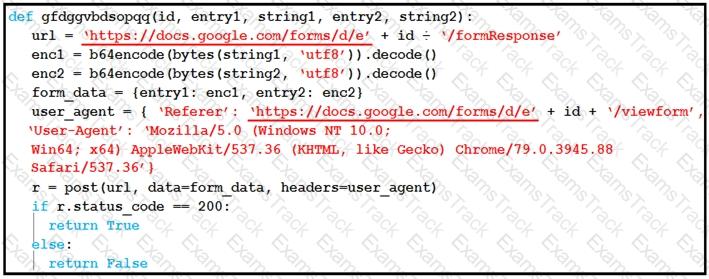
Refer to the exhibit.

300-215 Question 21

Which type of code is being used?

Options:
A.

Shell

B.

VBScript

C.

BASH

D.

Python

Cisco 300-215 Premium Access
Questions 22

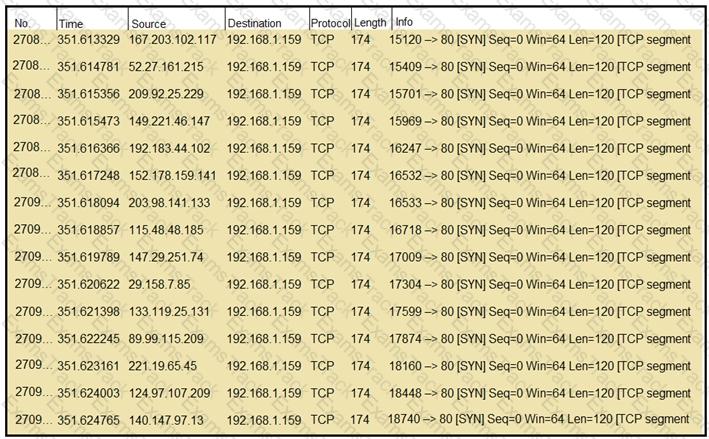
Refer to the exhibit.

300-215 Question 22

What should an engineer determine from this Wireshark capture of suspicious network traffic?

Options:
A.

There are signs of SYN flood attack, and the engineer should increase the backlog and recycle the oldest half-open TCP connections.

B.

There are signs of a malformed packet attack, and the engineer should limit the packet size and set a threshold of bytes as a countermeasure.

C.

There are signs of a DNS attack, and the engineer should hide the BIND version and restrict zone transfers as a countermeasure.

D.

There are signs of ARP spoofing, and the engineer should use Static ARP entries and IP address-to-MAC address mappings as a countermeasure.

Questions 23

An engineer is analyzing a ticket for an unexpected server shutdown and discovers that the web-server ran out of useable memory and crashed.

Which data is needed for further investigation?

Options:
A.

/var/log/access.log

B.

/var/log/messages.log

C.

/var/log/httpd/messages.log

D.

/var/log/httpd/access.log

Questions 24

What is the function of a disassembler?

Options:
A.

aids performing static malware analysis

B.

aids viewing and changing the running state

C.

aids transforming symbolic language into machine code

D.

aids defining breakpoints in program execution

Questions 25

A cybersecurity analyst must identify an unknown service causing high CPU on a Windows server. What tool should be used?

Options:
A.

Volatility to analyze memory dumps for forensic investigation

B.

Process Explorer from the Sysinternals Suite to monitor and examine active processes

C.

TCPdump to capture and analyze network packets

D.

SIFT (SANS Investigative Forensic Toolkit) for comprehensive digital forensics

Questions 26

A cybersecurity analyst is analyzing a complex set of threat intelligence data from internal and external sources. Among the data, they discover a series of indicators, including patterns of unusual network traffic, a sudden increase in failed login attempts, and multiple instances of suspicious file access on the company's internal servers. Additionally, an external threat feed highlights that threat actors are actively targeting organizations in the same industry using ransomware. Which action should the analyst recommend?

Options:
A.

Advise on monitoring the situation passively because network traffic anomalies are coincidental and unrelated to the ransomware threat.

B.

Propose isolation of affected systems and activating the incident response plan because the organization is likely under attack by the new ransomware strain.

C.

Advocate providing additional training on secure login practices because the increase in failed login attempts is likely a result of employee error.

D.

Notify of no requirement for immediate action because the suspicious file access incidents are normal operational activities and do not indicate an ongoing threat.

Questions 27

What are YARA rules based upon?

Options:
A.

binary patterns

B.

HTML code

C.

network artifacts

D.

IP addresses

Questions 28

An incident response team is recommending changes after analyzing a recent compromise in which:

    a large number of events and logs were involved;

    team members were not able to identify the anomalous behavior and escalate it in a timely manner;

    several network systems were affected as a result of the latency in detection;

    security engineers were able to mitigate the threat and bring systems back to a stable state; and

    the issue reoccurred shortly after and systems became unstable again because the correct information was not gathered during the initial identification phase.

Which two recommendations should be made for improving the incident response process? (Choose two.)

Options:
A.

Formalize reporting requirements and responsibilities to update management and internal stakeholders throughout the incident-handling process effectively.

B.

Improve the mitigation phase to ensure causes can be quickly identified, and systems returned to a functioning state.

C.

Implement an automated operation to pull systems events/logs and bring them into an organizational context.

D.

Allocate additional resources for the containment phase to stabilize systems in a timely manner and reduce an attack’s breadth.

E.

Modify the incident handling playbook and checklist to ensure alignment and agreement on roles, responsibilities, and steps before an incident occurs.

Questions 29

An organization recovered from a recent ransomware outbreak that resulted in significant business damage. Leadership requested a report that identifies the problems that triggered the incident and the security team’s approach to address these problems to prevent a reoccurrence. Which components of the incident should an engineer analyze first for this report?

Options:
A.

impact and flow

B.

cause and effect

C.

risk and RPN

D.

motive and factors

Questions 30

An incident response analyst is preparing to scan memory using a YARA rule. How is this task completed?

Options:
A.

deobfuscation

B.

XML injection

C.

string matching

D.

data diddling

Exam Code: 300-215
Certification Provider: Cisco
Exam Name: Conducting Forensic Analysis and Incident Response Using Cisco CyberOps Technologies (CBRFIR)
Last Update: Apr 7, 2026
Questions: 131