Pre-Summer Sale Limited Time 70% Discount Offer - Ends in 0d 00h 00m 00s - Coupon code: 70track

Free APMG-International AgilePM-Practitioner Practice Exam with Questions & Answers | Set: 4

Questions 31

The project is now in the second week of Timebox C. This is the final Timebox of Project Increment 1 and is scheduled to take one month. The plan is to open

Hoy Hall to the public at the end of this Increment. A Must Have requirement of Timebox C is the implementation of a hotel reservation system.

At the Daily Stand-up, the Software Developer working on the reservation system reported that the framework for the system is now complete and ready for content.

However, this work cannot progress further due to a disagreement over the content. The Marketing Director insists the system is to hold professional photos and video

tours of the facilities and grounds. These require a lot of storage space and regular updates. The IT Operations Manager insists the system is to take less than 5GB of

storage space on the company server and require minimal maintenance.

The Team Leader has arranged a Facilitated Workshop to discuss the content and agree the way forward.

Remember to limit your answers to the number of selections requested in each question.

Which 2 individuals should the Facilitator invite to participate in the Workshop?

Options:
A.

Chief Executive (Steering Group)

B.

Representative for Earth Excavations (Solution Developer)

C.

Representative for Timber Tigers (Solution Developer)

D.

IT Operations Manager (Solution Development Team)

E.

Marketing Director (Business Visionary)

APMG-International AgilePM-Practitioner Premium Access
Questions 32

Who is responsible for approving that the change in priority of the requirement for a secondary exit from the upstairs of the building accurately reflects the scope of the

project in the Prioritised Requirements List?

Options:
A.

Marketing Director, in the role of Business Visionary.

B.

Project Manager and Solution Development Team.

C.

Project Manager and Architect, in the role of Technical Co-ordinator.

D.

Architecture Angels ' Senior Management Team.

Questions 33

Using the Project Scenario, answer the following question about the activities in the Agile project lifecycle.

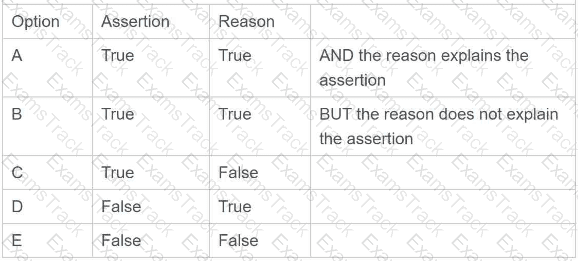
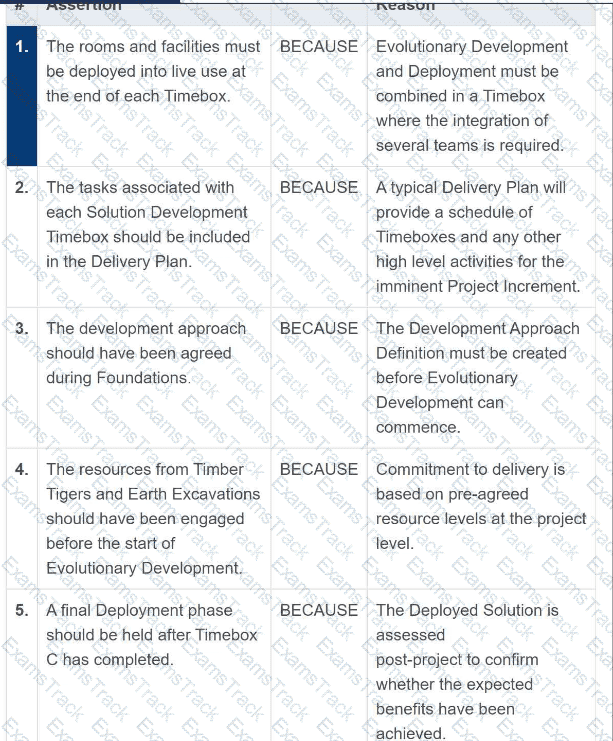
Lines 1 to 5 in the table below consist of an assertion statement and a reason statement. For each line identify the appropriate option, from options A to E, that applies. Each option can be used once, more than once or not at all.
AgilePM-Practitioner Question 33

Assertion:-

1. The rooms and facilities must be deployed into live use at the end of each Timebox.

BECAUSE

Reason:

Evolutionary Development and Deployment must be combined in a Timebox where the integration of several teams is required.

2. The tasks associated with each Solution Development Timebox should be included

in the Delivery Plan.

BECAUSE

Reason:

A typical Delivery Plan will provide a schedule of Timeboxes and any other high level activities for the imminent Project Increment.

3. The development approach should have been agreed during Foundations.

BECAUSE

Reason:

The Development Approach Definition must be created before Evolutionary

Development can commence.

4. The resources from Timber Tigers and Earth Excavations should have been engaged

before the start of Evolutionary Development.

BECAUSE

Reason:

Commitment to delivery is based on pre-agreed resource levels at the project level.

5. A final Deployment phase should be held after Timebox C has completed.

BECAUSE

Reason:

The Deployed Solution is assessed post-project to confirm whether the expected benefits have been

achieved.
AgilePM-Practitioner Question 33

AgilePM-Practitioner Question 33

Options:
Questions 34

Answer the following questions about the acceptance criteria within the project.

Decide whether the approach to setting and using acceptance criteria has been applied appropriately and select the response that supports your decision.

When specifying high-level prioritised requirements during Foundations, the Business Visionary has suggested that acceptance criteria for the requirement to " temporarily weatherproof the roof " should NOT be set until Solution Development Timebox A.

Is this an appropriate approach to setting high-level acceptance criteria?

Options:
A.

Yes, because the Local Planning Authority Officer will set the acceptance criteria.

B.

Yes, because acceptance criteria are NOT set before the Timeboxed work is started.

C.

No, because by the end of Foundations the quality expectations and overall acceptance criteria for at least the first increment should have been set, and high-level acceptance criteria set for later increments.

D.

No, because a Review Session should have been scheduled during Feasibility to enable the Solution Development Team to validate their understanding of the Local Planning Authority Officer ' s expectations.

Questions 35

Which 2 actions should the Workshop Facilitator take when preparing for the workshop?

Options:
A.

Ask the Software Developer to provide an estimate of how much storage space would be required to hold photos and videos.

B.

Invite the Marketing Director to create a summary of the content they believe the system should hold and why.

C.

Assign ownership of the workshop to the Software Developer.

D.

Ask the IT Operations Manager to prepare the agenda for the workshop.

E.

Research other hotel reservation systems to form an opinion on what the content should be.

Questions 36

(Which 2 statements describe appropriate team behaviour for effective risk management?)

Options:
A.

Team members should adopt a collaborative mindset, sharing responsibility for identifying and mitigating risks.

B.

Hira should have sole responsibility for managing all risks with clear accountability.

C.

Developers should resolve all risks collaboratively and promptly without escalation.

D.

Sukra Aroon should handle all technical risks independently to ensure the solution is fit for purpose.

E.

Risk management should be proactive and part of daily activities, not a separate process.

Questions 37

What action should the Project Manager take regarding the remaining windows?

Options:
A.

All requirements that have not been met are automatically carried over to the next increment.

B.

Extend the time allocated to Timebox C, to allow time to complete these.

C.

Insist that all available resources within the Solution Development Team are redirected to this work over the remaining two days.

D.

Decompose the individual elements of work to be completed on the windows and reprioritise them to meet the Minimum Usable Subset.

Questions 38

What action should the Project Manager take to plan the deployment activities?

Options:
A.

Prepare a Timebox Plan for the next Development Timebox.

B.

Check the Delivery Plan for deployment activities and update as required.

C.

Create a plan of activities to deploy the solution at the end of Timebox C.

D.

Update the Timebox Plan for Timebox C with the activities required to deploy the solution.

Questions 39

Which 2 statements describe the appropriate application of Agile Project Management when developing the Prioritised Requirements List during Feasibility?

Options:
A.

Details of which areas will require seeding in order to become lawn, and which are to become planted borders, should be captured.

B.

The re-laying of the driveway and a landscaping solution should be listed as Must Have requirements.

C.

The scope of the project should be agreed before moving into the Foundations phase.

D.

The responsibility for setting the priority of each of the requirements identified should be assigned to the Project Manager.

E.

Regulatory obligations associated with the redevelopment of Hoy Hall should be recorded as Must Have requirements.

Questions 40

(Hira discovers that material costs are exceeding initial supplier estimates, leading to a 5–10% budget overspend.)

Options:
A.

Approach-based, because cost estimates weren ' t properly validated or reviewed in the Foundations phase leading to inaccuracies.

B.

Approach-based, because Agile avoids detailed early planning to focus on iterative development, making estimates vague.

C.

VUCA-based, because internal constraints prevent Delivery Teams adjusting budgets to external changes.

D.

VUCA-based, because market fluctuations in material costs were unpredictable and could not be anticipated during planning.