examstrack logo

A patient with three thyroid nodules is seen for an FNA biopsy. Using ultrasonic guidance, the provider inserts a 25-gauge needle into each nodule. Nodular tissue is aspirated and sent to pathology.
What CPT® coding reported?
Which one of the following is correct to report an intermediate repair code (12031–12037)?
A 26-year-old male presents with a deep laceration from a kitchen knife to his right hand. The surgeon washes the open wound with sterile saline. Clamps are applied. The provider cleans the
vessel and prepares the edges of thee wound. She then repairs the bleeding vessel with sutures. The clamps are removed and the provider uses a Doppler probe to check the blood flow pattern
through the repaired vessel.
What CPT® code is reported?
A driver loses control of a vehicle and crashes into a guardrail on the side of the highway. The patient sustains a fracture of the anterior fossa cranial base. Imaging confirms Involvement of the sphenoid sinus, but no cerebrospinal fluid (CSF) leak is identified. The patient undergoes a surgical nasal sinus endoscopy with sphenoidotomy lo evaluate and treat the sinus injury. No CSF leak repair is performed.
What is the correct procedure and diagnosis coding combination to report this service?
In medical terminology, suffixes indicate the procedure, condition, disorder, or disease.
Which term contains a suffix?
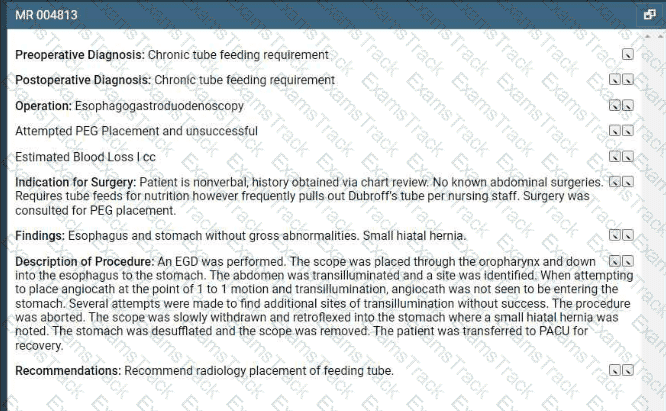
Refer to the supplemental information when answering this question:
View MR 004813
What CPT® and ICD-10-CM codes are reported?
The small intestine is divided into three parts. Which one of the following is NOT part of the small intestine?
This 27-year-old male has morbid obesity with a BMI of 45 due to a high calorie diet. He has decided to have an open Roux-en-Y gastric bypass. The patient is brought to the operating room and placed in supine position. A midline abdominal incision is made. The stomach is mobilized, and the proximal stomach is divided and stapled creating a small proximal pouch in continuity with the esophagus. A short limb of the proximal bowel of 155 cm is divided. It is brought up and anastomosed to the gastric pouch. The other end of the divided bowel is connected back into the distal small bowel to the short limb ' s gastric anastomosis to restore intestinal continuity. The abdominal incision is closed.
What are the procedure and diagnosis codes for this encounter?
A temporary steroid-releasing sinus implant is placed in the ethmoid sinus.
What HCPCS Level II code is reported?
A 42-year-old male is diagnosed with a left renal mass. Patient is placed under general anesthesia and in prone position. A periumbilical incision is made and a trocar inserted. A laparoscope is inserted and advanced to the operative site. The left kidney is removed, along with part of the left ureter. What CPT® code is reported for this procedure?
|
PDF + Testing Engine
|
|---|
|
$49.5 |
|
Testing Engine
|
|---|
|
$37.5 |
|
PDF (Q&A)
|
|---|
|
$31.5 |
AAPC Free Exams |
|---|

|

Copyright © 2026 Examstrack. All Rights Reserved

TESTED 15 Oct 2026
