examstrack logo

An administrator notices alerts triggering IOPS and Disk Throughput storage performance problems in the Fibre Channel datastore in a VMware Cloud Foundation (VCF) Workload Domain.
What can the administrator review to identify which Virtual Machines (VMs) may be experiencing storage IOPS and disk throughput performance issues?
A storage architect is designing a vSAN solution that enforces quotas and Access Based Enumeration (ABE) on all file shares.
What should the architect highlight as a design decision implication?
A storage architect is designing a VMware Cloud Foundation (VCF) Workload Domain with the following requirements:
• vSAN File Services hosting multiple file shares.
• Each department requires distinct protection levels and placement rules.
Which option satisfies the requirements?
An administrator is managing a local vSAN 3-node cluster running the Express Storage Architecture (ESA) as part of a VMware
Cloud Foundation (VCF) Workload Domain.
The following parameters apply at the cluster level:
• HA is enabled
• Reserved Failover Capacity = 25% for both CPU and Memory
The administrator is tasked with configuring the VSAN storage policy so it will tolerate the maximum number of failures.
What two protection levels can the administrator configure? (Choose two.)
An administrator is deploying a vSphere Supervisor Cluster on a VMware Cloud Foundation (VCF) Workload Domain that uses NFS storage. As part of the configuration, the administrator must define separate storage policies for container images, ephemeral volumes, and persistent volumes within the vSphere Namespace.
The solution must align with vSphere Storage Policy Based Management (SPBM) and Broadcom TechDocs recommendations for supported Supervisor configurations.
Which configuration meets these requirements?
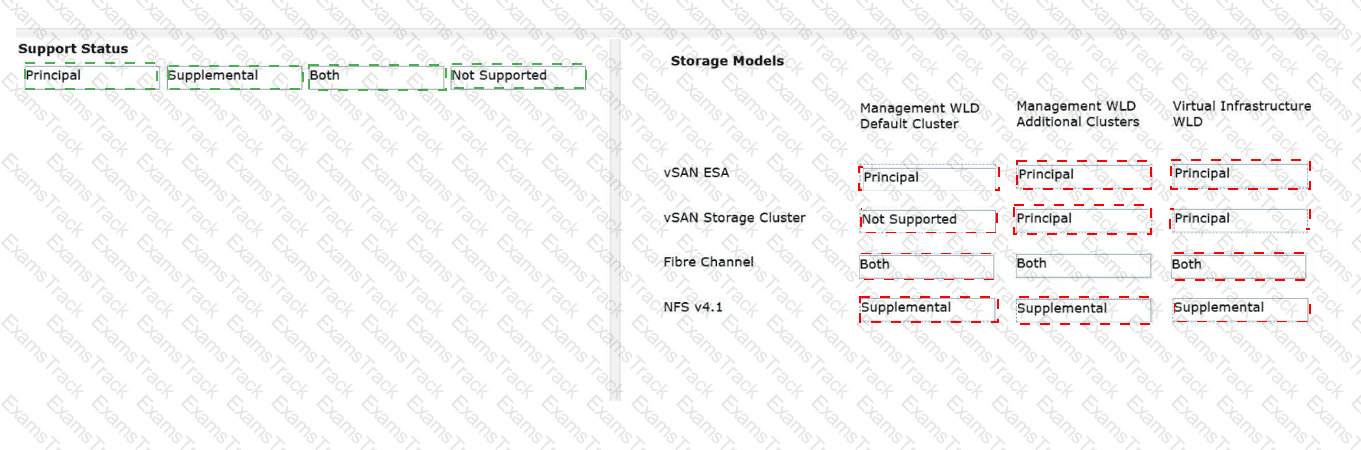
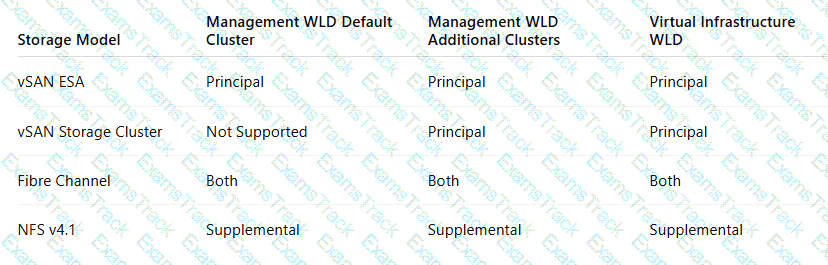
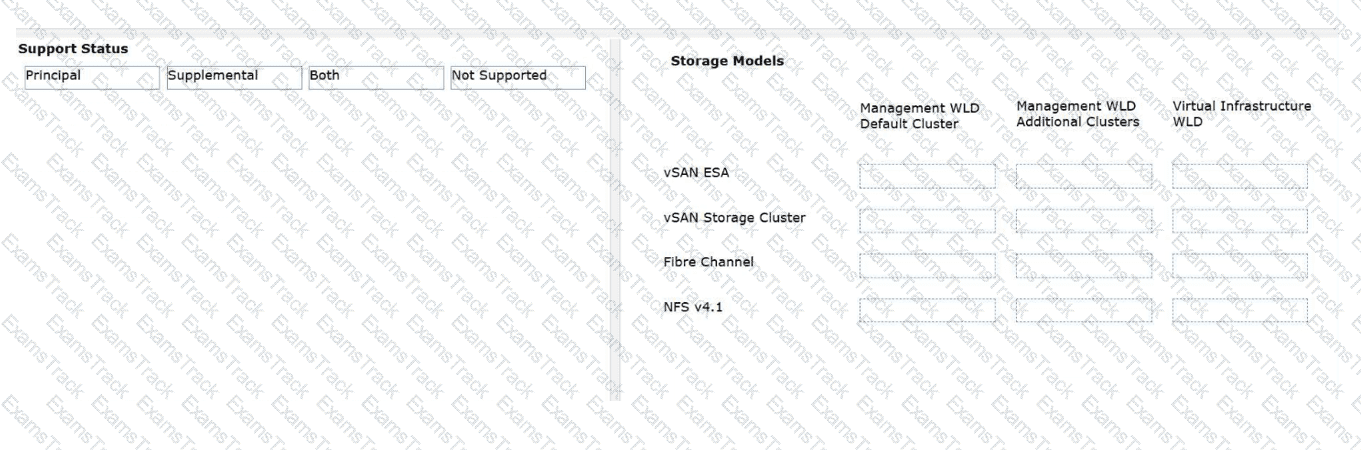
An architect is describing the for a client which storage platforms are supported in which types of Domains for automated installation in VMware Cloud Foundation (VCF) Private Clouds.
Drag and drop the Support Status of each storage model on the left to each type of Workload Domain on the right.
An architect is designing a vSAN Original Storage Architecture (OSA) cluster for a VMware Cloud Foundation (VCF) Management Domain. The following details were made available:
• 12 hosts, each host with: 3 x 800 GB NVMe (cache) and 12 x 3.84 TB SAS SSD (capacity).
• Planned configuration: 3 disk groups per host (1 NVMe + 4 SSD each).
• Storage policy: FTT = 2 (RAID-1), Checksum. Deduplication and Compression are Enabled.
• Network: 25 GbE dedicated vSAN network fabric, properly configured for jumbo frames.
After deployment and loading test data to 70% capacity, the operations team reported extended resync times when two hosts are placed into maintenance mode with “Ensure Accessibility” selected and no hardware or network bottlenecks were detected.
How can the administrator explain the observed behavior?
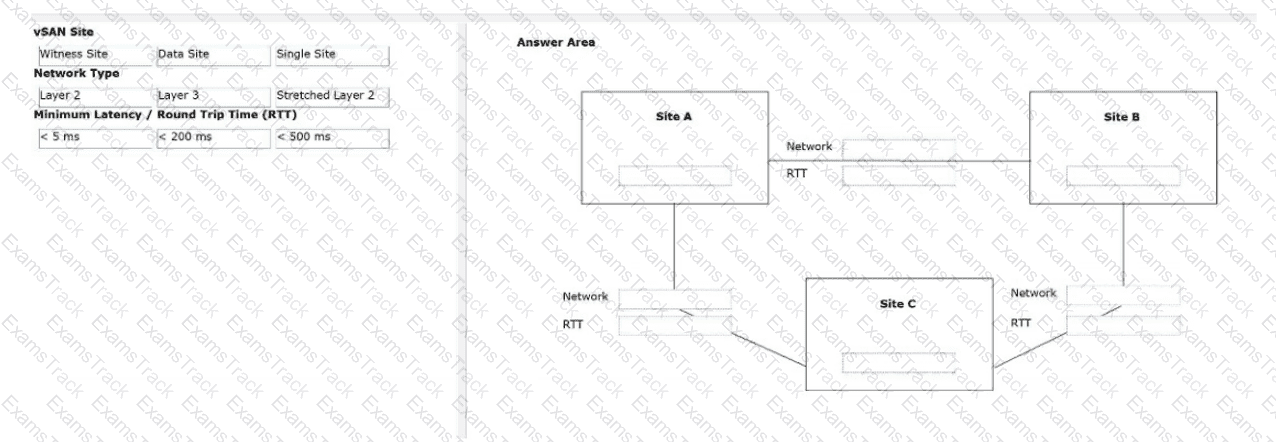
An administrator is responsible for managing a VMware Cloud Foundation (VCF) Private Cloud.
The following information has been provided about the environment:
• There are 3 customer datacenters, Site A, Site B and Site C.
• The datacenter at Site A runs all Production Services.
• The datacenter at Site B has reached capacity and there is no space for additional physical hardware.
• The datacenter at Site C has been commissioned to replace Site B, because there is more rack space and power capacity to cater for future demand.
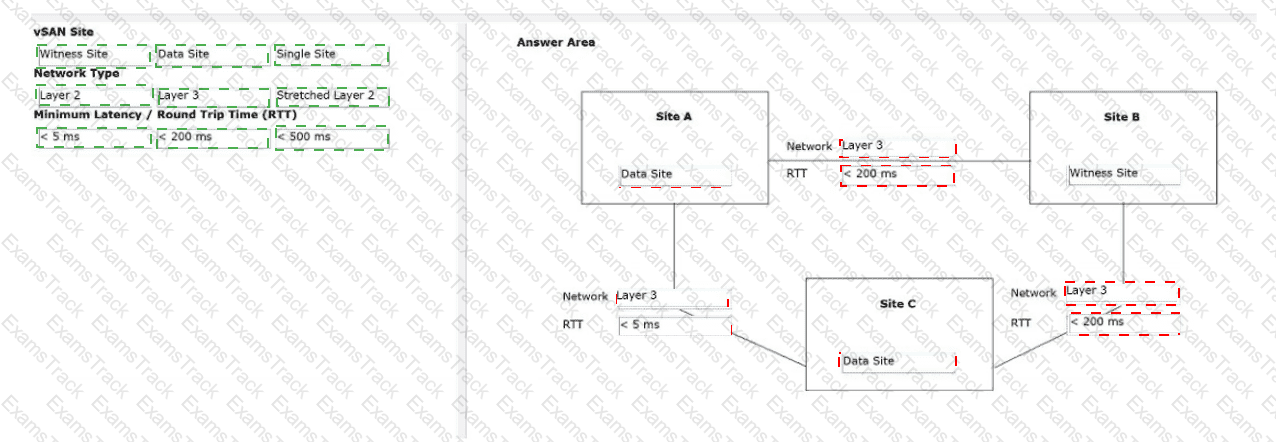
The administrator has been tasked with identifying the networking requirements for a new VMware vSAN Stretched Cluster with the following requirements:
• The solution will deploy a total of 10 new ESX host servers to create a VMware vSAN Stretched Cluster.
• The solution must deploy appropriate networking to ensure minimal disruption from issues with Spanning Tree Protocol (STP).
Drag and drop the correct vSAN Site Type, Networking Type and Round Trip Latency (RTT) within the boxes provided to complete the high-level diagram.
A customer attaches an external Fibre Channel (FC) VMFS datastore to a VMware Cloud Foundation (VCF) workload domain for backup staging. The administrator must confirm that the datastore is visible to all hosts, and that path and device health alarms will trigger should a fabric link or path fail.
Which action should the administrator take to verify this?
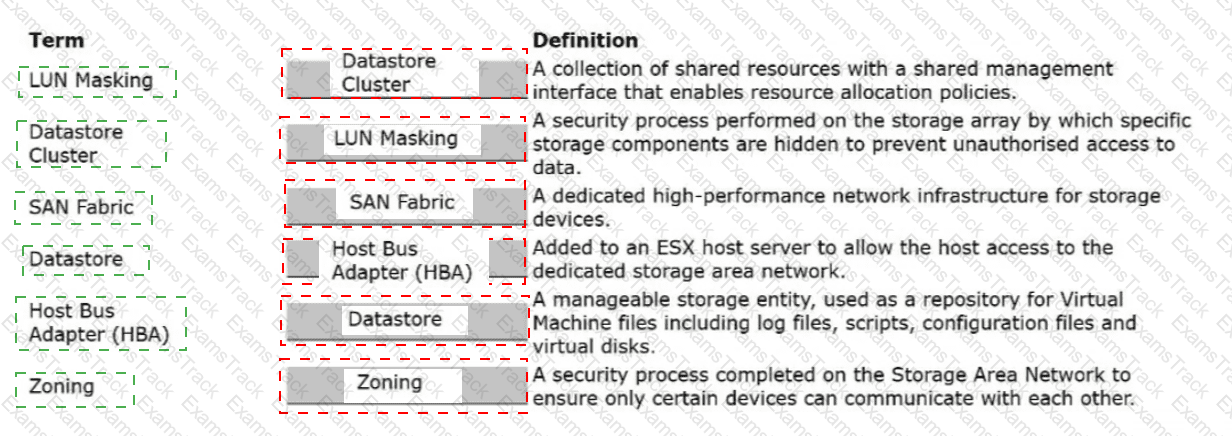
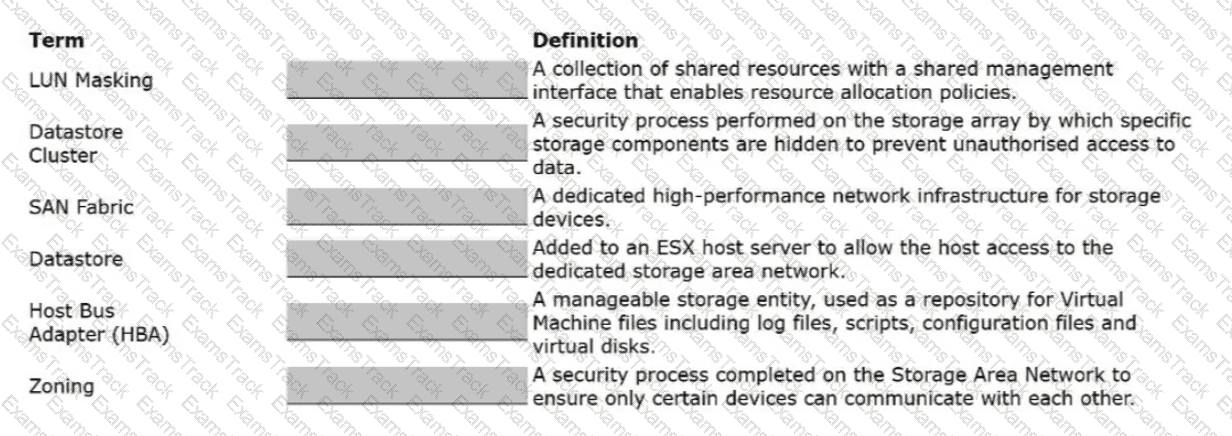
An administrator is responsible for a VMware Cloud Foundation (VCF) Private Cloud and has been tasked with identifying and explaining the different Fibre Channel (FC) Storage Area Network (SAN) components within a VCF Workload Domain cluster.
Drag and drop the correct Term onto its matching Definition.
|
PDF + Testing Engine
|
|---|
|
$49.5 |
|
Testing Engine
|
|---|
|
$37.5 |
|
PDF (Q&A)
|
|---|
|
$31.5 |
VMware Free Exams |
|---|

|

Copyright © 2026 Examstrack. All Rights Reserved

TESTED 06 Oct 2026