examstrack logo

An administrator is tasked with designing a highly available vSAN ESA two-node cluster for a remote VMware Cloud Foundation (VCF) workload domain. The solution should be able to survive the failure of any disk group in addition to a host failure without data loss.
What is the minimum total number of nested fault domains required for the design?
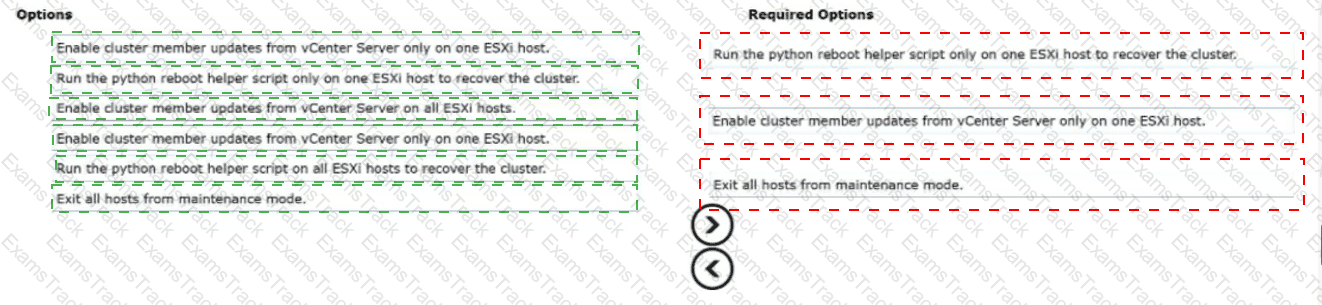
After a planned power outage, an administrator decided to restart the vSAN cluster manually.
Drag and drop the three correct options from the Options list on the left and place them into the Required Options on the right in any order. (Choose three.)

To respect the application criticality, an administrator is configuring the Recovery Priority of protected Virtual Machines (VMs).
What does VMware Live Site Recovery leverage to mark a recovery priority as completed?
A multinational corporation is deploying a VMware Cloud Foundation (VCF) Workload Domain cluster to host tier-1 business applications with the following requirements:
• Deliver high performance to all workloads.
• Integration with automated VM placement.
• Reuse of existing infrastructure including multiple Fibre Channel (FC) arrays partitioned by business unit.
• The storage architecture must avoid vSAN.
• Meet organizational separation requirements.
Which two deployment approaches meet these requirements? (Choose two.)
An administrator has successfully deployed a vSAN Stretched Cluster and needs to ensure that any Virtual Machines (VMs) that are created are placed in the appropriate site.
Which two steps are required to complete the task? (Choose two.)
A financial organization successfully deployed a new Workload Domain in VMware Cloud Foundation (VCF) using NFS storage. All ESX hosts are commissioned and connected to the same storage network. The system administrator is tasked to configure a new NFS datastore in the existing cluster.
Which two steps are correct? (Choose two.)
An administrator just built a new workload domain including a vSAN ESA cluster. The architecture design included the use of memory tiering and a specific smaller NVMe device has been installed in each ESX host for this purpose.
When looking in the vSphere UI, the administrator notices that the device intended to be used for memory tiering has been claimed by vSAN.
What action should be taken on each host to achieve the desired configuration?
An administrator is tasked with enabling vSAN Data Protection.
Which action is required to enable vSAN Data Protection?
An administrator is monitoring a vSAN ESA backed workload domain that is dedicated for running AI inferencing. When the administrator navigates to the Storage Performance dashboard in VMware Cloud Foundation Operations, the performance dashboard shows:
• High backend write latency ( > 8 ms)
• Low read latency ( < 1 ms)
• Normal network throughput
• Disk Group Health = Green
Based on the readings above, what would be the explanation?
An administrator attempts to enable vSAN Data-at-Rest Encryption on a cluster but receives the following error message:
“Key provider < vSphere Native Key Provider > is not available on host.”
The administrator configured the vSphere Native Key Provider (NKP) using the default settings.
What should the administrator validate before enabling vSAN Data-at-Rest Encryption?
|
PDF + Testing Engine
|
|---|
|
$49.5 |
|
Testing Engine
|
|---|
|
$37.5 |
|
PDF (Q&A)
|
|---|
|
$31.5 |
VMware Free Exams |
|---|

|

Copyright © 2026 Examstrack. All Rights Reserved

TESTED 06 Oct 2026