examstrack logo

During a third-party audit of a pharmaceutical company (CD9000) having seven COVID-19 vaccination stations in various terminals at a major international airport, you, as audit team leader, interview the CD9000’s Supervisor in Terminal 2.
You: “I see that the temperature of the freezer where you keep the vaccines reads -17.2 °C. I understood that the upper limit for storing vaccines was < -18.0 °C.”
Supervisor: “Yes, I know this. But do not worry, the people who calibrated the temperature sensors said that they have an uncertainty of +/- 1 °C. So, we ensure that the reading remains between -17 °C and -19 °C.”
From the following, select two options that would form your next step.
An audit team of three people is conducting a Stage 2 audit to ISO 9001 of an engineering organisation which manufactures sacrificial anodes for the
oil and gas industry in marine environments. These are aluminium products designed to prevent corrosion of submerged steel structures. As one of
the auditors, you find that the organisation has shipped anodes for Project DK in the Gulf of Mexico before the galvanic efficiency test results for the
anodes have been fully analysed and reported as required by the customer. The Quality Manager explains that the Managing Director authorised the
release of the anodes to avoid late delivery as penalties would be imposed. The customer was not informed since the tests rarely fall below the
required efficiency. You raise a nonconformity against clause 8.6 of ISO 9001.
During the audit team meeting in preparation for the Closing meeting, the second auditor disagreed with the clause of ISO 9001 selected for the
above nonconformity. He thinks it should be clause 9.1.1.
Choose three options for how the audit team leader should best respond to the situation:
When should the certification body accept the audit?
Scenario 7: POLKA is a car manufacturing company based in Stockholm, Sweden. The company has around 14,000 employees working in different sectors which help with the design, painting, assembling, and test drives of the final product. The company is widely known for its qualitative products and affordable prices. In order to retain their reputation, POLKA implemented a quality management system (QMS) based on ISO 9001.
Before applying for certification, the company decided to conduct an internal audit to check whether there are any nonconformities in their QMS and if the requirements of ISO 9001 are being fulfilled. The top management appointed Sean, the internal auditor, as the team leader of the internal audit team. Sean required from the top management to have unrestricted access to the employees and executives of POLKA and to the documented information. Furthermore, Sean required to establish a team with a large number of auditors, considering the size and the complexity of the organization. The top management of POLKA agreed with Sean ' s requirements.
The top management, in cooperation with Sean, assigned 10 more employees to the audit team. Following that. Sean planned the audit activities and assigned the roles and responsibilities to each auditor. They began by interviewing employees of different manufacturing departments to check whether they are aware of the process of the QMS implementation. While conducting these activities, one of the auditors asked Sean for permission to audit the department in which he worked on a daily basis, as he was very familiar with the processes of the department.
Along the way, the teams findings showed that the staff were trained, documented information was updated, and the QMS fulfilled the requirements of ISO 9001. The internal audit took three weeks to complete, and on the last week the audit team held a final meeting
The team shared their results and together drafted the audit report This report was submitted to the top management of the company. The report was maintained as documented information, and was available to the relevant interested parties.
Based on the scenario above, answer the following question:
Ten employees of POLKA were part of the audit team that conducted the internal audit. Is this acceptable?
You are leading a Stage 2 certification audit of a multi-site organisation and have received the audit schedule below;
Head Office and Site 1 – Day 1
Site 2 (150 km from HQ) – Days 2 and 3
During Day 1 of the audit, the client informs you that the laboratory at Site 2 has been closed for decontamination due to a serious outbreak of an infectious disease among workers. In Site 2, all other functions could be audited as planned.
As the audit team leader, what would you do?
Choose the best acceptable action you could take:
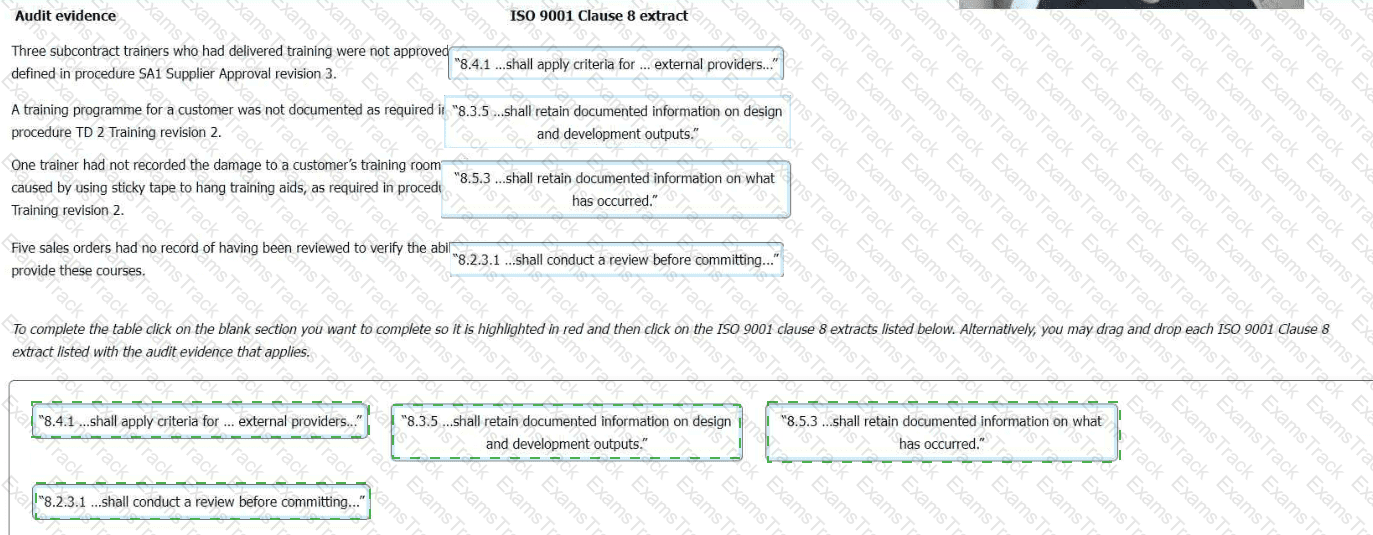
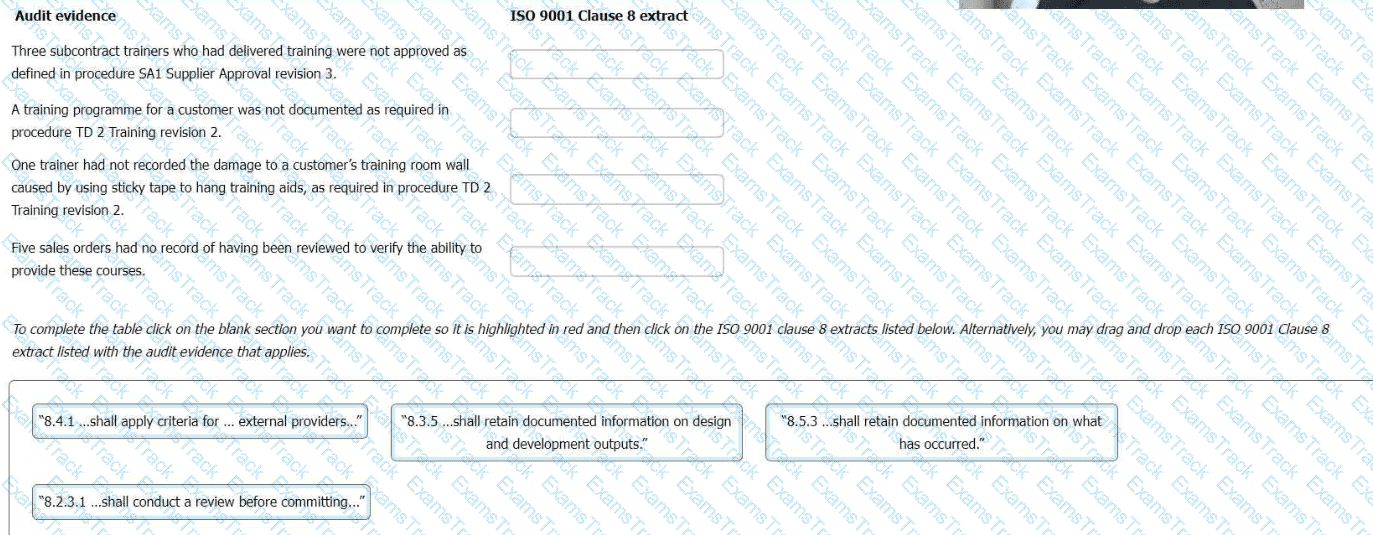
You are conducting an audit at an organisation seeking certification to ISO 9001 for the first time. The organisation offers health and safety training to customers. Training courses are offered either as open courses, delivered at a public venue, or online, or as courses that are tailored to meet specific requirements. The business operates from a single office and those who deliver the training are either full-time employees or subcontractors.
You have gathered audit evidence as outlined below. Match the ISO 9001 Clause 8 extract to the audit evidence.
The following actions need to be carried out during a third-party audit planning stage. Which two actions correspond to the individual(s) managing the audit program before the involvement of the audit team leader’
You work as an external quality consultant for an organisation, “ABC”, which provides packaged food to the public. You are asked to lead a team (you as the leader and two other auditors) to audit an external provider, “XYZ”, which provides packaging materials to “ABC”. It is 4 pm, and the closing meeting was scheduled for 5 pm.
You, as the audit team leader, audited Top Management. You explain to the audit team that you identified two non-conformities:
a. There is no documented information on the results of Top Management Reviews, as required in clause 9.3 of ISO 9001:2015.
b. There is no evidence of Top Management commitment as required in clause 5.1 of ISO 9001:2015 (e.g., not ensuring the availability of resources to operate the QMS, not ensuring the establishment of objectives).
All agreed to present these two non-conformities, graded as major.
As the audit team leader, select the best option on how to handle the closing meeting.
You are preparing an audit plan for a third-party ISO 9001 audit of organisation ABC that extracts lithium from mines in Bolivia.
ABC’s head office is in Lima, Peru, and it outsources all processes related to Production, Maintenance, Procurement and Human Resources to local Bolivian companies. ABC personnel manage in Bolivia only the Planning function.
Your plan starts in Lima, then you decide to go to Bolivia and fly back to Lima to audit the Quality Function and Top Management and conduct the closing meeting.
What would be your best decision when planning the audit in Bolivia?
Will the auditee be subject to an audit follow-up if a minor nonconformity has been reported by the audit team leader in the audit conclusions?
|
PDF + Testing Engine
|
|---|
|
$49.5 |
|
Testing Engine
|
|---|
|
$37.5 |
|
PDF (Q&A)
|
|---|
|
$31.5 |
PECB Free Exams |
|---|

|

Copyright © 2026 Examstrack. All Rights Reserved

TESTED 12 Oct 2026