examstrack logo

You have an Azure subscription named Sub1 that contains an Azure
• a registered MLflow model named Model1
• an online endpoint named Endpoint1
Outbound network connectivity from Endpointl is blocked. You need to deploy ModeM to Endpointl. What should you do first?
You manage an Azure Machine Learning workspace. You have an environment for training jobs which uses an existing Docker image.
A new version of the Docker image is available.
You need to use the latest version of the Docker image for the environment configuration by using the Azure Machine Learning SDK v2.
What should you do?
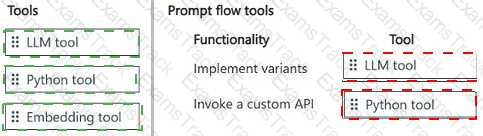
You develop a Prompt flow in Microsoft Foundry project.
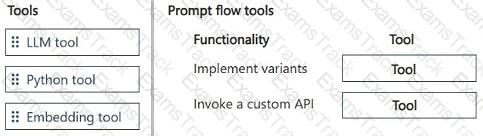
You plan to use variants and invoke a custom API in the flow.
You need to add tools to the flow that will implement the planned functionality. Your solution must minimize development efforts.
Which tools should you use? To answer, move the appropriate tools to the correct functionalities. You may use each tool once, more than once, or not at all. You may need to move the split bar between panes or scroll to view content.
NOTE: Each correct selection is worth one point.
A company ' s platform engineers manage the resource settings and governance of Microsoft Foundry.
Developers must be able to create and update project assets but must not be able to change resource-level configurations.
You need to enforce least privilege access for the engineers and developers.
Which two actions should you perform? Each correct answer presents part of the solution. NOTE: Each correct selection is worth one point. Choose two.
An organization provisions Azure Machine learning workspaces for development, test, and production environments.
Each environment must be deployed consistently and updated through source control. The deployment process must be automated repeatable. and auditable. You need to deploy Azure Machine Learning resources in a consistent and controlled manner.
Solution: Clone an existing Azure Machine I earning workspace to create additional environments.
Does the solution meet the goal?
You create an MLflow model
You must deploy the model to Azure Machine Learning for batch inference.
You need to create the batch deployment.
Which two components should you use? Each correct answer presents a complete solution.
NOTE: Each correct selection is worth one point
A data science team plans to evaluate multiple hyperparameter values automatically while training a model in Azure Machine Learning.
The tuning process must run multiple training trials without manually modifying the training script for each run.
You need to automate hyperparameter tuning for the training job.
What should you do?
Note: This question is part of a series of questions that present the same scenario. Each question in the series contains a unique solution that might meet the stated goals.
You have an Azure Machine Learning workspace. You connect to a terminal session from the Notebooks page in Azure Machine Learning studio.
You plan to add a new Jupyter kernel that will be accessible from the same terminal session.
You need to perform the task that must be completed before you can add the new kernel.
Solution: Create an environment.
Does the solution meet the goal?
Note: This question is part of a series of questions that present the same scenario. Each question in the series contains a unique solution that might meet the stated goals. Some question sets might have more than one correct solution, while others might not have a correct solution.
After you answer a question in this section, you will NOT be able to return to it. As a result, these questions will not appear on the review screen.
You work in Microsoft Foundry with a prompt flow.
You must manually evaluate prompts and compare results across prompt variants.
You need to capture the inputs, outputs, token usage, and latencies for each flow run for the evaluation.
Solution: Use the prompt flow SDK to enable tracing for the flow before executing runs. Then run the flow to generate traceable results.
Does the solution meet the goal?
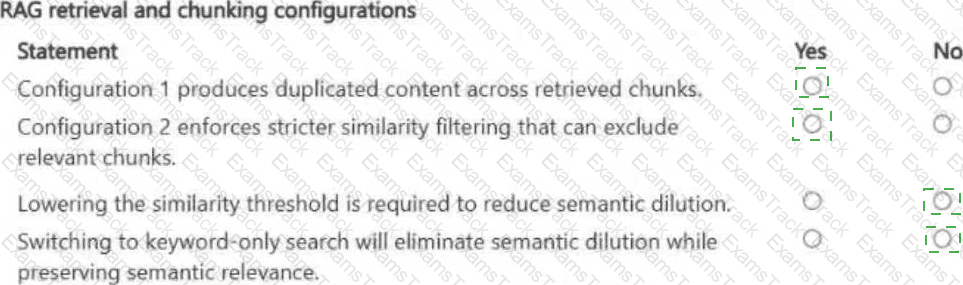
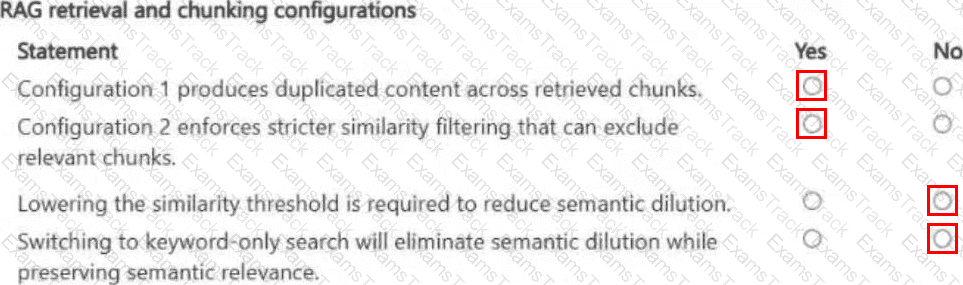
You manage a Retrieval-Augmented Generation (RAG) system that retrieves internal policy documents from a vector index.
Recent analysis shows that:
Retrieved results frequently include duplicated content from the same document.
Retrieved chunks sometimes span unrelated policy sections.
You review the following retrieval and ingestion configurations:
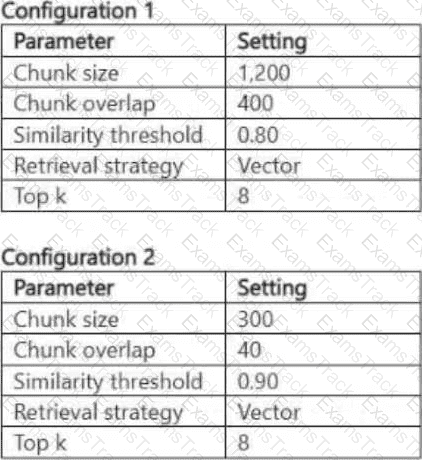
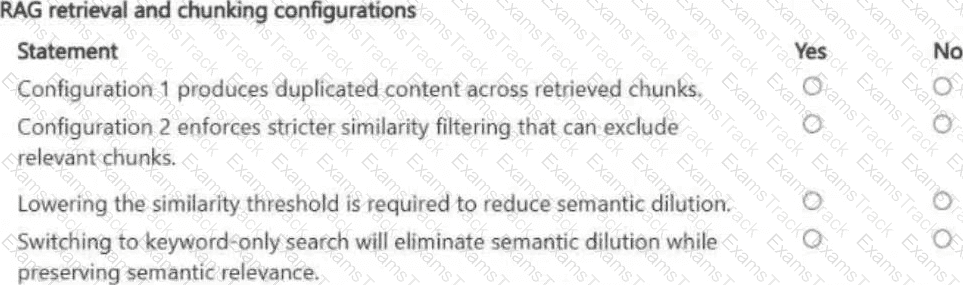
You need to reduce duplicated retrieval results and improve chunk relevance across policy sections.
For each of the following statements, select Yes if the statement is true. Otherwise, select No. NOTE: Each correct selection is worth one point.
|
PDF + Testing Engine
|
|---|
|
$45 |
|
Testing Engine
|
|---|
|
$35 |
|
PDF (Q&A)
|
|---|
|
$30 |
Microsoft Free Exams |
|---|

|

Copyright © 2026 Examstrack. All Rights Reserved

TESTED 20 Nov 2026