examstrack logo

It has been identified that the client’s existing network must retransmit packets because of possible hardware or configuration issues. Hardware configuration and transport reliability will need to be reviewed before completing the new design.
How should this phenomenon be classified?
Original exhibit — Question 47
Refer to the exhibit.
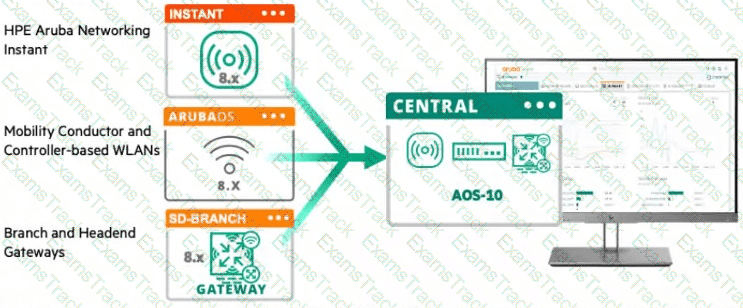
As part of a migration plan from HPE Aruba Networking AOS-8 to AOS-10, which are valid technical requirements for the proposed deployment?
Choose two.
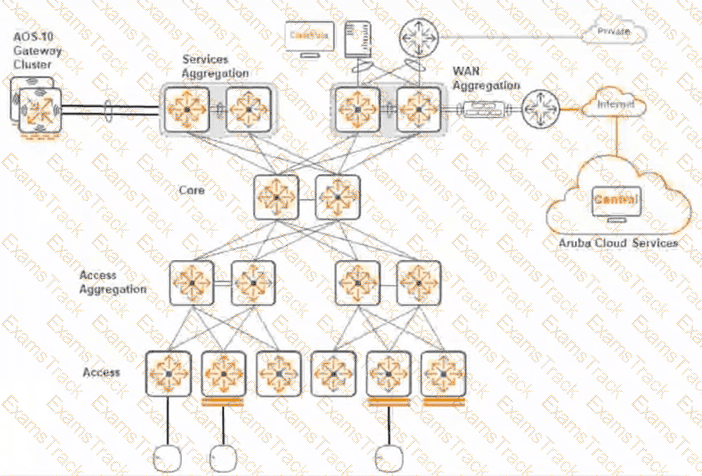
Based on this campus design, select the layer most suitable to be designed as a Border Persona when considering an EVPN VXLAN Fabric.
Original network architecture exhibit
You are planning a secure onboarding solution for a customer’s enterprise network. The plan includes HPE Aruba Networking ClearPass Policy Manager (CPPM) Onboard to simplify device onboarding and enforce security policies.
Which critical design considerations and feature recommendations should be included in your proposal to ensure a smooth, effective implementation?
Choose two.
You meet with a customer to update the network after the prior network manager has left the company for another role.
Which methods can validate the current network state when the available network documentation is invalid?
Choose two.
A global cruise-line company needs to refresh its current fleet. It will refresh the ship’s internal infrastructure to be cost-effective and improve sustainability. It will replace all WLAN/LAN hardware on the ship. As part of this refresh, the company will not change its existing security requirements. The CIO also wants to minimize the number of unused switch ports. Any future expansion will always require a hardware refresh. The company will begin with the smallest ship, with a maximum of 800 guests.
Each ship has a LAN infrastructure comprising two core switches, up to 10 redundant distribution switches, and up to 500 access switches (400 cabins and 100 technical rooms). The core switches are in the ship’s MDF, and the distribution switches are in the IDFs. Each cabin and technical room receives a single access switch.
The ship’s cabling infrastructure will not be replaced. Each IDF connects to the MDF over SMF, with two pairs available for the interconnect between core and distribution. The SMF length between the MDF and IDF is less than 300 meters (980 ft), and it is OS1 fiber. Each cabin connects to its IDF with one OM2 pair, with a maximum length of 60 meters (200 ft). Each technical room connects to its IDF with one OM2 pair, with lengths from 100 to 150 meters (320 to 500 ft).
For every cabin and technical room, the customer wants to replace its current fanless 2530/2540 switches without changing the requirements, except that the uplink to the distribution switch must be upgraded to 10GbE to accommodate increased network traffic, and the technical rooms require redundant power.
The WLAN infrastructure will be refreshed 1:1, with no new cabling or AP locations. Its WLAN infrastructure uses 200/300-series indoor and outdoor APs running InstantOS (fewer than 300 APs), and the customer has no changes to WLAN requirements.
The cruise-line company will replace its existing Internet connection before the LAN/WLAN refresh. The new Internet connection will offer 99.8% uptime, needed to keep paid guest Wi-Fi continuously operational. With this new Internet connection, the CIO wants to base the design on Aruba’s ESP architecture because the Internet connection is guaranteed.
Based on best practices, what optic type should be recommended for the connection between the MDF and the IDFs?
A junior engineer has been hired to help with a large-scale network infrastructure project. Because the engineer has not previously worked on a project this complex, they want to better understand the role each stakeholder will have.
Match each stakeholder title with the responsibility most likely associated with that role.

Which licenses are required to use the UXI Client on Zebra devices?
Choose two.
You are creating a wireless intrusion detection and prevention strategy (WIDS/WIPS) for a client’s enterprise network with HPE Aruba Networking and AOS-10. As part of the design, you intend to deploy dedicated Air Monitors (AMs).
Which two statements are consistent with HPE Aruba Networking best practices for deploying AMs in an AOS-10 environment?
Choose two.
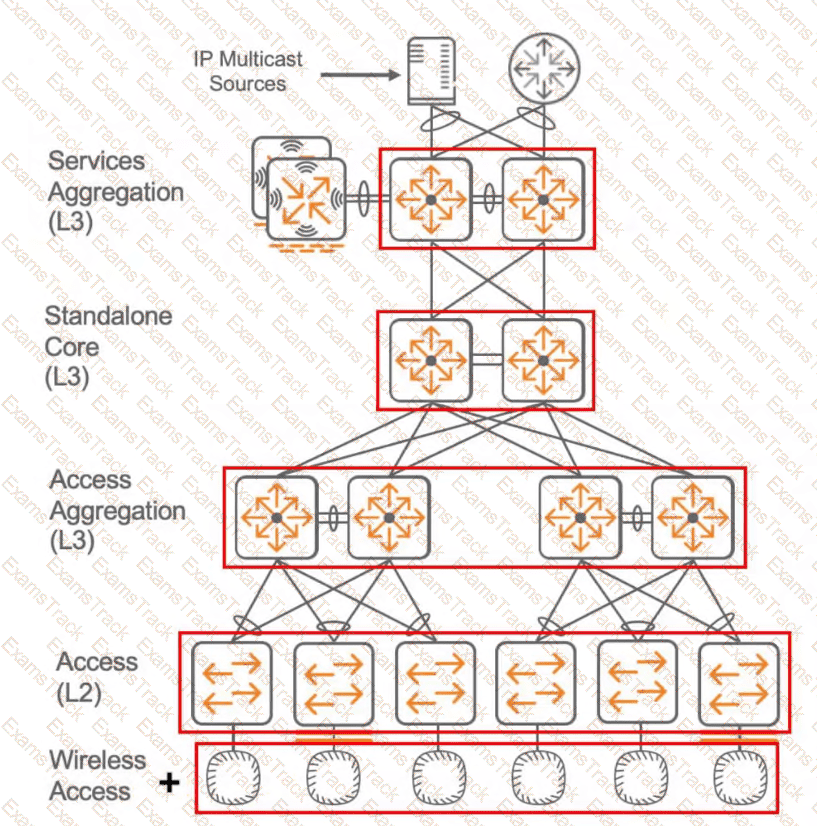
Mark the layer at which Dynamic Multicast Optimization should be activated.
HPE campus multicast network diagram showing services aggregation, standalone core, access aggregation, access layer and wireless access
|
PDF + Testing Engine
|
|---|
|
$42.5 |
|
Testing Engine
|
|---|
|
$32.5 |
|
PDF (Q&A)
|
|---|
|
$26.25 |
HP Free Exams |
|---|

|

Copyright © 2026 Examstrack. All Rights Reserved

TESTED 22 Nov 2026


