examstrack logo

Which alternative source is best suited for site surveys or simul-ations if no floor plans are available?
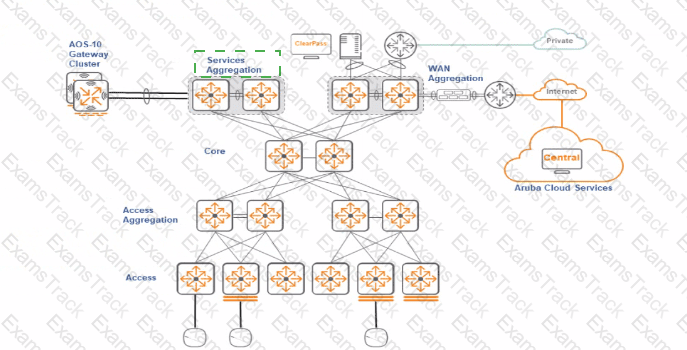
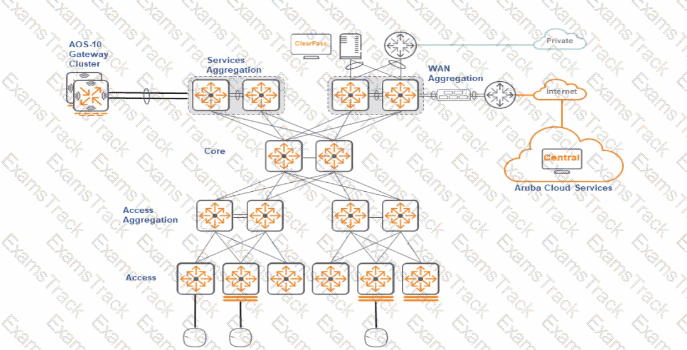
Based on this campus design, click on the layer that is the most appropriate to be designed as a Stub Persona, considering an EVPN VXLAN Fabric?
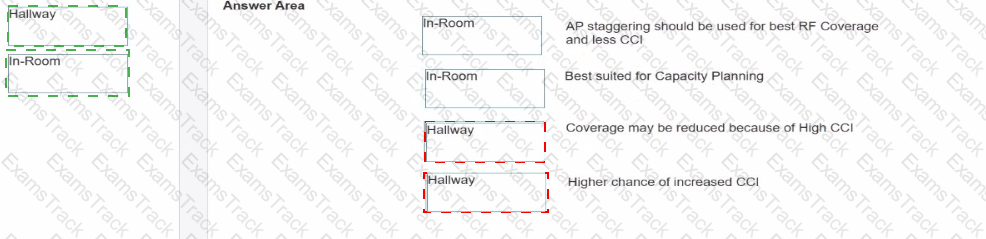
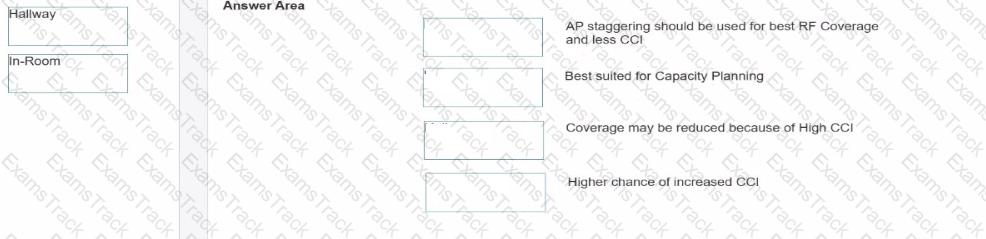
Match the deployment mode to the description.
A global cruise line company needs to refresh its current fleet. They will refresh the “insides” of the ship to be cost-effective and increase their sustainability. They will replace the complete WLAN/LAN hardware of the ship. In this refresh, the company will not refresh its current security requirements. The CIO also wants to limit the number of unused ports in the switches. Future expansion will always mean a refresh of hardware. They start with the smallest ship with a maximum of 800 guests.
Each ship has a LAN infrastructure consisting of two core switches, up to 10 redundant distribution switches, and up to 500 access switches (400 cabins, 100 technical rooms). The core switches are located in the MDF of the ship and the distribution switches are located in the IDFs of the ship. Each cabin and technical room gets one single access switch.
The cabling structure of the ship will not be refreshed. Each IDF is connected to the MDF by SMF, of which two pairs are available for the interconnect between the core and distribution. The length of SM fiber between MDF and IDF is less than 300 meters (980 ft), type used is OS1. Each cabin is connected by a single OM2 pair to the IDF, the maximum length is 60 meters (200 ft). Each technical room is connected by a single OM2 pair to the IDF, with lengths between 100 and 150 meters (320 and 500 ft).
For each cabin/technical room the customer is looking to replace their current fan-less 2530/2540 without changing the requirements, except they need to upgrade the uplink to distribution switch to 10 GbE to handle the increased network traffic, and the technical rooms need redundant power.
The WLAN infrastructure will be 1:1 refreshed without new cabling or new AP locations. Their WLAN infrastructure is based on the 200/300 series indoor and outdoor APs running InstantOS (less than 300 APs). The customer has no change in WLAN requirements.
The cruise line company will replace its current Internet connection before the LAN/WLAN refresh. The new Internet connection will provide a 99.8% uptime, which is needed to ensure the paid guest Wi-Fi is always operational. With this new Internet connection, the CIO of the cruise line wants to base the design on the ESP architecture from Aruba because Internet connection is guaranteed.
The week after the presentation of your design to the CIO of the cruise line company, the CIO calls you to discuss increasing the security on the wired network infrastructure. Since one of their competitors had one of their cruise ships cyber hacked, the CSO of the cruise line has mandated increased security on the wired network. They have heard about dynamic segmentation and central and decentral overlay networks. For their POS systems, they need a low-latency connection between the POS system and the POS server in the onboard data center.
What solution fits the customer’s requirements?
A global furniture retail company called 'No-Stair Inc.' requests you design their new WLAN infrastructure for a global footprint. Each location of No-Stair Inc.' has a similar layout: three small manager offices, a warehouse, and a 'retail' area. The 'retail' area and the warehouse together amount to 95% of the location. The IT department of the company Is minimally engaged In their LAN refresh so the CTO of the company has shared the information below
Current WLAN Infrastructure Is based on the 802.1 In "WlF14Less" access-points series (both model 2013-INT (2.4 only Internal antenna) and model 2019-EXT (dual-band external antenna only)). These AP models are standalone without any centralized management. Last year 'No-Stair InC ran a project called secure. It' ensuring that all needed network security was Implemented to be fully compliant with their security standards. During this project, they also upgraded the AAA infrastructure to handle the Increased AAA requests. No additional Wi-Fi or security requirements are listed for this WLAN refresh, which means that 'No-Stair Inc.' will continue to use bridged SSIDs. with local breakout into different VLANs.
The CTO of No-Stair Inc.' understands the need for you to ask additional questions to deliver the design The questions may be sent in written form and will be answered within two weeks.
What additional question needs to be answered in order to collect needed information for tie WLAN design?
What is the simple difference between a main distribution framework (MOF) closet and an intermediate distribution framework (IDF) closet?
A global cruise line company needs to refresh its current fleet. They win refresh the insides' of the ship to be cost-effective and increase their sustain ability. They Mill replace the complete WLAN/LAN hardware of the ship. In this refresh, the company will not refresh Us current security requirements. The CIO also wants to limit the number of unused ports in the switches. Future expansion will always mean a refresh of hardware. They start with the smallest ship with a maximum of 800 guests
Each ship has a LAN infrastructure consisting of two core switches, up to 10 redundant distribution switches, and up to 500 access switches (400 cabins. 100 technical rooms). The Core switches are located in the MDF of the ship and the distribution switches are located in the IDFs of the ship. Each cabin and technical room gets one single access switch.
The cabling structure of the ship will not be refreshed. Each IDF is connected to the MDF by SMF. of which two pairs are available for the interconnect between the core and distribution. The length of SM fiber between MDF and IDF is less than 300 meters (930 ft) and the type used is 0S1. Each cabin is connected by a single 0M2 pair to the IDF. the maximum length is 60 meters (200 ft). Each technical room is connected by a single 0M2 pail to the IDF. with lengths between 100 and 150 meters (320 and 500 ft).
For each cabin/technical room the customer is looking to replace their current fan-less 2530/2540 without changing the requirements, except they need to upgrade the uplink to distribution switch to 10GbEto handle the increased network traffic, and the technical rooms need redundant power.
The WLAN infrastructure will be 1:1 refreshed without new cabling or new AP locations. Their WLAN Infrastructure is based on the 200/300 series Indoor and outdoor APs running instantOS (less than 300 APs). the customer has no change in WLAN requirements.
The cruise line company will replace its current Internet connection before the LAN/WLAN refresh. The new Internet connection will provide a 99.8% uptime, which is needed to ensure the paid guest Wi-Fi is always operational. With this new internet connection, the CIO of the cruise line wants to base the design on the ESP architecture from Aruba because Internet connection is guaranteed.
Based on the best practices, what should be recommended as the most cost-effective switch model tor the technical rooms?
Which access switch oversubscription option would be best suited for CAD desktops?
'Don't Buy at Us' is a US-based retail company that is expanding Into Europe. They are expanding into EMEA with a regional headquarters called HQ2 inside The Netherlands.
Their US-based headquarters HQ1 was refreshed last year based on the Aruba ESP architecture. You have treated the design for HQ? based on the same design as HQ1. a two-tier architecture. The high level is shown below.
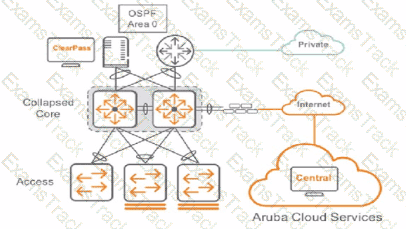
Switch BOM for this project based on Two Tier:
Collapsed Core: 2 x Aruba 8360-16Y2C in VSX (ISL 2» ICOG0E DAC)
Access Slack: 10 x Slack of Aruba 6200F 48G Class4 PoE 4SFP- 740W each stack has A members. VSF
with 10GbE VSF links) 12 x 10GbE uplink pet stack)
During the presentation of your design to the CTO of 'Don't Buy at Us' you were informed about the updated fiber infrastructure that Don't Buy at Us' has installed in HQ2.
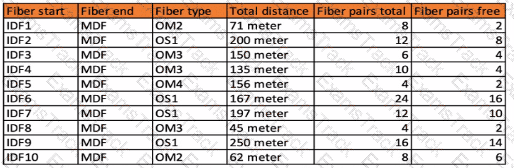
The core stack is Installed in the MDF and per IOF there is one access stack installed. Based on best practice, what is the most cost-effective update to the switch BOM?
|
PDF + Testing Engine
|
|---|
|
$49.5 |
|
Testing Engine
|
|---|
|
$37.5 |
|
PDF (Q&A)
|
|---|
|
$31.5 |
HP Free Exams |
|---|

|

Copyright © 2026 Examstrack. All Rights Reserved

TESTED 05 Oct 2026