
Pre-Summer Sale Limited Time 70% Discount Offer - Ends in 0d 00h 00m 00s - Coupon code: 70track

Free Amazon Web Services DVA-C02 Practice Exam with Questions & Answers | Set: 11

Questions 151

A developer is trying get data from an Amazon DynamoDB table called demoman-table. The developer configured the AWS CLI to use a specific IAM use ' s credentials and ran the following command.

The command returned errors and no rows were returned.

What is the MOST likely cause of these issues?

Options:
A.

The command is incorrect; it should be rewritten to use put-item with a string argument

B.

The developer needs to log a ticket with AWS Support to enable access to the demoman-table

C.

Amazon DynamoOB cannot be accessed from the AWS CLI and needs to called via the REST API

D.

The IAM user needs an associated policy with read access to demoman-table

Amazon Web Services DVA-C02 Premium Access
Questions 152

A company has a serverless application that uses an Amazon API Gateway API to invoke an AWS Lambda function. A developer creates a fix for a defect in the Lambda function code. The developer wants to deploy this fix to the production environment. To test the changes, the developer needs to send 10% of the live production traffic to the updated Lambda function version.

Options:

Options:
A.

A. Publish a new version of the Lambda function that contains the updated code.

B.

B. Set up a new stage in API Gateway with a new Lambda function version. Enable weighted routing in API Gateway stages.

C.

C. Create an alias for the Lambda function. Configure weighted routing on the alias. Specify a 10% weight for the new Lambda function version.

D.

D. Set up a routing policy on a Network Load Balancer. Configure 10% of the traffic to go to the new Lambda function version.

E.

E. Set up a weighted routing policy by using Amazon Route 53. Configure 10% of the traffic to go to the new Lambda function version.

Questions 153

A developer manages an application that stores user objects in an Amazon S3 bucket without versioning enabled. The application has premium users and basic users.

After premium users upload objects, the premium users have unlimited downloads of their objects. Their objects are stored with a premium/ prefix. After basic users upload objects, the basic users can download their objects for 90 days. Their objects are stored with a basic/ prefix.

The developer needs to implement a solution to automatically delete objects for the basic users after 90 days.

Which solution will meet these requirements with the LEAST development effort?

Options:
A.

Create an AWS Lambda function that removes any objects in the S3 bucket that have the basic/ prefix and are more than 90 days old. Set up an Amazon EventBridge schedule to invoke the Lambda function every day.

B.

Set up an S3 Lifecycle rule that applies to the objects that have the premium/ prefix. Set the S3 Lifecycle rule action to expire the current version of the objects that have the premium/ prefix after 90 days.

C.

Set up an S3 Lifecycle rule that applies to the objects that have the basic/ prefix. Set the S3 Lifecycle rule action to expire the current version of the objects that have the basic/ prefix after 90 days.

D.

Create a rule for the S3 bucket to identify objects that have the basic/ prefix. Set the rule action to delete any objects that have object delete markers and unfinished multipart uploads after 90 days.

Questions 154

A company caches session information for a web application in an Amazon DynamoDB table. The company wants an automated way to delete old items from the table.

What is the simplest way to do this?

Options:
A.

Write a script that deletes old records; schedule the script as a cron job on an Amazon EC2 instance.

B.

Add an attribute with the expiration time; enable the Time To Live feature based on that attribute.

C.

Each day, create a new table to hold session data; delete the previous day ' s table.

D.

Add an attribute with the expiration time; name the attribute ItemExpiration.

Questions 155

A developer is designing a new feature for an existing application that uses an AWS Lambda function. The developer wants to test the Lambda function safely in development and testing AWS accounts before deploying the function to a production AWS account. The developer must be able to roll back the function if issues are discovered.

Which solution will meet these requirements with the LEAST operational overhead ?

Options:
A.

Create new Lambda function versions and aliases for the development, testing, and production accounts. After successful testing, update the production alias to point to the function version. Roll back to the most recent stable version if issues are discovered.

B.

Deploy the Lambda function separately to the development, testing, and production accounts after testing the function in each environment.

C.

Use Lambda layers to separate the code and libraries for each AWS account and deploy the function with different layers.

D.

Use environment variables to differentiate development, testing, and production behavior.

Questions 156

A developer built an application that calls an external API to obtain data, processes the data, and saves the result to Amazon S3. The developer built a container image with all of the necessary dependencies to run the application as a container.

The application runs locally and requires minimal CPU and RAM resources. The developer has created an Amazon ECS cluster. The developer needs to run the application hourly in Amazon ECS.

Which solution will meet these requirements with the LEAST amount of infrastructure management overhead?

Options:
A.

Add a capacity provider to manage instances.

B.

Add an Amazon EC2 instance that runs the application.

C.

Define a task definition with an AWS Fargate launch type.

D.

Create an Amazon ECS cluster and add the managed node groups feature to run the application.

Questions 157

A company has an application that consists of different microservices that run inside an AWS account. The microservices are running in containers inside a single VPC. The number of microservices is constantly increasing. A developer must create a central logging solution for application logs.

Options:
A.

Create a different Amazon CloudWatch Logs stream for each microservice.

B.

Create an AWS CloudTrail trail to log all the API calls.

C.

Configure VPC Flow Logs to track the communications between the microservices.

D.

Use AWS Cloud Map to map the interactions of the microservices.

Questions 158

A company receives food orders from multiple partners. The company has a microservices application that uses Amazon API Gateway APIs with AWS Lambda integration. Each partner sends orders by calling a customized API that is exposed through API Gateway. The API call invokes a shared Lambda function to process the orders.

Partners need to be notified after the Lambda function processes the orders. Each partner must receive updates for only the partner ' s own orders. The company wants to add new partners in the future with the fewest code changes possible.

Which solution will meet these requirements in the MOST scalable way?

Options:
A.

Create a different Amazon Simple Notification Service (Amazon SNS) topic for each partner. Configure the Lambda function to publish messages for each partner to the partner ' s SNS topic.

B.

Create a different Lambda function for each partner. Configure the Lambda function to notify each partner ' s service endpoint directly.

C.

Create an Amazon Simple Notification Service (Amazon SNS) topic. Configure the Lambda function to publish messages with specific attributes to the SNS topic. Subscribe each partner to the SNS topic. Apply the appropriate filter policy to the topic subscriptions.

D.

Create one Amazon Simple Notification Service (Amazon SNS) topic. Subscribe all partners to the SNS topic.

Questions 159

A company uses AWS CloudFormation to deploy an application that includes an Amazon API Gateway REST API integrated with AWS Lambda and Amazon DynamoDB. The application has three stages: development, testing, and production, each with its own DynamoDB table.

The company wants to deploy a new production release and route 20% of traffic to the new version while keeping 80% of traffic on the existing production version. The solution must minimize the number of errors that any single customer experiences.

Which approach should the developer take?

Options:
A.

Deploy incremental portions of the changes to production in multiple steps.

B.

Use Amazon Route 53 weighted routing between the production and testing stages.

C.

Deploy an Application Load Balancer in front of the API Gateway stages and weight traffic.

D.

Configure canary deployment settings for the production API stage and route 20% of traffic to the canary.

Questions 160

A company stores its data in data tables in a series of Amazon S3 buckets. The company received an alert that customer credit card information might have been exposed in a data table on one of the company ' s public applications. A developer needs to identify all potential exposures within the application environment.

Which solution will meet these requirements?

Options:
A.

Use Amazon Athena to run a job on the S3 buckets that contain the affected data. Filter the findings by using the SensitiveData:S30bject/Personal finding type.

B.

Use Amazon Made to run a job on the S3 buckets that contain the affected data. Filter the findings by using the SensitiveData:S30bject/Financial finding type.

C.

Use Amazon Made to run a job on the S3 buckets that contain the affected data. Filter the findings by using the SensitiveData:S30bject/Personal finding type.

D.

Use Amazon Athena to run a job on the S3 buckets that contain the affected data. Filter the findings by using the SensitiveData:S30bject/Financial finding type.

Questions 161

A company operates on-premises data centers that run an image processing service composed of containerized applications on Kubernetes clusters . All applications share access to a common NFS file system for data storage.

The company is running out of NFS capacity and must migrate to AWS quickly. The Kubernetes clusters must be highly available on AWS.

Which combination of actions will meet these requirements? (Select TWO.)

Options:
A.

Transfer the data from the NFS share to an Amazon EBS volume. Upload the container images to Amazon ECR.

B.

Transfer the data from the NFS share to an Amazon EFS file system. Upload the container images to Amazon ECR.

C.

Create an Amazon ECS cluster and configure each node to mount the Amazon EBS volume.

D.

Create an Amazon EKS cluster and configure each node to mount the Amazon EBS volume.

E.

Create an Amazon EKS cluster and configure each node to mount the Amazon EFS file system.

Questions 162

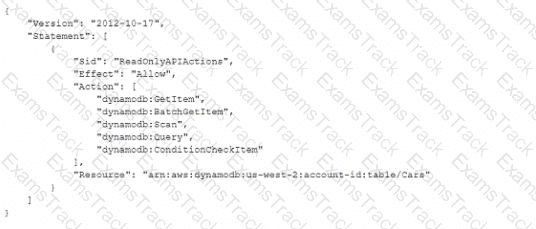
A developer is troubleshooting an application mat uses Amazon DynamoDB in the uswest-2 Region. The application is deployed to an Amazon EC2 instance. The application requires read-only permissions to a table that is named Cars The EC2 instance has an attached IAM role that contains the following IAM policy.
DVA-C02 Question 162

When the application tries to read from the Cars table, an Access Denied error occurs.

How can the developer resolve this error?

Options:
A.

Modify the IAM policy resource to be " arn aws dynamo* us-west-2 account-id table/* "

B.

Modify the IAM policy to include the dynamodb * action

C.

Create a trust policy that specifies the EC2 service principal. Associate the role with the policy.

D.

Create a trust relationship between the role and dynamodb Amazonas com.

Questions 163

A developer is troubleshooting an application in an integration environment. In the application, an Amazon Simple Queue Service (Amazon SQS) queue consumes messages and then an AWS Lambda function processes the messages. The Lambda function transforms the messages and makes an API call to a third-party service.

There has been an increase in application usage. The third-party API frequently returns an HTTP 429 Too Many Requests error message. The error message prevents a significant number of messages from being processed successfully.

How can the developer resolve this issue?

Options:
A.

Increase the SQS event source ' s batch size setting.

B.

Configure provisioned concurrency for the Lambda function based on the third-party API ' s documented rate limits.

C.

Increase the retry attempts and maximum event age in the Lambda function ' s asynchronous configuration.

D.

Configure maximum concurrency on the SQS event source based on the third-party service ' s documented rate limits.

Questions 164

A company has a web application that runs on Amazon EC2 instances with a custom Amazon Machine Image (AMI) The company uses AWS CloudFormation to provision the application The application runs in the us-east-1 Region, and the company needs to deploy the application to the us-west-1 Region

An attempt to create the AWS CloudFormation stack in us-west-1 fails. An error message states that the AMI ID does not exist. A developer must resolve this error with a solution that uses the least amount of operational overhead

Which solution meets these requirements?

Options:
A.

Change the AWS CloudFormation templates for us-east-1 and us-west-1 to use an AWS AMI. Relaunch the stack for both Regions.

B.

Copy the custom AMI from us-east-1 to us-west-1. Update the AWS CloudFormation template for us-west-1 to refer to AMI ID for the copied AMI Relaunch the stack

C.

Build the custom AMI in us-west-1 Create a new AWS CloudFormation template to launch the stack in us-west-1 with the new AMI ID

D.

Manually deploy the application outside AWS CloudFormation in us-west-1.

Questions 165

A developer is working on a web application that requires selective activation of specific features. The developer wants to keep the features hidden from end users until the features are ready for public access. Which solution will meet these requirements?

Options:
A.

Create a feature flag configuration profile in AWS AppSync. Store the feature flag values in the configuration profile. Activate and deactivate feature flags as needed.

B.

Store prerelease data in an Amazon DynamoDB table. Enable Amazon DynamoDB Streams in the table. Toggle between hidden and visible states by using DynamoDB Streams.

C.

Create a feature flag configuration profile in AWS AppConfig. Store the feature flag values in the configuration profile. Activate and deactivate feature flags as needed.

D.

Store prerelease data in AWS Amplify DataStore. Toggle between hidden and visible states by using Amplify DataStore cloud synchronization.