
Weekend Special Sale 80% Discount Offer - Ends in 0d 00h 00m 00s - Coupon code: FRIDAY80

Free Nokia 4A0-C03 Practice Exam with Questions & Answers | Set: 5

Questions 41

A static route is configured on router R1 to reach the PC at 139.120.121.2. What could be causing the ping failure?

Exhibit:
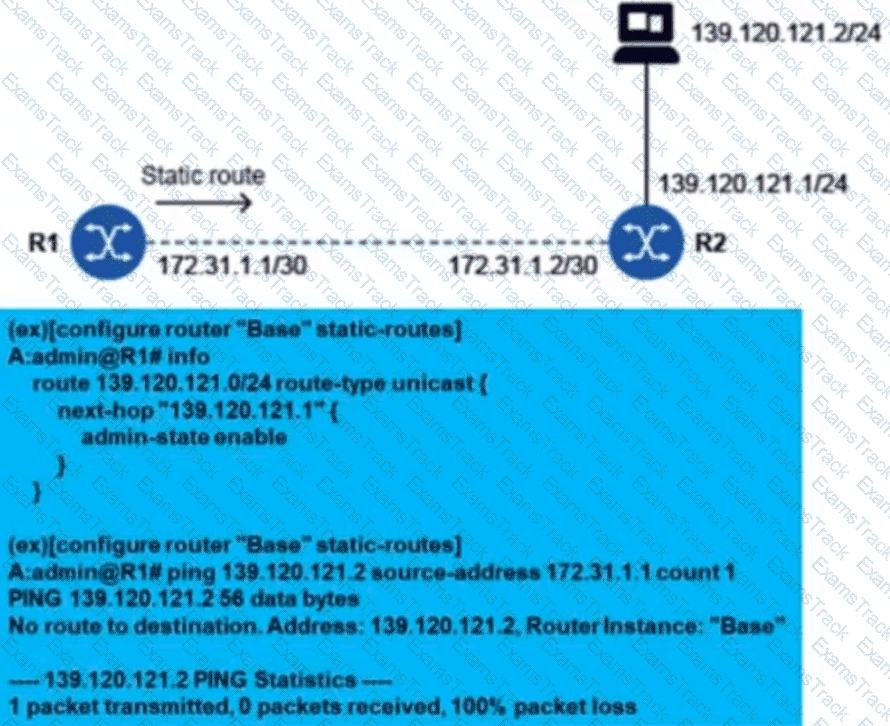
4A0-C03 Question 41

(ex)[configure router "Base" static-routes]

Options:
A.

admin@R1# info

route 139.120.121.0/24 route-type unicast {

next-hop "139.120.121.1" {

admin-state enable

}

}

(ex)[configure router "Base" static-routes]

B.

admin@R1# ping 139.120.121.2 source-address 172.31.1.1 count 1

PING 139.120.121.2 56 data bytes

No route to destination. Address: 139.120.121.2,

Router Instance: "Base"

---- 139.120.121.2 PING Statistics ----

1 packet transmitted, 0 packets received,

100% packet loss

C.

Router R2 needs a static route to the PC.

D.

Router R1 needs a static route to router R2.

E.

The configured next hop does not belong to a subnet adjacent to R1.

F.

The configured static route needs to be a default route.

Nokia 4A0-C03 Premium Access
Questions 42

When a router receives an IP packet but finds no routing-table match for the destination IP address, which actions does it take?

Options:
A.

The packet is flooded out all router interfaces to ensure it reaches its intended destination.

B.

The packet is dropped and ICMP destination unreachable message is sent back to the source.

C.

The packet is silently discarded.

D.

The router sends an ICMP destination unreachable message out all interfaces to find out if the IP address is being used by a neighbor.

Questions 43

Which of these is a characteristic of LDP Hello messages?

Options:
A.

They are multicast to the All Hosts address.

B.

They are multicast to the All Hosts address.

C.

They are multicast to the All Routers address.

D.

They are broadcast or multicast, depending on the physical media.

Exam Code: 4A0-C03
Certification Provider: Nokia
Exam Name: Nokia NRS II Composite Exam: IS-IS version
Last Update: Nov 29, 2026
Questions: 145