examstrack logo

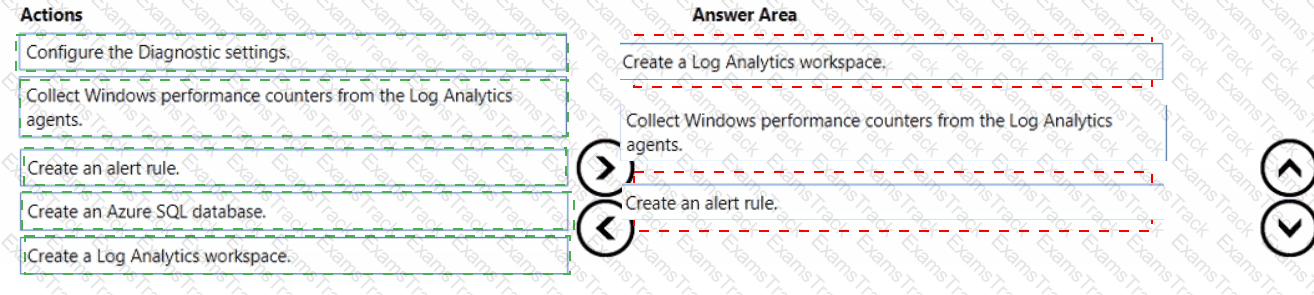
You have an Azure subscription.
You plan to migrate 50 virtual machines from VMware vSphere to the subscription.
You create a Recovery Services vault.
What should you do next?
You have an Azure subscription that contains an Azure container registry named ContReg1. You enable the Admin user for ContReg1. Which username can you use to sign in to ContReg1?
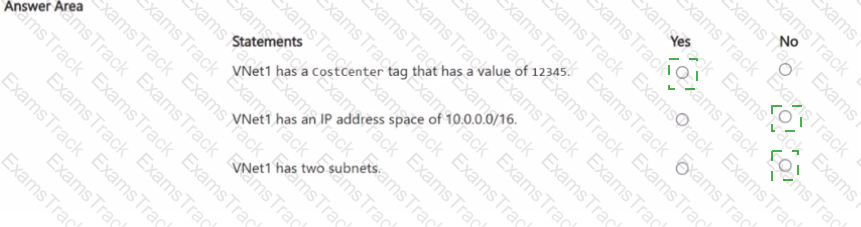
You have an Azure subscription that contains a resource group named RG1.
You have a file named File1.bicep as shown in the File1.bicep exhibit. (Click the File1.bicep tab.)
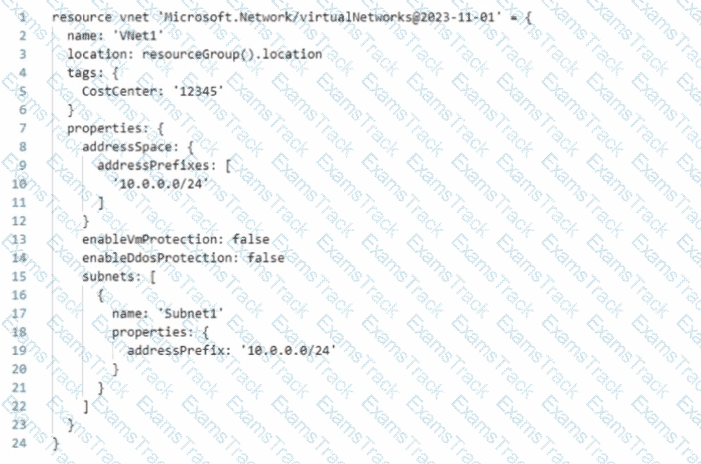
You create a file named File2.bicep as shown in the File2.bicep exhibit. (Click the File2.bicep tab.)
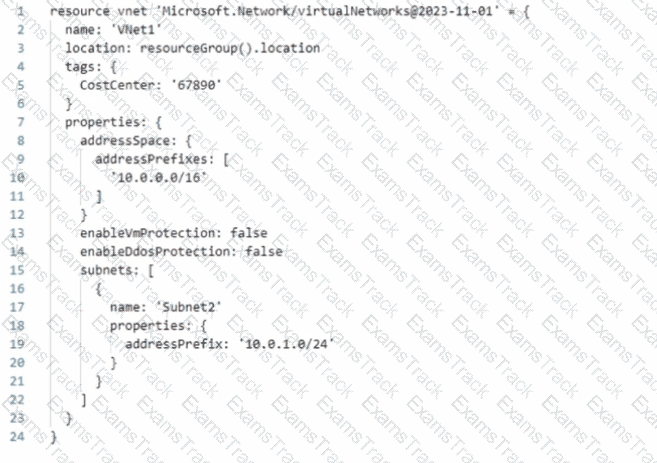
You run the following PowerShell commands.
New-AzResourceGroupDeploynent -ResourceOroupHame RGi -TeaplateFile Filel.bicep
New-AzResourceGroupDeploynent -Whatif -ResourceGroupNaae RG1 -TemplateFile File2.bicep
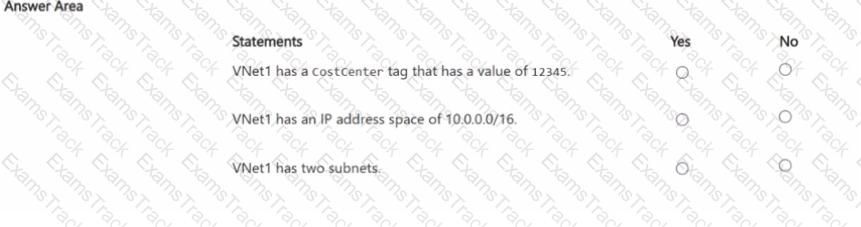
For each of the following statements, select Yes if the statement is true. Otherwise, select No.
NOTE: Each correct selection is worth one point.
You have two Azure Resource Manager (ARM) templates named Template1 and Template2.
Deployments of Template1 currently fail because a virtual machine extension in Template1 depends on a resource referenced in Template2.
You need to ensure that Template1 and Template2 deploy together as a single transaction, and that if either deployment fails, the overall deployment fails. Both templates must remain separate and reusable.
What should you do?
Note: This question is part of a series of questions that present the same scenario. Each question in the series contains a unique solution that might meet the stated goals. Some question sets might have more than one correct solution, while others might not have a correct solution.
After you answer a question in this section, you will NOT be able to return to it. As a result, these questions will not appear in the review screen.
You have an app named App1 that is installed on two Azure virtual machines named VM1 and VM2. Connections to App1 are managed by using an Azure Load Balancer.
The effective network security configurations for VM2 are shown in the following exhibit.
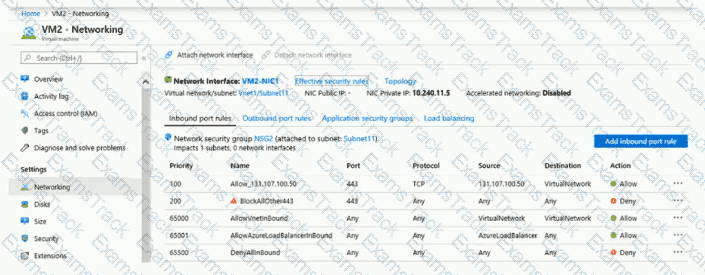
You discover that connections to App1 from 131.107.100.50 over TCP port 443 fail. You verify that the Load Balancer rules are configured correctly.
You need to ensure that connections to App1 can be established successfully from 131.107.100.50 over TCP port 443.
Solution: You create an inbound security rule that denies all traffic from the 131.107.100.50 source and has a cost of 64999.
Does this meet the goal?
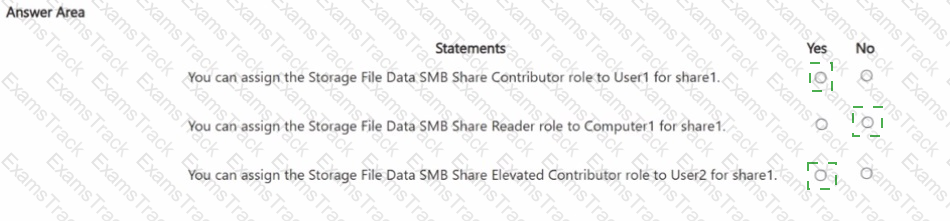
You have an Azure subscription that contains a storage account named storage1. The subscription is linked to a Microsoft Entra tenant named contoso.com that syncs with an on-premises Active Directory domain. The domain contains the security principals shown in the following table.
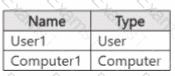
In the Microsoft Entra tenant you create a user named User2.
The storage1 account contains a file share named share! and has the following configurations.
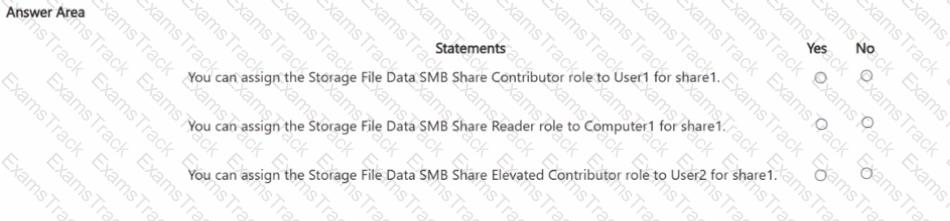
For each of the following statements, select Yes if the statement is true. Otherwise, select No.
NOTE: Each correct selection is worth one point
You have an app named App1 that is installed on two Azure virtual machines named VM1 and VM2. Connections to App1 are managed by using an Azure Load Balancer.
The effective network security configurations for VM2 are shown in the following exhibit.
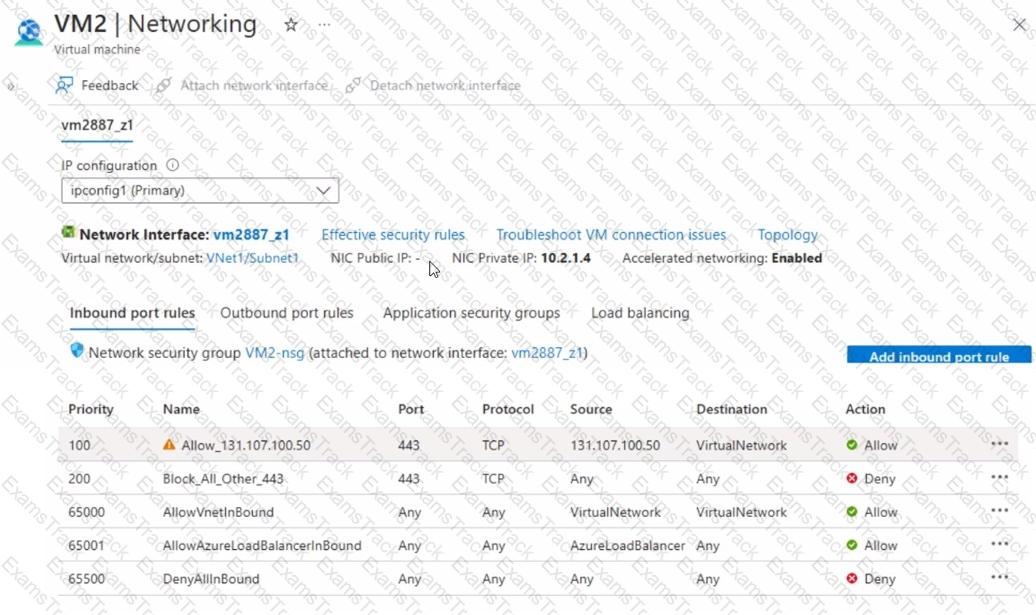
You discover that connections to App1 from 131.107.100.50 over TCP port 443 fail.
You verify that the Load Balancer rules are configured correctly.
You need to ensure that connections to App1 can be established successfully from 131.107.100.50 over TCP port 443.
Solution: You create an inbound security rule that denies all traffic from the 131.107.100.50 source and has a priority of 4096.
Does this meet the goal?
You have an Azure App Service app named App1 that contains two running instances.
You have an autoscale rule configured as shown in the following exhibit.
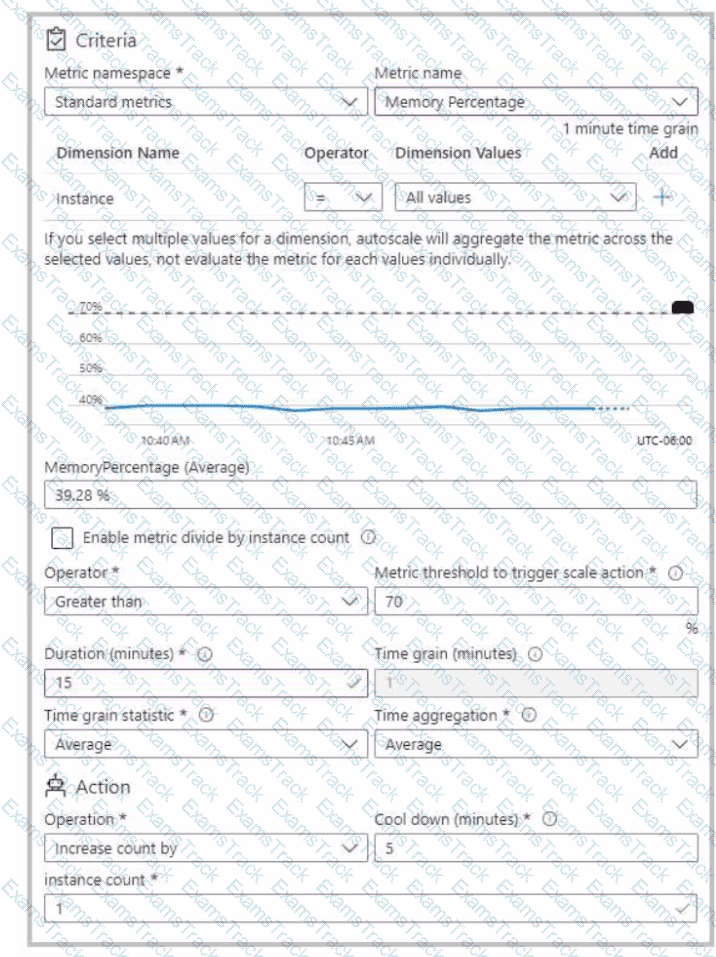
For the Instance limits scale condition setting, you set Maximum to 5.
During a 30-minute period, App1 uses 80 percent of the available memory.
What is the maximum number of instances for App1 during the 30-minute period?
Note: This question is part of a series of questions that present the same scenario. Each question in the series contains a unique solution that might meet the stated goals. Some question sets might have more than one correct solution, while others might not have a correct solution.
After you answer a question in this section, you will NOT be able to return to it. As a result, these questions will not appear in the review screen.
You manage a virtual network named VNet1 that is hosted in the West US Azure region.
VNet1 hosts two virtual machines named VM1 and VM2 that run Windows Server.
You need to inspect all the network traffic from VM1 to VM2 for a period of three hours.
Solution: From Azure Network Watcher, you create a connection monitor.
Does this meet the goal?
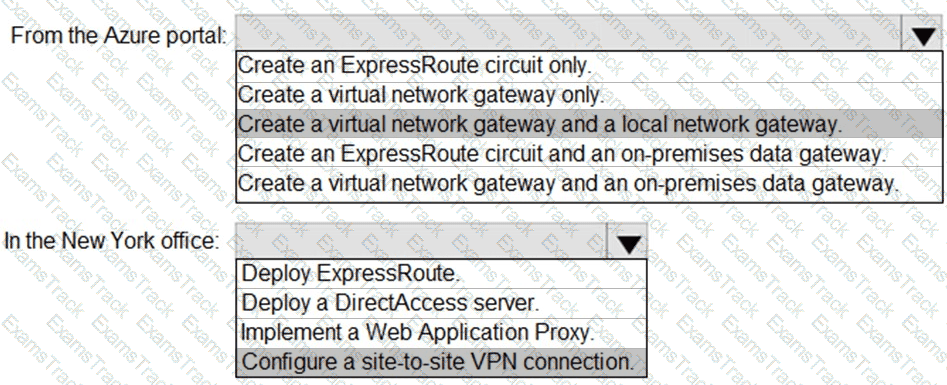
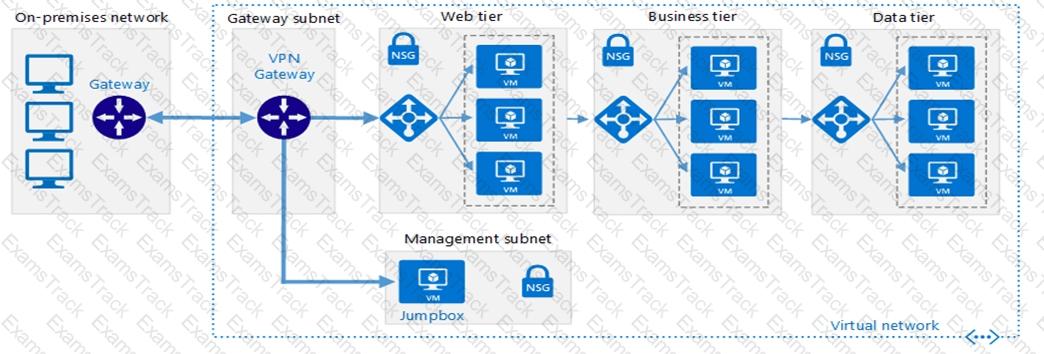
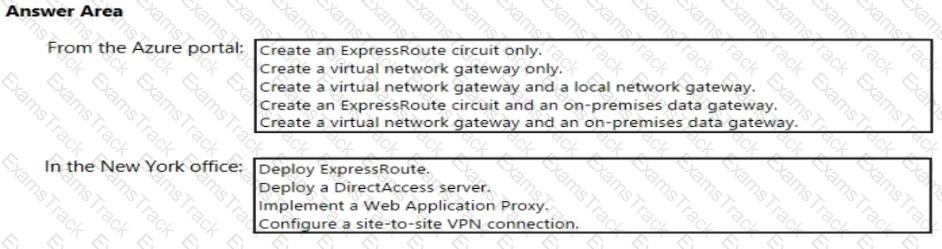
You need to meet the connection requirements for the New York office.
What should you do? To answer, select the appropriate options in the answer area.
NOTE: Each correct selection is worth one point.
|
PDF + Testing Engine
|
|---|
|
$43.75 |
|
Testing Engine
|
|---|
|
$33.75 |
|
PDF (Q&A)
|
|---|
|
$28.75 |
Microsoft Free Exams |
|---|
|

Copyright © 2026 Examstrack. All Rights Reserved

TESTED 18 Oct 2026