
Spring Sale Limited Time 70% Discount Offer - Ends in 0d 00h 00m 00s - Coupon code: 70track

Free Juniper JN0-281 Practice Exam with Questions & Answers

Questions 1

Within OSPF, what is the purpose of a designated router DR and backup designated router BDR on a broadcast network? Choose one.

Options:
A.

to reduce the resource overhead of maintaining a full mesh of adjacencies

B.

to ensure that only external LSAs from other routers are directed to the correct destination

C.

to coordinate routing updates to all the other routers of the point-to-point network

D.

to provide a backup path in case the Designated Router goes down

Juniper JN0-281 Premium Access
Questions 2

In a five-stage IP fabric, what is the role of the superspine layer?

Options:
A.

It ensures that every leaf device has a physical connection to every spine device in the five-stage IP fabric.

B.

It establishes a common BGP autonomous system that combines multiple three-stage IP fabric spine-and-leaf nodes into one autonomous system.

C.

It creates a Layer 2 underlay network between the spine nodes and leaf nodes in the five-stage IP fabric.

D.

It interconnects the spine layers in different three-stage IP fabric pods in a data center at the same site or across different sites.

Questions 3

You are troubleshooting an issue and notice that an interface is down.
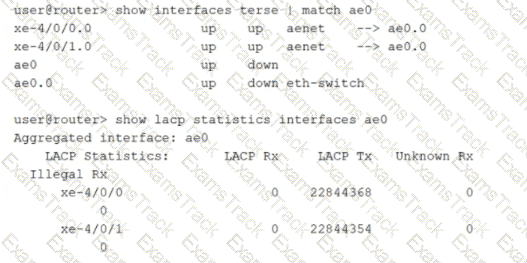
JN0-281 Question 3

Referring to the exhibit, what is the cause of the problem?

Options:
A.

The remote device is not using any routing protocols that require LACP.

B.

The local device does not have LACP configured.

C.

The local device is not using any routing protocols that require LACP.

D.

The remote device does not have LACP configured.

Questions 4

You are asked to ensure that traffic and routing information is not interrupted if your primary Routing Engine fails or switches to the backup Routing Engine. In this scenario, which high availability feature will accomplish this behavior?

Options:
A.

nonstop active routing NSR

B.

graceful Routing Engine switchover GRES

C.

link aggregation control protocol LACP

D.

bidirectional forwarding detection BFD

Questions 5

Which statement is correct about access ports?

Options:
A.

They are assigned to a single VLAN.

B.

They are assigned to multiple VLANs.

C.

They must be connected to a router.

D.

They must be connected to a firewall.

Questions 6

You want your Junos OS router to drop packets that it receives for a particular destination IP address. You also want to notify the source of the traffic that the destination IP address is unreachable. How would you accomplish this task?

Options:
A.

Create a static route for the destination IP address in the inet.3 routing table.

B.

Add the destination IP address to the list of martian IP addresses.

C.

Create a static route for the destination IP address with a next hop of reject.

D.

Create and apply a firewall filter to the ingress interface that discards traffic destined to the IP address.

Questions 7

Which two statements about EBGP are correct? Choose two.

Options:
A.

EBGP is used between ASs.

B.

EBGP is used within a single AS.

C.

EBGP does not require a supporting IGP.

D.

EBGP requires a supporting IGP.

Questions 8

Which statement about the qualified next-hop feature is correct when configuring a static route?

Options:
A.

Qualified next-hop is used for specifying redundant next-hops.

B.

Qualified next-hop is used when the next-hop address is not within the route table of the local device.

C.

Qualified next-hop is only required when a link-state protocol is configured.

D.

Qualified next-hop uses pings to verify that the next hop is up.

Questions 9

What are two names used to refer to the Layer 2 table that maintains known switching information? Choose two.

Options:
A.

inet.0 table

B.

routing information base RIB

C.

Ethernet switching table

D.

forwarding information base FIB

Questions 10

What are two advantages of spine and leaf architectures compared to legacy architectures within a data center? Choose two.

Options:
A.

Containers and hypervisors are easier to manage with spine and leaf architectures.

B.

Spine and leaf fabrics demonstrate better scaling features.

C.

Better performance is due to low and predictable hop counts.

D.

All broadcast domains become reachable, allowing easier host connectivity.