Summer Sale Limited Time 70% Discount Offer - Ends in 0d 00h 00m 00s - Coupon code: 70track

Free Netskope NSK200 Practice Exam with Questions & Answers | Set: 2

Questions 11

A customer wants to deploy the Netskope client on all their employee laptops to protect all Web traffic when users are working from home. However, users are required to work from their local offices at least one day per week. Management requests that users returning to the office be able to transparently leverage the local security stack without any user intervention.

Which two statements are correct in this scenario? (Choose two.)

Options:
A.

You must enable On-premises Detection in the client configuration.

B.

You must allow users to unenroll In the client configuration.

C.

You must disable Dynamic Steering in the traffic steering profile.

D.

You must configure IPsec/GRE tunnels on the local network to steer traffic to Netskope.

Netskope NSK200 Premium Access
Questions 12

While most Web and SaaS traffic is decrypted for inspection, you are asked to prevent a certain host on the network from SSL decryption for privacy purposes.

Options:
A.

Create a steering exception for the host.

B.

Create a Real-time Protection policy, select the host, and choose to block SSL decryption.

C.

Create a Source Network Location for a Do Not Decrypt SSL policy.

D.

Add the host to the certificate-pinned application list.

Questions 13

Your company asks you to use Netskope to integrate with Endpoint Detection and Response (EDR) vendors such as CrowdStrike. In this scenario, what is a requirement for a successful Integration and sharing of threat data?

Options:
A.

API Client ID

B.

device classification

C.

custom log parser

D.

user endpoint

Questions 14

You are deploying a Netskope client in your corporate office network. You are aware of firewall or proxy rules that need to be modified to allow traffic.

Which two statements are true in this scenario? (Choose two.)

Options:
A.

You need to allow TLS 1.1 traffic to pass through the firewalls from the users ' IP to all destinations.

B.

You must enable SSL decryption in the proxy to inspect the Netskope tunnel.

C.

It is recommended to allow UDP port 443 to the Netskope IP ranges to allow DTLS.

D.

You need to allow TCP port 443 to the Netskope IP ranges or domains.

Questions 15

After setting up the Netskope client in an explicit proxy environment, the Netskope client establishes the SSL tunnel between the client and the Netskope gateway. The client cannot connect directly through the default gateway to establish the SSL tunnel. In this scenario, what needs to be done for the client to connect to the Netskope gateway?

Options:
A.

Configure the PAC files of the system ' s proxy settings to open a connection to the explicit proxy server.

B.

Set up an HTTP proxy server to tunnel the SSL connection to the Netskope gateway.

C.

Install proxy decryption certificates on the device.

D.

Allow outbound domains and port 443 for the proxy configuration.

Questions 16

Deploying the Netskope Client using IdP requires which two prerequisites? (Choose two.)

Options:
A.

The user must be authenticated using IdP.

B.

The Home POP Domain must be preconfigured using the client CLI parameters.

C.

The tenant name will be automatically determined during IdP authentication.

D.

The IdP mode parameter must be specified when installing the client.

Questions 17

Your customer has some managed Windows-based endpoints where they cannot add any clients or agents. For their users to have secure access to their SaaS application, you suggest that the customer use Netskope ' s Explicit Proxy.

Which two configurations are supported for this use case? (Choose two.)

Options:
A.

Endpoints can be configured to directly use the Netskope proxy.

B.

Endpoints must have separate steering configurations in the tenant settings.

C.

Endpoints must be configured in the device section of the tenant to interoperate with all proxies.

D.

Endpoints can be configured to use a Proxy Auto Configuration (PAC) file.

Questions 18

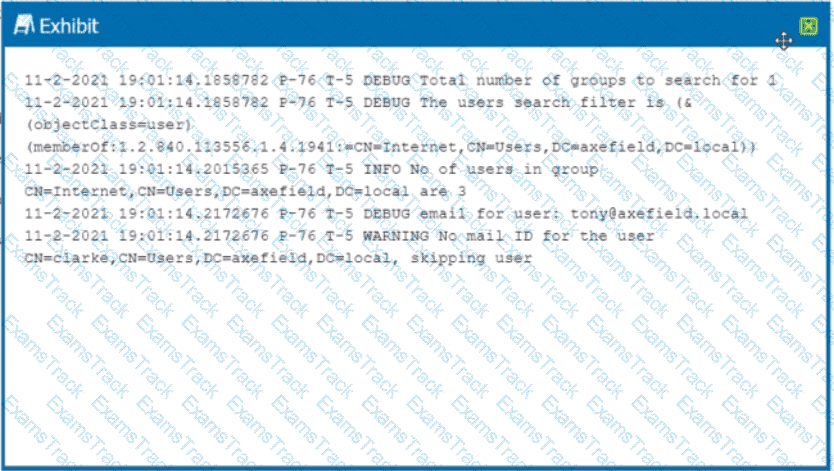
Review the exhibit.

NSK200 Question 18

You are troubleshooting a Netskope client for user Clarke which remains in a disabled state after being installed. After looking at various logs, you notice something which might explain the problem. The exhibit is an excerpt from the nsADImporterLog.log.

Referring to the exhibit, what is the problem?

Options:
A.

The client was not Installed with administrative privileges.

B.

The Active Directory user is not synchronized to the Netskope tenant.

C.

This is normal; it might take up to an hour to be enabled.

D.

The client traffic is decrypted by a network security device.

Questions 19

What is the purpose of the file hash list in Netskope?

Options:
A.

It configures blocklist and allowlist entries referenced in the custom Malware Detection profiles.

B.

It is used to allow and block URLs.

C.

It provides the file types that Netskope can inspect.

D.

It provides Client Threat Exploit Prevention (CTEP).

Questions 20

Your company wants to deploy Netskope using a tunnel because you have a mixture of device operating systems. You also do not want to enable encryption because you want to maximize bandwidth.

Options:
A.

explicit proxy

B.

IPsec

C.

proxy chaining

D.

GRE

Exam Code: NSK200
Certification Provider: Netskope
Exam Name: Netskope Certified Cloud Security Integrator (NCCSI)
Last Update: Jul 6, 2026
Questions: 96
PDF + Testing Engine
$164.99
$49.5
Testing Engine
$124.99
$37.5
PDF (Q&A)
$104.99
$31.5

Netskope Free Exams

Netskope Free Exams
Examstrack provides free Netskope exam prep materials and practice tests to support your Netskope certification goals.