examstrack logo

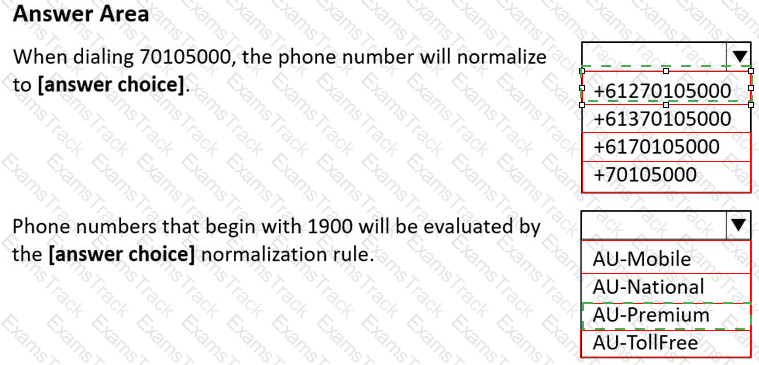
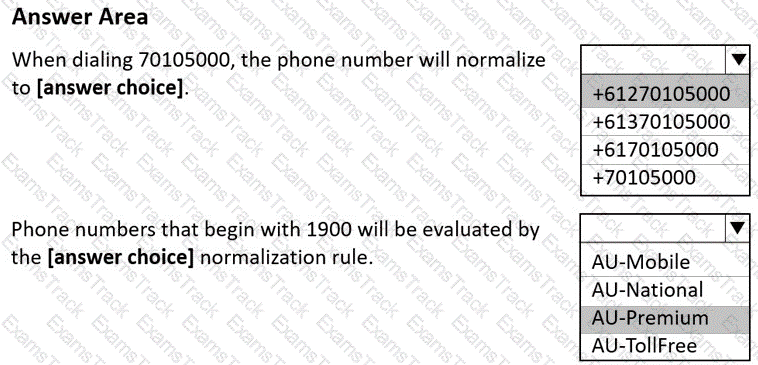
Normalization rules are configured as shown in the following exhibit.
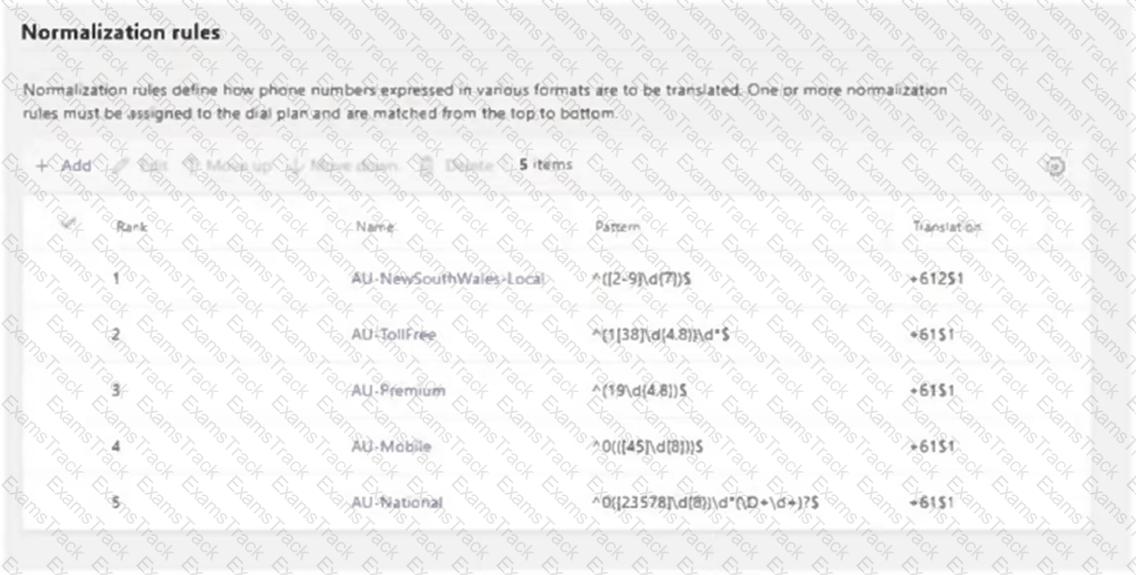
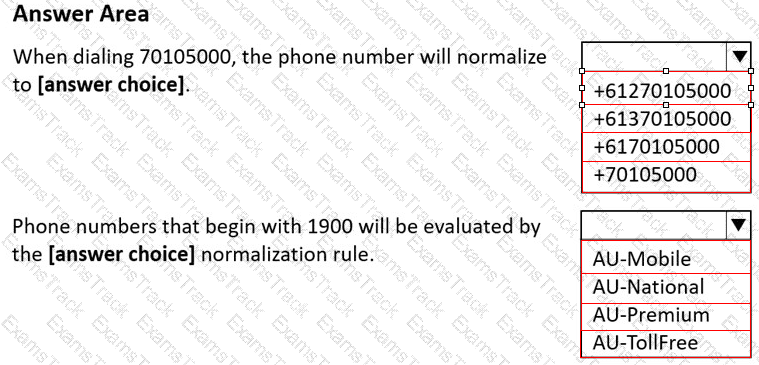
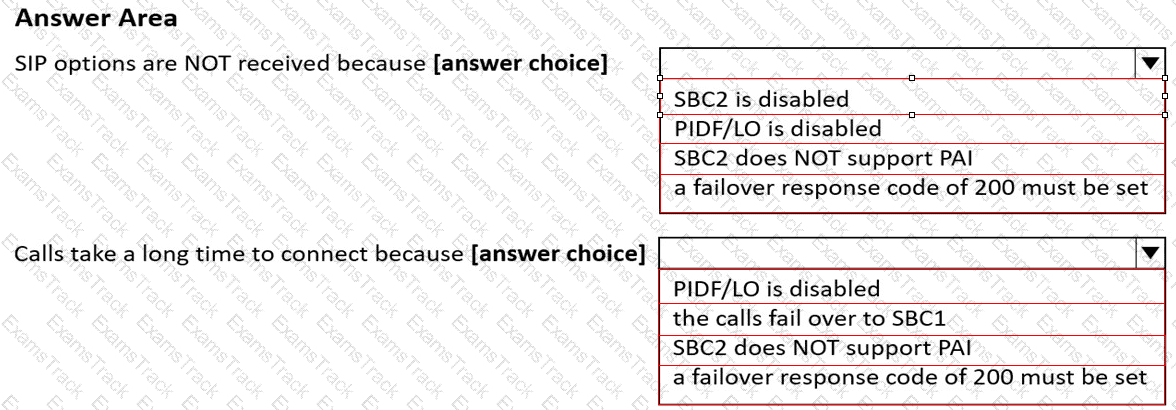
Use the drop down menus to select the answer choice that completes each statement based on the information presented in the graphic.
NOTE: Each correct selection is worth one point.
You have a Teams Phone deployment that contains a Session Border Controller (SBC) named SBC1.
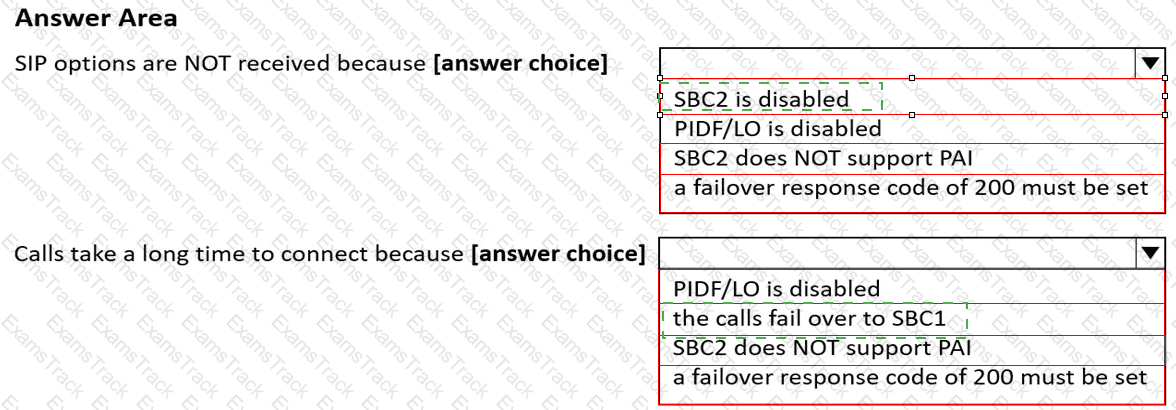
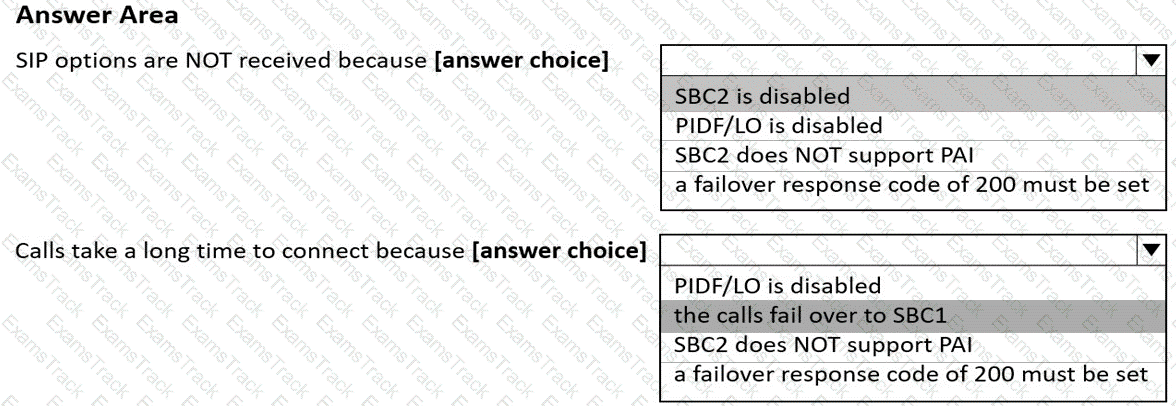
You deploy a second SBC named SBC2 that is configured as shown in the following exhibit.
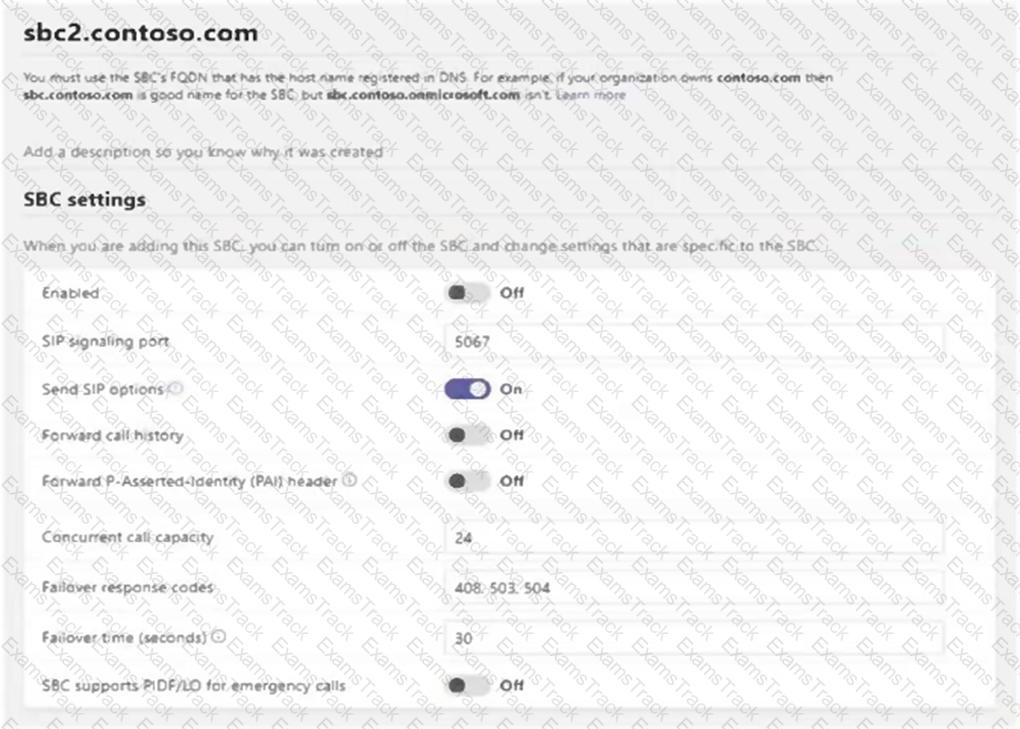
You discover that SBC2 fails to receive SIP Options packets from Microsoft SIP gateways and you notice that calls take a long time to connect.
Use the drop down menus to select the answer choice that completes each statement based on the information presented in the graphic.
NOTE: Each correct selection is worth one point.
You have a Teams Phone deployment that uses Direct Routing on a single Session Border Controller (SBC).
Users report that outbound PSTN calls are failing, but inbound PSTN calls are successful.
When you review the SBC logs, you discover that Microsoft is responding to SIP option requests, but is NOT sending SIP option requests.
What is the cause of the issue?
You have a Microsoft Teams Phone deployment.
You are deploying Direct Routing by using a certified Session Border ControNer CSBC). The FQDN of the SBC is sbc1.contoso.com. You use signaling port 5067.
You cannot place calls and receive an error message in the Microsoft Teams admin center as shown in the following exhibit.
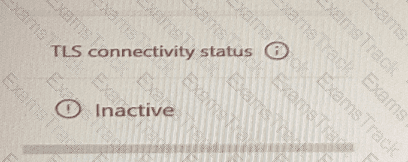
What is a possible cause of the issue?
You have a Microsoft Teams Phone employment mat contains a Session Border Controller (SBC named SBCi.contoso.com. Direct Routing integrates with a P6X phone system that uses only four-digit dialing and is configured to use the SBC. Teams is configured to use dial plans that normalize any four-digit calls to E-164. You have the following translation rule.

You have a Microsoft Teams Phone deployment.
You are deploying Direct Routing.
All users have a SIP URI in the format of user@contoso.com. The Session Border Controller (SBC) is named sbc.voice.contoso.com.
When troubleshooting errors on the SBC, you receive the warning shown in the following exhibit.
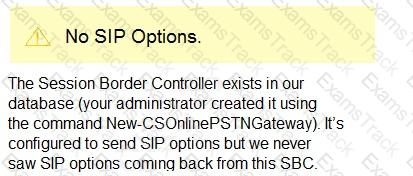
What is a possible cause of the issue?
Your company has a branch office named Branch1 that has limited network bandwidth.
The company has a Microsoft Teams Phone deployment.
You need to limit the amount of data the Teams client utilizes when users are in Branch1.
How should you complete the command? To answer, select the appropriate options in the answer area.
NOTE: Each correct selection is worth one point.

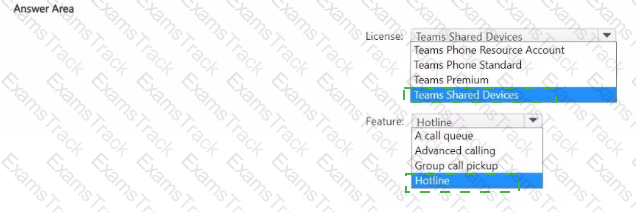
You have a Microsoft Teams Phone deployment.
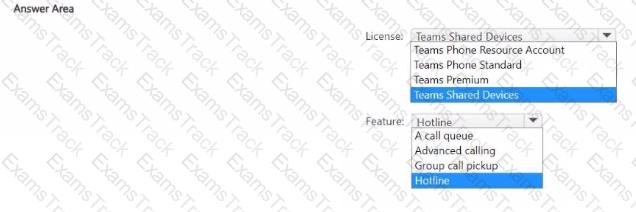
You need to deploy a Teams device named Device1 trial meets the following requirements:
• Autodials a preconfigured call queue when the phone handset is picked up
• Displays the common area phone user interface
Which license should you assign to Device1. and which feature should you enable for Device1? To answer. select the appropriate options in the answer area.
NOTE: Each correct selection is worth one point.
You are deploying a Microsoft Teams Rooms on Windows device. You need to enable Intelligent Speaker for the device. What should you do?
Exhibit
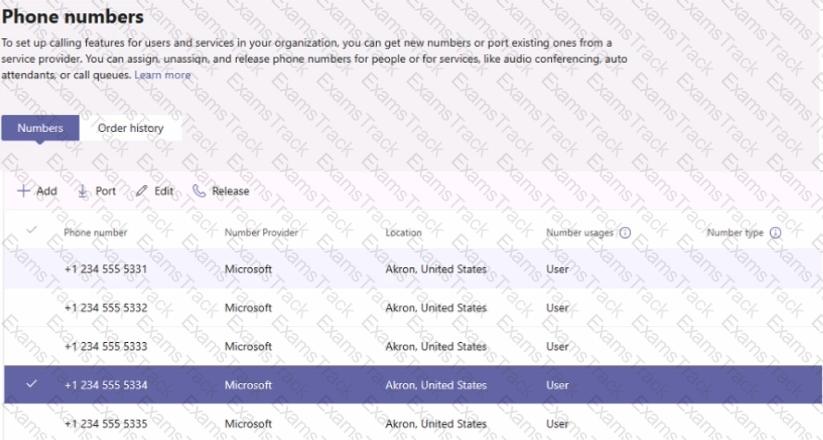
You are deploying Microsoft Teams Calling Plans.
You port all phone numbers to Microsoft Teams Phone as shown in the exhibit (Click the Exhibit tab.)
You need to assign. The number -1-234-555-5334 to an auto attendant.
What should you do first?
|
PDF + Testing Engine
|
|---|
|
$52.5 |
|
Testing Engine
|
|---|
|
$40.5 |
|
PDF (Q&A)
|
|---|
|
$34.5 |
Microsoft Free Exams |
|---|

|

Copyright © 2026 Examstrack. All Rights Reserved

TESTED 05 Oct 2026