examstrack logo

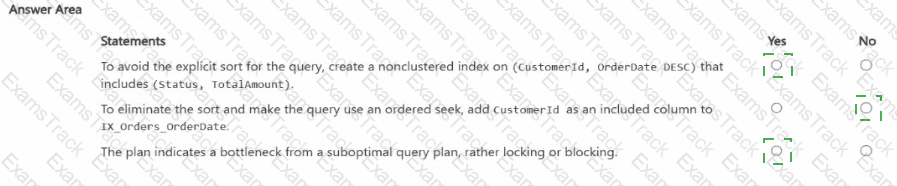
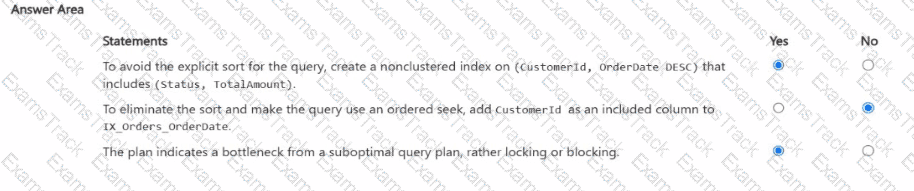
You have an Azure SQL database that has Query Store enabled
Query Performance Insight shows that one stored procedure has the longest runtime. The procedure runs the following parameterized query.
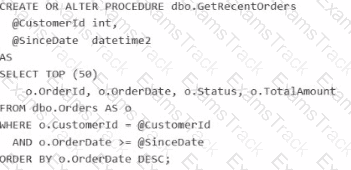
The dbo.orders table has approximately 120 million rows. Customer-id is highly selective, and orderOate is used for range filtering and sorting.
Vou have the following indexes:
• Clustered index: PK_Orders on (Orderld)
• Nonclustered index: lx_0rders_order-Date on (OrderDate) with no included columns
An actual execution plan captured from Query Store for slow runs shows the following:
• An index seek on ixordersorderDate followed by a Key Lookup (Clustered) on PKOrders for customerid, status, and TotalAnount
• A sort operator before top (50), because the results are ordered by orderDate DESC
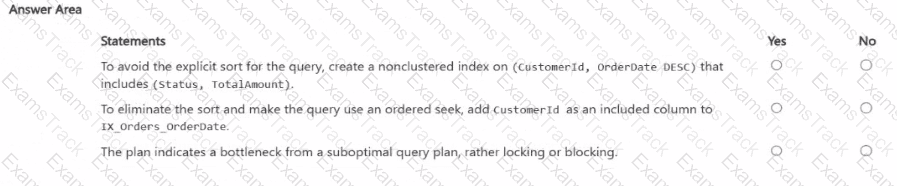
For each of the following statements, select Yes if the statement is true. Otherwise, select No. NOTE: Each correct selection is worth one point.
You have an Azure SQL database named ProductsDB.
You deploy Data API builder (DAB) to Azure Container Apps by using the [mcr.microsoft.com/azure-databases/data-api-builder:latest](https://mcr.microsoft.com/azure-databases/data-api-builder:latest) image.
The container app has the following configurations:
Secrets: mssql-connection-string, dab-config-base64
Environment variables:
MSSQL_CONNECTION_STRING=secretref:mssql-connection-string
DAB_CONFIG_BASE64=secretref:dab-config-base64
Ingress: External on port 5000
Users report that the /health endpoint returns a healthy response, but all requests that query an entity named Products fail and generate a connection error.
You confirm that the SQL login in the connection string is correct and the database exists.
You need to ensure that the container app can establish connections to the Azure SQL logical server without changing the container app deployment settings or the DAB configuration file.
What should you do on the Azure SQL logical server?
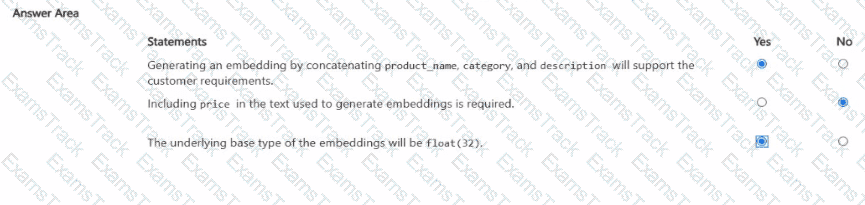
Your company has an ecommerce catalog in a Microsoft SQL Server 202b database named SalesDB SalesDB contains a table named products, products contains the following columns:
• product.id (int)
• product_name (nvarchar(200))
• description (nvarchar(max))
• category (nvarchar(50))
• brand (nvarchar(W))
• price (decimal)
• sku (nvarchar(40))
The description fields ate updated dairy by a content pipeline, and price can change multiple times per day. You want customers to be able to submit natural language queries and apply structured filters for brand and price. You plan to store embeddings in a new VECTOR(1536) column and use VECTOR_SEARCH(... METRIC=’ cosine ' ...).
For each of the following statements, select Yes if the statement is true. Otherwise, select No.
NOTE: Each correct selection is worth one point.

You have an Azure SQL database named SalesDB on a logical server named sales-sql01.
You have an Azure App Service web app named OrderApi that connects to SalesDB by using SQL authentication.
You enable a user-assigned managed identity named OrderApi-Id for OrderApi.
You need to configure OrderApi to connect to SalesDB by using Microsoft Entra authentication. The managed identity must have read and write permissions to SalesDB.
Which Transact-SQL statements should you run in SalesDB?
You need to recommend a solution to lesolve the slow dashboard query issue. What should you recommend?
You need to recommend a solution for the development team to retrieve the live metadata. The solution must meet the development requirements.
What should you include in the recommendation?
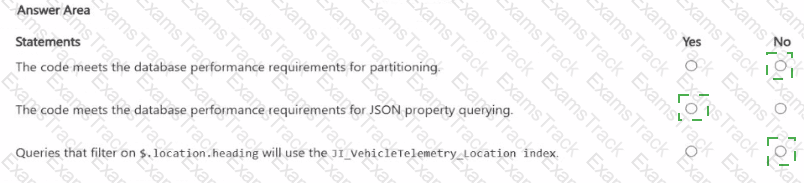
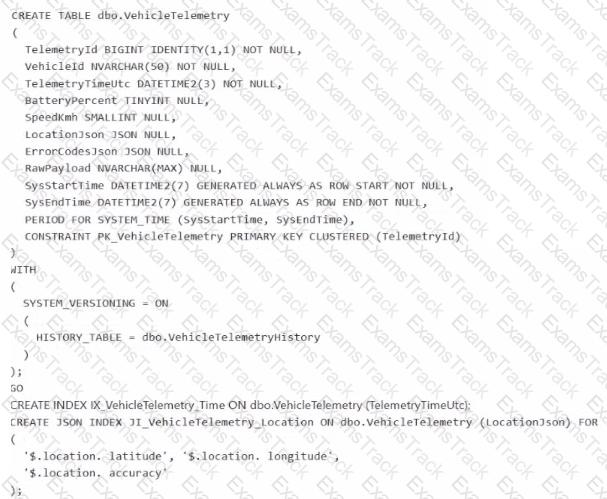
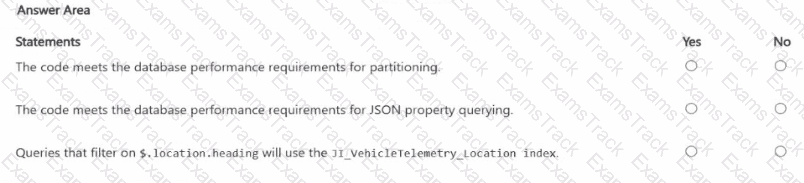
You need to create a table in the database to store the telemetry data. You have the following Transact-SQL code.
You need to generate embeddings to resolve the issues identified by the analysts. Which column should you use?
|
PDF + Testing Engine
|
|---|
|
$52.5 |
|
Testing Engine
|
|---|
|
$40.5 |
|
PDF (Q&A)
|
|---|
|
$34.5 |
Microsoft Free Exams |
|---|

|

Copyright © 2026 Examstrack. All Rights Reserved

TESTED 03 Oct 2026