examstrack logo

You provision an Azure Cosmos DB for NoSQL container. You set the throughput to Autoscale, and the maximum request units per second {RU/s) to 20,000.
For how many RU/s will you be charged when the actual RU/s usage is zero?
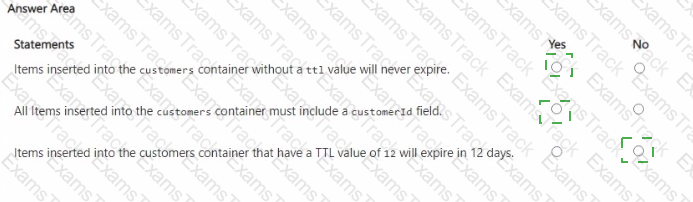
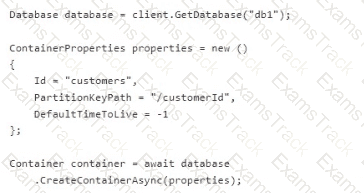
You have an Azure Cosmos DB for NoSQL database named db1.
You run the following code:
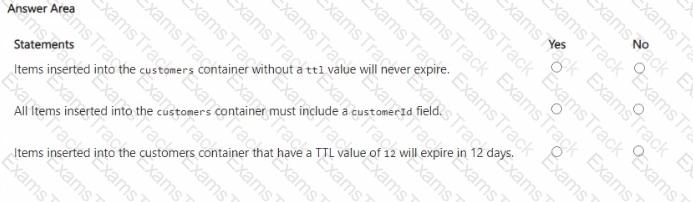
For each of the following statements, select Yes if the statement is true. Otherwise, select No.
NOTE: Each correct selection is worth one point.
You have a global ecommerce application that stores data in an Azure Cosmos OB for NoSQL account. The account is contoured for multi-region writes.
You need to create a stored procedure for a custom conflict resolution policy for a new container. In the event of a conflict caused by a deletion the deletion must always take priority.
Which parameter should you check m the stored procedure function?
You have a database in an Azure Cosmos DB for NoSQL account that is configured for multi-region writes.
You need to use the Azure Cosmos DB SDK to implement the conflict resolution policy for a container. The solution must ensure that any conflict sent to the conflict feed.
Solution: You set ConfilictResolutionMode to Custom. You Set ResolutionProcedures to a custom stored procedure. You configure the custom stored procedure to use the conflictingItems parameter to resolve conflict.
Does this meet the goal?
You have an app named App1 that uses an Azure Cosmos DB for NoSQL database.
App1 uses the spatial columns shown in the following table.
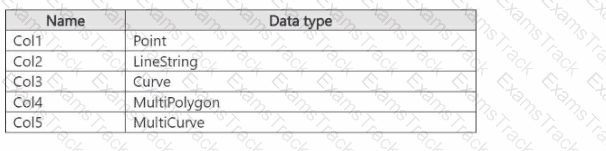
You need to design an indexing strategy for App1.
Which columns can be indexed by using spatial indexes?
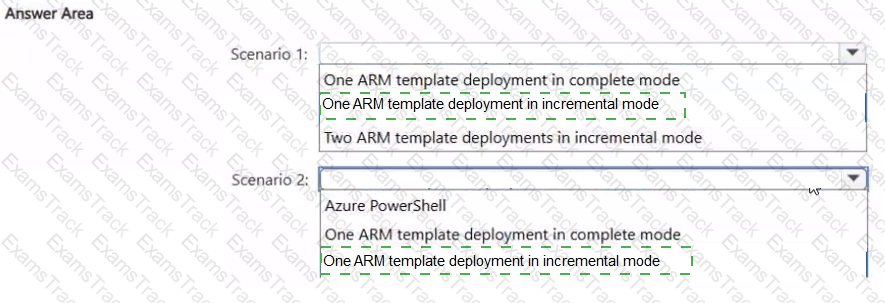
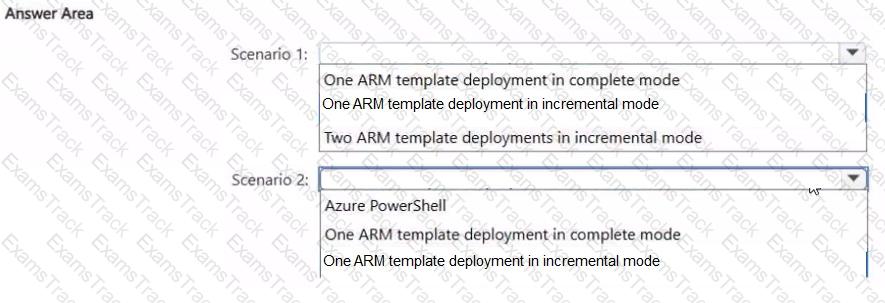
You have an Azure Resource Manager (ARM) template that provisions Azure Cosmos DB accounts and databases. The accounts are deployed to a single Azure region. The databases have provisioned throughput configured. The name of the region, the type of database throughput, and the throughput value are defined as template parameters.
You need to modify some of the Azure Cosmos DB accounts and databases based on the following scenarios:
• Scenario 1: Add a read region and increase the database throughput.
• Scenario 2: Change the provisioned database throughput to autoscale.
The solution must minimize administrative effort and the duration of the modifications.
What should you use for each scenario? To answer, select the appropriate options in the answer area.
NOTE: Each correct selection is worth one point.
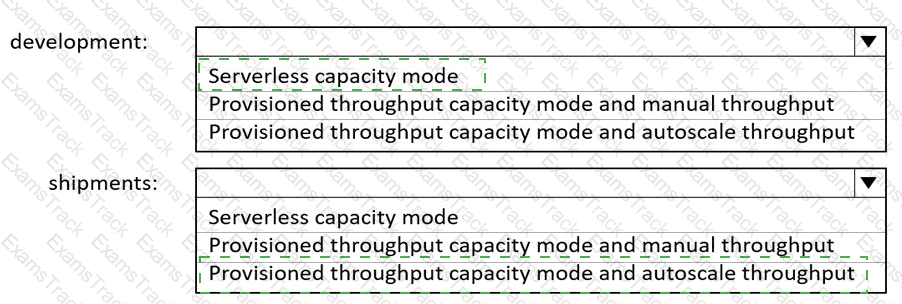
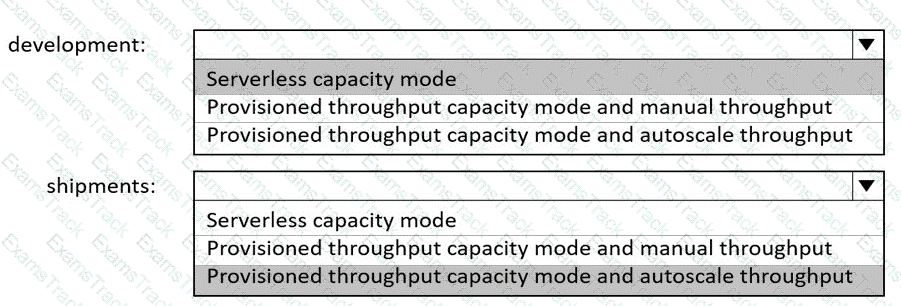
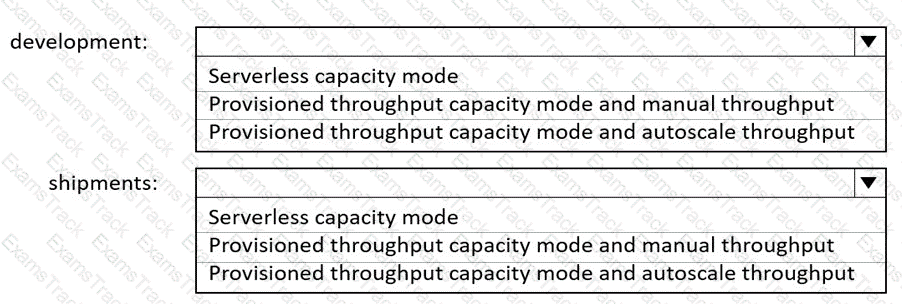
You plan to deploy two Azure Cosmos DB Core (SQL) API accounts that will each contain a single database. The accounts will be configured as shown in the following table.
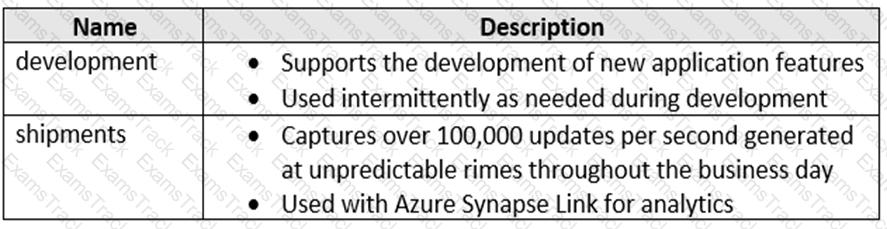
How should you provision the containers within each account to minimize costs? To answer, select the appropriate options in the answer area.
NOTE: Each correct selection is worth one point.
You have an Azure subscription that contains an Azure Cosmos DB for NoSQL database named DB1.
You develop a software as a service (SaaS) app named App1 that uses DB1. App1 will be used by multiple vendors to manage their customers.
You need to create a container in DB1 that will store customer and order details for each vendor. The solution must meet the following requirements:
• Each vendor must have a unique tenant ID.
• The performance of the container must be optimized for reads.
• Customer IDs can be duplicated across the container but must be unique for each vendor.
• The container must be optimized for concurrent queries from multiple customers. Each query will return data for a single vendor.
How should you configure the container?
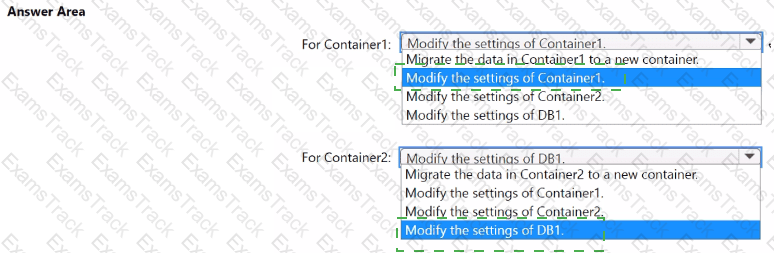
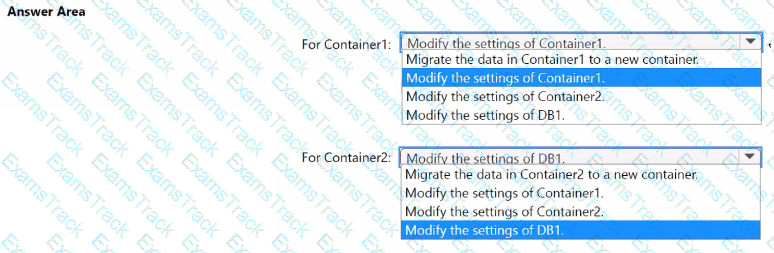
You have an Azure subscription that contains an Azure Cosmos DB for NoSQL database named DB1. The shared throughput provisioned for DB1 is 10,000 DTU/s. DB1 contains the containers shown in the following table.
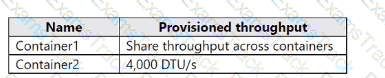
You need to modify the throughput for the containers. The solution must meet the following requirements:
• The maximum throughput for Container1 must be 4,000 DTU/s.
• The throughput for Contained must be shared across the containers.
• Administrative effort must be minimized.
What should you do? To answer, select the appropriate options in the answer area. NOTE: Each correct selection is worth one point.
|
PDF + Testing Engine
|
|---|
|
$43.75 |
|
Testing Engine
|
|---|
|
$33.75 |
|
PDF (Q&A)
|
|---|
|
$28.75 |
Microsoft Free Exams |
|---|

|

Copyright © 2026 Examstrack. All Rights Reserved

TESTED 20 Oct 2026