examstrack logo

You develop an ASP.NET Core app that uses Azure App Configuration. You also create an App Configuration containing 100 settings. The app must meet the following requirements:
• Ensure the consistency of all configuration data when changes to individual settings occur.
• Handle configuration data changes dynamically without causing the application to restart.
• Reduce the overall number of requests made to App Configuration APIs
You must implement dynamic configuration updates in the app.
What are two ways to achieve this goal? Each correct answer presents part of the solution.
NOTE: Each correct selection is worth one point.
You are implementing an application by using Azure Event Grid to push near-real-time information to customers.
You have the following requirements:
• You must send events to thousands of customers that include hundreds of various event types.
• The events must be filtered by event type before processing.
• Authentication and authorization must be handled by using Microsoft Entra ID.
• The events must be published to a single endpoint
You need to implement Azure Event Grid
Solution: Publish events to a custom topic. Create an event subscription for each customer.
Does the solution meet the goal?
You deploy a new revision of an app in Azure Container Apps.
You need to gradually shift production traffic to the revision while monitoring performance. In addition, you need to be able to quickly roll back. Which two actions should you perform?
Each correct answer presents part of the solution. Choose two.
NOTE: Each correct selection is worth one point.
You must ensure an Azure OpenAI-powered application never exceeds a defined token-per-minute budget across all users to avoid runaway costs.
What should you configure?
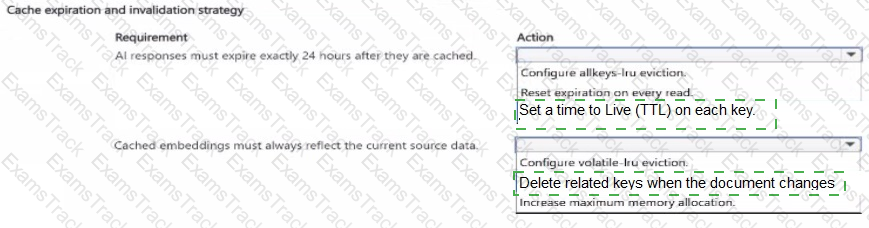
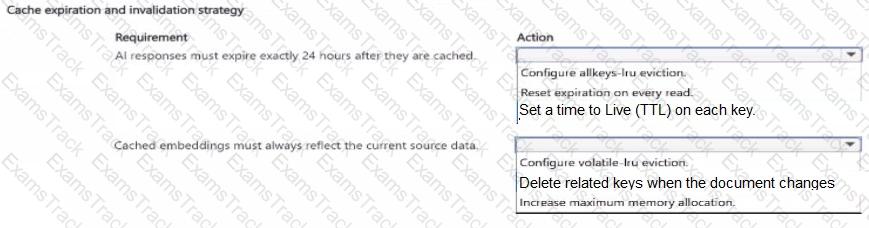
You are developing a Retrieval-Augmented Generation (RAG) solution for a company. AI responses and embedding vectors are cached in Redis. The solution must meet the following requirements.
• AI responses must expire exactly 24 hours after they are cached
• Cached embeddings must always reflect the current source data.
You need to configure Redis to meet the requirements.
You are implementing semantic retrieval for a chatbot.
Embeddings are already stored in Redis. However, vector similarity queries do not return matches.
You need to resolve the vector similarity search issue.
What should you do?
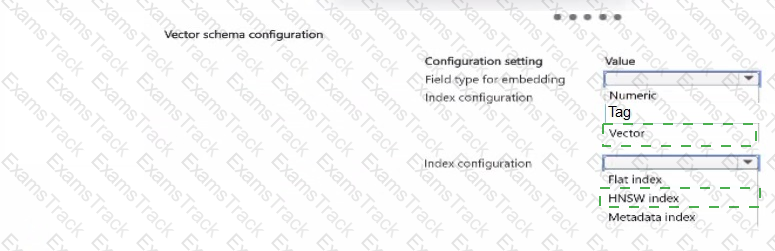
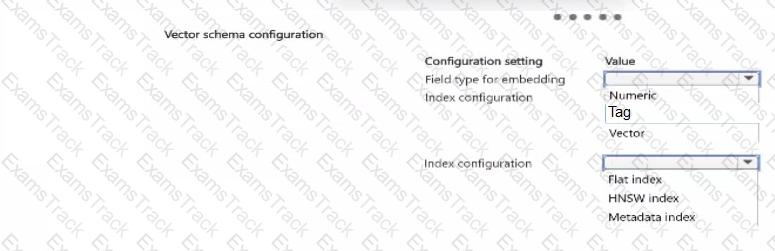
You are implementing semantic retrieval in Redis.
The solution must support low-latency, approximate nearest neighbor (ANN) vector similarity search for large-scale AI retrieval workloads.
You need to select the appropriate vector schema settings.
Which configuration values should you select? To answer, select the appropriate options in the answer area.
NOTE: Each correct selection is worth one point.
You have an Event Grid subscription that triggers an Azure Function.
You need to prevent loss of events in case the endpoint returns an HTTP 400 response. Which action should you perform?
An application performs similarity search across 5 million embeddings stored in Azure Database for PostgreSQL with pgvector. Queries often filter by department before ranking by cosine distance.
P95 latency for vector similarity queries exceeds the SLA target. Monitoring shows sustained high CPU use during query execution.
You need to reduce P95 latency for filtered vector similarity queries.
What should you do?
You are investigating high latency in an AI search application that processes millions of requests daily. Telemetry is stored in Azure Monitor Logs.
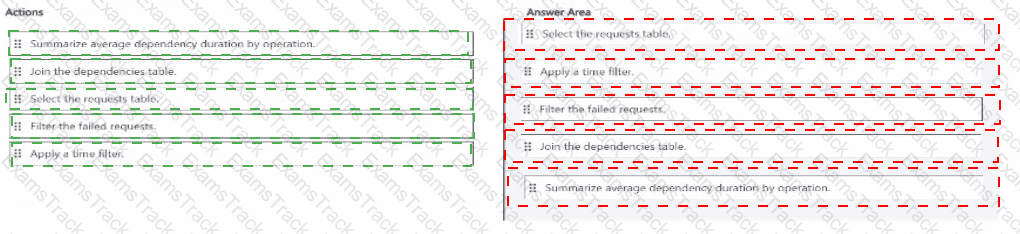
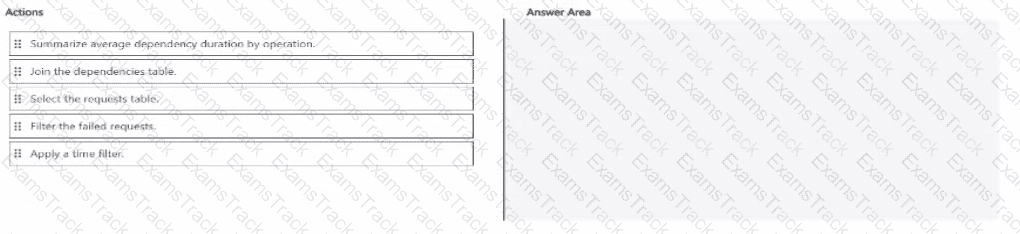
You must create a KQL query that correlates information from the AppRequests table and the AppDependencies table. The query must meet the following requirements:
Include only data from the last 24 hours.
Filter for failed requests only.
Calculate the average duration of dependencies, grouped by operation.
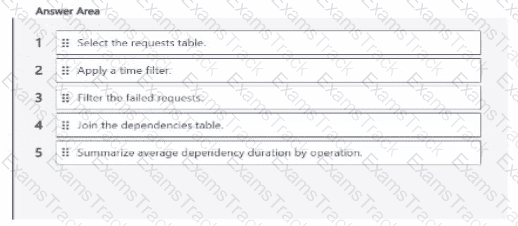
The query must follow best practice to optimize the performance by minimizing the initial data scan.
You need to create the query.
In which order should perform the actions? To answer, move all actions from the list of actions to the answer area and arrange them in the correct order.
|
PDF + Testing Engine
|
|---|
|
$52.5 |
|
Testing Engine
|
|---|
|
$40.5 |
|
PDF (Q&A)
|
|---|
|
$34.5 |
Microsoft Free Exams |
|---|

|

Copyright © 2026 Examstrack. All Rights Reserved

TESTED 07 Oct 2026