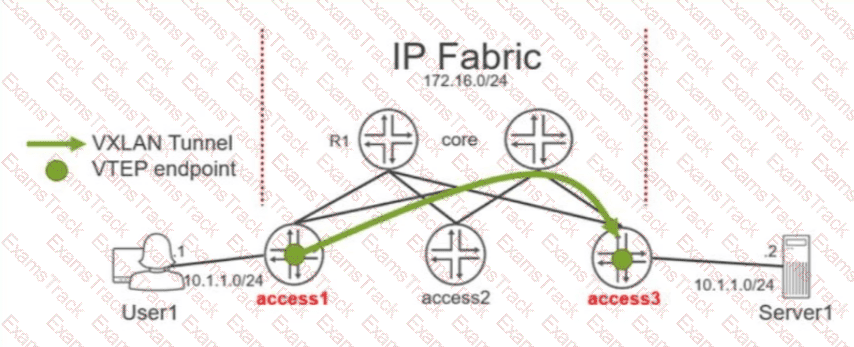
Juniper’s official Campus Fabric IP Clos designfor Mist Wired Assurance defines that the3-stage IP Clostopology eliminates the traditionaldistribution layerentirely. This architecture is intended for smaller campus environments that do not need an intermediate distribution layer between the access and core.
“Juniper’s Wired Assurance supports 3-Stage and 5-Stage IP Clos deployments. The 3-Stage IP Clos is targeted towards deployments that do not require a Distribution Layer and have smaller scale requirements.”
Because the distribution layer is not present, the only hierarchical connection in a 3-stage campus fabric is between thecore and access layers. Traffic is routed directly at the access layer, and each access switch acts as a Layer-3 gateway (IRB) for its VLANs.
“In a campus fabric IP Clos architecture, Mist provisions Layer-3 (L3) integrated routing and bridging (IRB) interfaces on the access layer. All the access switches are configured with the same IP address for each L3 subnet.”
Additionally, the Juniper documentation explains that point-to-point links are configuredbetween layers, and in the case of the 3-stage design (with no distribution), this means between thecore and accessdevices:
“The point-to-point links between each layer utilize /31 addressing to conserve addresses.”
Therefore, the correct statement isC: The core layer is connected to the access layer.
OptionsAandBincorrectly mention a distribution layer that does not exist in this topology.
OptionDis incorrect because core (spine) devices in a Clos fabric are not interconnected with each other.
[References:, Juniper Mist AI for Wired – Campus Fabric IP Clos Architecture Guide, Juniper Mist AI for Wired – Campus Fabric IP Clos Workflow, Juniper Mist AI for Wired – Configure Campus Fabric IP Clos, Juniper Validated Design – Campus Fabric IP Clos Deployment Types, , , , ]