Summer Sale Limited Time 70% Discount Offer - Ends in 0d 00h 00m 00s - Coupon code: 70track

Free Anthropic CCAR-P Practice Exam with Questions & Answers | Set: 3

Questions 21

You are presenting an architectural decision to a mixed audience that includes an executive sponsor and the engineering leads who will implement the decision.

Which presentation strategy best serves both audiences?

Options:
A.

Open with a deep dive into low-level implementation details targeted at engineering leads, and stop there without addressing the business outcomes or trade-offs the executive sponsor needs.

B.

Lead with the decision, the business outcomes it serves, and the trade-offs accepted; follow with the technical rationale, alternatives, and implementation implications for the engineering audience.

C.

Skip the rationale, alternatives, and trade-off discussion entirely and simply announce the chosen decision, leaving both audiences without the context needed to implement or validate it.

D.

Present a single undifferentiated narrative that addresses technical and business concerns with equal weight throughout, treating both audiences as requiring the same depth on every section.

Anthropic CCAR-P Premium Access
Questions 22

A Claude architect at a health services organization is defining evaluation metrics for a clinical-summary pipeline. The pipeline must remain within a per-query cost ceiling and must never surface patient data to unauthorized roles.

Which two metrics directly address these requirements? (Select two.)

Options:
A.

BLEU score computed against a human-annotated reference summary set

B.

Role-based access-control enforcement rate measured on a red-team dataset

C.

Throughput measured as successful requests processed per minute

D.

Per-query token cost measured against the defined cost ceiling

E.

Response latency at the 95th percentile across a one-week sample window

Questions 23

You are compiling a diagnostic toolkit for Claude Code operational issues.

Which two diagnostic actions belong in the toolkit? (Select two.)

Each correct answer presents a complete solution.

Options:
A.

Increase the model sampling temperature so that intermittent issues surface more frequently for analysis.

B.

File a support ticket with vendor support before any local reproduction or evidence collection.

C.

Reproduce the issue with a minimal reproduction case that isolates one variable at a time.

D.

Roll back to the previous Claude Code version immediately to confirm whether the issue is version specific.

E.

List the configured Model Context Protocol (MCP) servers and inspect server status to identify connection failures.

Questions 24

A document analysis service processes legal filings averaging 80,000 tokens each. Each filing is queried by attorneys an average of 14 times during a case. The current architecture sends the full filing on every query. The CFO has asked you to reduce per-query costs while preserving response quality. The security officer requires that filing contents not be stored outside Fabrikam's tenancy.

Which optimization approach should you recommend?

Options:
A.

Summarize each filing once at intake and run all subsequent queries against the summary.

B.

Cache the filing as the prompt prefix for reuse across the 14 queries per case.

C.

Index filings in a vector store and retrieve only the relevant passages per query.

D.

Move the workload to a smaller Claude model to reduce the per-token cost paid.

Questions 25

You must present an architectural recommendation to deploy a Claude-based contract review assistant to a steering committee that includes the CFO, the general counsel, and the CIO. Each stakeholder cares about different aspects of the decision.

How should you structure the recommendation document?

Options:
A.

Lead with the technical architecture diagram and the full component list before any other section.

B.

Lead with detailed cost projections across the full multi-year horizon before the rationale section.

C.

Present the same dense narrative throughout with no stakeholder differentiation in any section.

D.

Lead with the architectural decision, then address each stakeholder’s primary concerns directly.

Questions 26

You are selecting a model for a new production workload and must complete the upstream steps before testing candidate models empirically.

Which two steps must be completed BEFORE running a representative sample on a candidate model? (Select two.)

Each correct answer presents part of the solution.

Options:
A.

Select the lightest model that consistently meets the quality bar across the sample.

B.

Retest the model choice when a new model version becomes available.

C.

Choose a candidate model based on the requirements profile and known capabilities.

D.

Define the quality bar, latency tolerance, and expected volume for the workload.

E.

Sign off the production rollout plan with the platform and security teams.

Questions 27

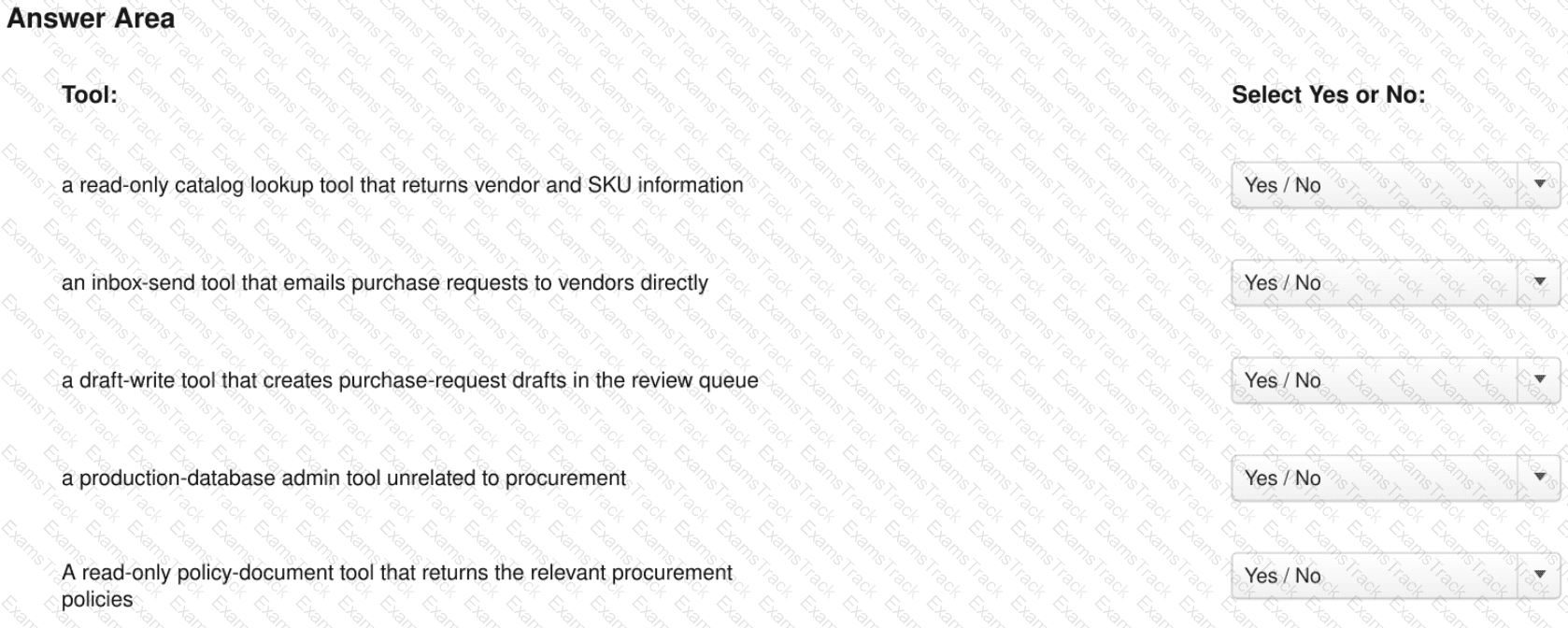
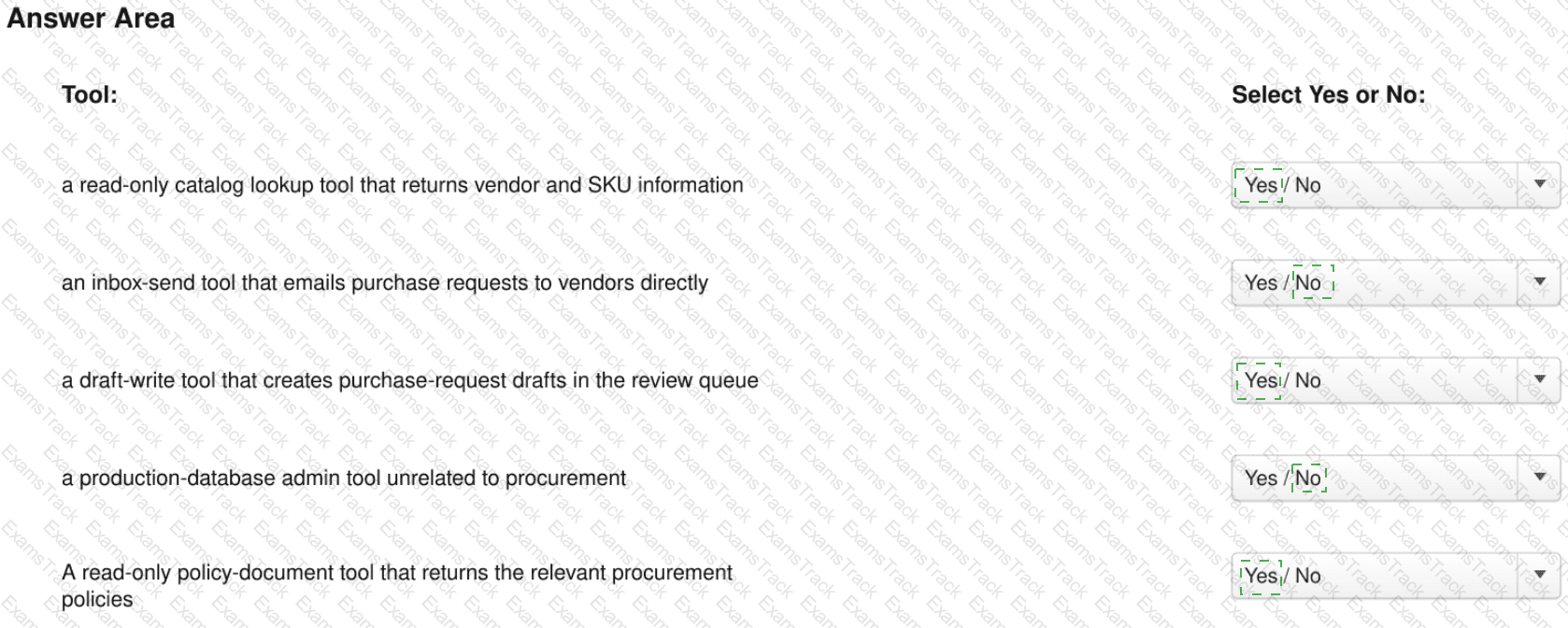
You are evaluating retrieval-strategy claims used by a peer team.

For each claim, select yes if the statement is generally accurate. Otherwise, select no.

CCAR-P Question 27

Options:
Questions 28

You are supporting a team whose Claude Code sessions consistently load 60 or more MCP tools from many servers, exhausting context budget before the session begins.

Which adjustment most directly addresses this issue without removing capability?

Options:
A.

Enable Tool Search so tool definitions are deferred and discovered on demand rather than loaded into context upfront.

B.

Disable every MCP server in the configuration to free up context budget, accepting that the team loses all tool access and cannot perform any MCP-dependent task in the session.

C.

Increase the prompt’s verbosity with additional instructions and context, which consumes more of the context budget rather than reducing the tool-definition overhead causing the issue.

D.

Add additional MCP servers to give the team more capability, which increases rather than reduces the number of tool definitions loaded into the session’s context budget.

Questions 29

You are a solution architect designing a Claude-based assistant with access to 60 internal tools across multiple business domains. Loading every tool definition on every request increases token usage and time to first response.

Which design pattern best addresses this issue without sacrificing capability breadth?

Options:
A.

Apply progressive tool discovery so a curated initial subset is exposed and additional tools are loaded on demand based on the task.

B.

Use a separate model call to summarize all 60 tool definitions before each user turn.

C.

Increase the maximum context length and load all 60 tool definitions on every request, accepting the higher token cost and latency as necessary for full capability.

D.

Hard-code a fixed set of five tools per request to reduce token usage, regardless of whether those tools are relevant to the current task.

Questions 30

A Claude architect observes that after a recent model-version upgrade, grounded responses began including claims not supported by the retrieved source documents.

Which mitigation is most directly targeted at this failure mode?

Options:
A.

Constrain responses to source-supported content, require citations, and add a verification step.

B.

Score each new model version against a stable adversarial evaluation set.

C.

Replace the shared API key with per-user OAuth tokens to restrict data access.

D.

Treat retrieved data as untrusted and apply input classifiers at ingestion time.

Exam Code: CCAR-P
Certification Provider: Anthropic
Exam Name: Claude Certified Architect - Professional
Last Update: Aug 22, 2026
Questions: 114